Preverite v realnem okolju
 Pošlji kot čestitko
 Deli
Deli
 Podrobnosti
 Navodila

 Prenesi
 Podobni artefakti
 Rentgenski posnetek
 Predvajaj diaporama
 Statistika
Jesenja izleta


 Preberi več
Ročno izdelana oljna reprodukcija
Ročno slikano olje na platnu v vaši izbiri velikosti in okvirja, izdelano po naročilu naših umetnikov. ( Preklop na tiskanine Preklop na digitalno sliko)




P118B $10

P118H $10

P118W $10

P438Z $10

P508JH $12

P508YH $12

P805H $10

P805Z $10

P919BZ $10

P919G $10

P919XJ $10

P959ZH $10

P968JZ $12

W106C $8

W218G $10

W218JH $8

W218Y $10

W307PJ $10

W316G $10

W316PJ $8

W316Y $10

W398PJ $8

W4111J $10

W500HY $15

W500JH $15

W692G $12

W849H $8

W940BG $15

W953PJ $8




Izberite eno od naših vnaprej določenih velikosti, ki ustrezajo prvotnim proporcijam umetničkega dela.

Svoje dimenzije lahko vnesete tako, da se prilagodite določenemu okvirju ali prostoru. Če izbrana velikost ne ustreza razmerjem originalne slike, bomo umetniško delo obrezali ali sliko dopolnili z dodatnimi ročno naslikanimi elementi. Pred začetkom proizvodnje vam bo poslan digitalni osnutek v odobritev.
Upoštevajte, da predogled na zaslonu ne odraža dejanskega obrezovanja ali podaljšanja. Le osnutek bo natančno prikazal končno kompozicijo.
Čeprav so na voljo velikosti po meri, priporočamo izbiro dimenzije s preddefiniranega seznama, da ohranimo originalne razmere.
Po oddaji naročila bo ekipa AllPaintingsStore.com stranki po e-pošti poslala navodila in predogled digitalnega predogleda.
Mednarodna dostava () v 3/4 tednih namesto običajnih 5 tednov. (22 september). Brez kompromisov pri kakovosti.

Brezplačna ekspresna dostava po vsem svetu

Visokokakovostno laneno platno

Popolno zavarovanje pošiljke

Garancija povračila carine in uvoznih davkov

Garancija popolnega barvnega ujemanja

Politika vračila v 100 dneh (le v primeru okvar)

Garancija 100% povračila denarja

Popust pri večjem naročilu
 Možnost stekla je na voljo le za velikosti pod 110 cm

Jesenja izleta
Tehnika reprodukcije
Velikost reprodukcije
-


Skupna cena
$ 283
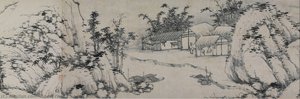
Shen Zhou: A Masterpiece of Tranquility – Decoding Spring Outing
Shen Zhou’s “Spring Outing,” painted around 1483 during the Ming Dynasty, stands as an emblem of Neo-Confucian aesthetics and a testament to the enduring beauty of Chinese landscape painting. More than just a depiction of a snowy mountain vista, it's a carefully orchestrated meditation on harmony, contemplation, and the profound connection between humanity and nature—themes central to the intellectual currents shaping Ming artistic sensibilities. The scroll’s provenance traces back to Hua Fang, a wealthy connoisseur who commissioned Shen Zhou to capture the essence of springtime serenity in his garden retreat – a deliberate gesture reflecting Hua's refined taste and embodying the ideals of scholarly elegance.- Style & Technique: Shen Zhou expertly blends elements of Ni Zan’s sparse brushwork with Huang Gongwang’s long hemp-fibre texture strokes, creating a visual dialogue between two titans of Yuan Dynasty landscape art. This fusion exemplifies the Wu School's commitment to mastering diverse stylistic approaches and achieving unparalleled expressive depth.
- Composition: The horizontal format mirrors traditional scroll paintings, emphasizing stability and conveying a sense of expansive space. Layers of rocky hills frame a central area populated by buildings and figures—a deliberate arrangement designed to guide the viewer’s gaze and foster contemplation.
- Color Palette & Texture: Dominated by monochrome ink wash – primarily shades of grey achieved through subtle variations in ink density – “Spring Outing” eschews vibrant hues, prioritizing tonal nuance and textural richness. Dry brushwork meticulously renders the rugged surfaces of rocks, while wet washes imbue the snow with a luminous quality.
- Symbolism: The inclusion of bare trees—a motif frequently employed by Ni Zan—represents resilience and acceptance of impermanence, mirroring the Confucian belief in embracing change as an inevitable aspect of life’s cycle. Similarly, the distant mountains symbolize grandeur and timelessness, reinforcing the painting's overarching message of spiritual harmony.
- Historical Context: Produced during a period marked by intellectual ferment and artistic innovation, “Spring Outing” reflects Ming Dynasty scholars’ fascination with Neo-Confucian philosophy—a worldview prioritizing moral cultivation and aligning oneself with cosmic order. The scroll’s dedication to Hua Fang underscores the importance of patronage in fostering artistic excellence and disseminating humanist ideals.
Detailed Examination: Brushstrokes & Texture – Capturing Essence Through Craftsmanship
Shen Zhou's meticulous brushwork is paramount to conveying the painting’s profound emotional impact. The artist skillfully utilizes long hemp-fibre texture strokes—a technique directly inherited from Huang Gongwang—to depict the rocky hillsides with remarkable realism and textural detail. These strokes capture the rough, uneven surfaces of stone, creating a palpable sense of physicality and grounding the viewer in the natural world. Furthermore, Shen Zhou employs wet washes to soften areas of snow, achieving an ethereal luminosity that contrasts beautifully with the darker contours of the rocks. This masterful manipulation of ink density demonstrates not only technical prowess but also a deep understanding of how color—or rather its absence—can evoke powerful emotions and convey nuanced meanings.The Poetic Resonance: Shen Zhou’s Calligraphy & Hua Fang's Patronage
Beyond its visual splendor, “Spring Outing” is enriched by four poetic inscriptions penned by Wen Zhengming—Shen Zhou’s most celebrated pupil—which commemorate Hua Fang and celebrate the harmonious blend of art and scholarship. These verses underscore the painting’s significance as a symbol of intellectual refinement and artistic excellence—values deeply cherished during the Ming Dynasty. The scroll's provenance reveals that Hua Fang, a prominent connoisseur known for his charitable endeavors, commissioned Shen Zhou to immortalize this serene landscape—a gesture reflecting Hua’s commitment to cultivating beauty and fostering contemplation within his garden retreat.A Legacy of Tranquility – Influence & Interpretation
“Spring Outing” continues to inspire artists and collectors alike, serving as a cornerstone of the Wu School's artistic legacy. Its understated elegance—characterized by its monochrome palette, sparse composition, and masterful brushwork—remains remarkably relevant in contemporary art discourse. The painting’s enduring appeal lies in its ability to transcend temporal boundaries and communicate universal themes of harmony, contemplation, and appreciation for the sublime beauty of nature—a testament to Shen Zhou's genius as a painter and his profound understanding of humanist ideals.Sorodna umetniška dela


Biografija umetnika
A Life Dedicated to Art and Contemplation
Shen Zhou, a name synonymous with the flourishing of scholar-artist ideals in Ming dynasty China, was born in 1427 near Suzhou into a family whose wealth stemmed from both land ownership and service as tax collectors. This fortunate circumstance afforded him an upbringing steeped in learning and cultural refinement, yet he consciously chose a path diverging from the conventional expectations of his social standing. Rather than pursuing official examinations and a career within the imperial bureaucracy, Shen Zhou dedicated himself to filial piety, caring for his widowed mother, Chang Su-wan. This decision wasn’t one of resignation but rather a deliberate embrace of a reclusive life centered on artistic pursuits, intellectual exchange, and quiet contemplation – a lifestyle that would profoundly shape both his art and legacy. He lived a long life, dying in 1509, witnessing significant shifts within the Chinese political and artistic landscape, and ultimately becoming a pivotal figure in defining a new aesthetic direction.The Rise of the Wu School and a Revivalist Spirit
Shen Zhou’s artistic development unfolded during a period of considerable transition in Chinese painting history. The relocation of the Ming capital from Nanjing to Beijing created a cultural distance, lessening the direct influence of imperial tastes and allowing for regional styles to flourish. It was within this environment that Shen Zhou emerged as the founder of the Wu School, based in Suzhou. This wasn’t merely a geographical designation; it represented a conscious revival of artistic principles championed by scholar-painters of the preceding Yuan dynasty. These artists viewed painting not as a profession or a means to courtly favor, but as an integral part of self-cultivation – a meditative practice reflecting one's inner world and understanding of the universe. The Wu School painters deliberately distanced themselves from the more formal, technically precise style favored by the Ming court, seeking instead a return to the expressive freedom and individualistic spirit of earlier masters.Mastering Tradition, Forging a Unique Style
Shen Zhou’s artistic foundations were deeply rooted in the legacy of Yuan dynasty painters like Wang Meng, Huang Gongwang, and Wu Zhen. He meticulously studied their techniques, absorbing their compositional strategies and brushwork nuances. However, he wasn't simply an imitator; he possessed a remarkable ability to synthesize these influences with his own innovative sensibilities. His landscapes are particularly celebrated for their meticulous detail, reflecting both a reverence for Chinese history and the philosophical underpinnings of Confucianism. He also became renowned for his distinctive “boneless” flower paintings – delicate renderings of blossoms and foliage achieved without strong outlines, echoing the ethereal quality found in the works of Yuan masters. This technique demanded exceptional control over ink wash and an intuitive understanding of form. Beyond technical skill, Shen Zhou’s work is characterized by a harmonious integration of painting, poetry, and calligraphy. He frequently collaborated with fellow artists, engaging in gatherings where these art forms intertwined, creating holistic expressions of artistic vision. The accompanying poems were not mere embellishments but integral components of the artwork itself, adding layers of meaning and emotional resonance.A Lasting Legacy: The Four Masters and Beyond
Shen Zhou’s impact on Chinese art history is immeasurable. His establishment of the Wu School fostered a new generation of scholar-artists who carried forward his ideals of artistic independence and expressive freedom. He is rightfully regarded as one of the “Four Masters of Ming,” alongside Wen Zhengming, Tang Yin, and Qiu Ying – a testament to his enduring influence and exceptional talent. His art continues to be studied and admired for its technical brilliance, profound philosophical depth, and embodiment of the scholar-artist ideal. Shen Zhou’s work represents not just a revival of past traditions but a vital contribution to the ongoing evolution of Chinese painting, shaping the course of Ming dynasty aesthetics and leaving an indelible mark on subsequent generations of artists. He remains a significant figure whose serene landscapes and delicate floral studies continue to captivate and inspire.
Shen Zhou
1427 - 1509 , China
Ključne informacije
- Artistic Movement Or Style: Wu School
- Artists Or Movements Influenced By This Artist:
- Wen Zhengming
- Tang Yin
- Qiu Ying
- Wu School
- Artists Who Influenced This Artist:
- Wang Meng
- Huang Gongwang
- Wu Zhen
- Date Of Birth: 1427
- Date Of Death: 1509
- Full Name: Shen Zhou
- Nationality: Chinese
- Notable Artworks:
- Landscape with Four Pines
- Marsh Scene with Birds
- Autumn Colors among Streams…
- Place Of Birth: Xiangcheng, China
Sorodni članki
Ephemeral Expressions: Exploring the Nuances of Ink on Paper Through History & Contemporary Art
Explore the captivating world of ink wash painting – from its ancient origins to contemporary masters. Discover techniques, symbolism & conservation insights with AllPaintingsStore.com.

Hokusai's Masterpieces: 25 Iconic Prints & Paintings for Art Lovers | AllPaintingsStore
Journey through Katsushika Hokusai’s 25 most iconic artworks, including *The Great Wave*. Explore the ukiyo-e master's history, style & timeless Japanese woodblock prints. Find museum-quality reproductions for your home at AllPaintingsStore.com.

The Beauty of Ink Wash: Discover Serene & Soulful Art for Your Home
Discover the tranquil beauty of ink wash painting. Explore how Sumi-e and monochrome landscapes bring Zen-inspired serenity and soulful elegance to your home decor through expert curation and timeless East Asian aesthetics.

Xie Zhiliu: A Legacy of Ink Wash Painting & Modern Chinese Literati Tradition
Explore the legacy of Xie Zhiliu, a master of Chinese ink wash painting & prominent figure in modern art. Discover his techniques, influences, and contributions to literati tradition. A guide for discerning collectors.
The Alchemy of Ink: Mastering the Timeless Beauty and Art History of Paper and Brush
Embark on a sophisticated exploration of ink wash painting and Sumi-e. Uncover the profound historical lineages, Zen philosophies, and technical mastery behind this timeless medium in our authoritative guide for fine art enthusiasts.