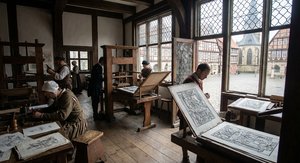
The Master of Swabian Wood: The Legacy of Jörg Lederer
In the heart of the German Renaissance, amidst the mist-covered landscapes of Füssen, a master was born who would leave an indelible mark on the spiritual and tactile landscape of Southern Germany. Jörg Lederer, active during the late 15th and early 16th centuries, emerged not merely as a sculptor but as a custodian of sacred narratives. His life, spanning approximately from 1470 to 1550, coincided with a period of profound religious devotion and artistic flourishing in the Swabian region. While history often remembers the grand painters of the Italian Renaissance, it is through the hands of craftsmen like Lederer that the visceral, emotional weight of the Northern tradition was carved into the very grain of limewood.
Lederer’s artistry was deeply rooted in the traditions of German woodcarving, a medium that allowed for an unparalleled level of intricate detail and expressive movement. His work often centered around the creation of winged altarpieces—monumental structures designed to transform the atmosphere of a church through their dramatic presence. These altars were not merely decorative; they were theatrical stages for the divine, where saints and biblical figures emerged from the wood with a lifelike intensity that commanded the prayers of the faithful. Through his mastery of the chisel, Lederer could breathe life into the stiffest timber, creating drapery that seemed to flutter in an unseen holy wind and faces that captured the profound sorrow or ecstatic joy of the Christian narrative.
Technique and the Swabian Spirit
The essence of the circle of Jörg Lederer lies in a shared devotion to the Swabian style, characterized by its meticulous attention to texture and its ability to blend realism with spiritual symbolism. To observe a piece attributed to his workshop is to witness a symphony of fine lines and deep undercuts. The artist possessed an uncanny ability to manipulate light and shadow across the surfaces of his sculptures, ensuring that even in the dim candlelight of a cathedral, the figures remained legible and evocative. This technical prowess extended beyond simple figure carving; it encompassed the entire architectural ensemble of the altarpiece, from the delicate tracery of the gothic arches to the painted narratives that adorned the interior wings.
The development of his style reflects the broader shifts in Northern European art, moving from the more rigid, late-medieval forms toward a more fluid and humanistic approach. His influence can be seen in the way he approached the anatomy of his subjects, imbuing them with a sense of weight and presence that grounded the divine within the earthly realm. The workshop's output was characterized by:
- The use of limewood, a medium prized for its fine grain and suitability for high-relief carving.
- A profound command over polychromy, where paint and gilding were used to enhance the sculptural depth.
- The integration of complex religious iconography designed to educate and inspire a largely illiterate populace.
Historical Significance and Enduring Echoes
Though the name Jörg Lederer may not resonate with the same immediate fame as a Michelangelo or a Raphael, his historical significance is found in the enduring physical presence of his creations. His work served as a cornerstone for the religious identity of the Swabian and South Tyrolean regions, providing a visual language for devotion that lasted for generations. The survival of significant pieces, such as the Winged Altarpiece housed in Budapest, allows modern scholars to trace the lineage of German sculptural traditions and understand the profound impact of the workshop system on the dissemination of Renaissance ideals.
As the tides of the Reformation began to reshape the religious landscape of Germany, the era of such grand, ornate altarpieces faced unprecedented challenges. Yet, the legacy of Lederer remains anchored in the museums and cathedrals where his woodcarvings continue to tell stories of faith, suffering, and transcendence. He remains a vital figure for anyone seeking to understand the soul of the German Renaissance—a period where the boundary between the material wood and the spiritual vision was blurred by the masterful hand of a true craftsman.