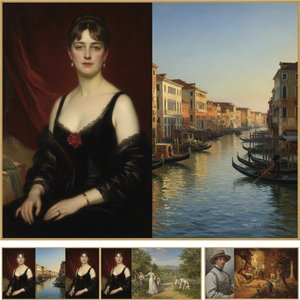
The Melodic Brush: The Life and Legacy of John Dick Bowie
In the annals of British art history, few figures possess a narrative as strikingly dualistic as John Dick Bowie. Born in Edinburgh in 1864, Bowie’s early existence was shaped by a profound, rhythmic connection to music, inherited from a father who navigated the world through the professional strains of the violin. This early immersion in melody did more than merely provide a soundtrack to his youth; it instilled in him a unique sensory perception that would later allow him to bridge the gap between the structured grandeur of the Victorian era and the fluid, emotive expansiveness of modernism. His journey from the rugged landscapes of Scotland to the prestigious halls of the Royal Scottish Academy of Art & Architecture was marked by a relentless pursuit of a visual language that could capture both the tangible reality of his subjects and the intangible echoes of the soul.
Bowie’s formative years under the tutelage of masters such as George William Balfour grounded him in the rigorous traditions of classical realism. During this period, his work was characterized by an almost scientific precision, particularly in his portraiture. He possessed a rare ability to render the textures of velvet, the sheen of silk, and the subtle complexities of human expression with a dignity that commanded respect. His early masterpieces, such as the commanding Sir Andrew MacDonald, serve as quintessential examples of this era, embodying the weight and prestige of late Victorian society through meticulous detail and a sense of monumental permanence.
A Transition Toward Light and Impression
As the nineteenth century drew to a close, the rigid boundaries of realism began to soften within Bowie’s practice. The winds of change were blowing through the European art world, carried by the revolutionary brushstrokes of Claude Monet and Pierre-Auguste Renoir. Bowie, ever the seeker of new horizons, allowed these Impressionist influences to permeate his canvases. This evolution was not a rejection of his training but an expansion of it; he began to trade the heavy, controlled shadows of his youth for a more luminous palette and a looser, more spontaneous application of paint. The psychological depth that had been his hallmark in portraiture found a new ally in this light-drenched technique, allowing him to explore themes of movement, atmosphere, and the fleeting nature of perception.
This period of experimentation saw Bowie moving beyond mere representation toward a more symbolic and emotive way of seeing. His later works began to pulse with an energy that hinted at the burgeoning modernism of the twentieth century. By integrating the structural integrity of his academic training with the vibrant, sensory-driven approach of Impressionism, he created a body of work that felt both timeless and contemporary. He was no longer just documenting the faces of the Scottish elite; he was capturing the very essence of light and emotion as they danced across the surface of the canvas.
Historical Significance and Artistic Resonance
The historical significance of John Dick Bowie lies in his role as a transitional visionary. While often overshadowed by the more radical avant-garde movements that followed, his ability to synthesize the old world with the new provided a crucial bridge for British art. His career, spanning from the opulent Edwardian era through the shifting cultural tides of the early 1900s, reflects a period of immense societal transformation. Through his eyes, we witness the transition from the structured certainty of the Victorian age to the more fragmented and psychologically complex modern era.
Today, Bowie’s legacy is cherished by collectors and historians alike who recognize the profound musicality in his brushwork. His ability to imbue oil and canvas with a sense of rhythmic movement and emotional resonance ensures that his work remains as captivating today as it was during his lifetime. He remains a singular figure—a painter who understood that art, much like music, is a continuous, evolving symphony of light, shadow, and human experience.
Vprašanja in odgovori
Koliko umetnin umetnika John Dick Bowie je na voljo za ogled?
Na strani Vsi umetniški slogi si lahko ogledate 11 umetnin del umetnika John Dick Bowie.
Kako lahko spremljam dela umetnika John Dick Bowie po letih?
Stran Kronologija del umetnika prikazuje dela umetnika John Dick Bowie razvrščena po datumu, leto za leto.
Ali lahko dela umetnika John Dick Bowie pregledam po tehniki?
Vsa dela umetnika John Dick Bowie v določeni tehniki si lahko ogledate na njegovi strani Vse tehnike.