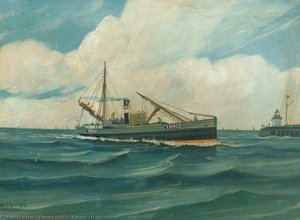
Kenneth Luck: A Visionary of Steam and Sea
Kenneth Luck (1874-1936) wasn’t merely an artist; he was a meticulous recorder of a vanishing world – the age of steam. Born in Yarmouth, England, his life coincided with a period of dramatic industrial transformation, and his art became inextricably linked to this shift. While often categorized as an early 20th-century painter, Luck's work transcends simple labels, offering a poignant blend of realism, romanticism, and a deep appreciation for the maritime heritage of his home region.
Luck’s artistic journey began with formal training at the Great Yarmouth College of Art, followed by further studies in London. This grounding provided him with technical skills, but it was his keen observation and fascination with the working docks and bustling harbors that truly defined his style. Unlike many artists of the time who focused on grand landscapes or idealized subjects, Luck chose to depict the gritty reality of coastal life – the weathered faces of fishermen, the imposing silhouettes of steamships against a turbulent sky, and the intricate details of shipbuilding yards. His palette was deliberately muted, dominated by blues, greys, and browns, reflecting the often-damp and overcast conditions of his subject matter. This restrained approach allowed the textures and forms to speak for themselves, creating a powerful sense of atmosphere and immediacy.
The Steamship Canvas
Luck’s most celebrated works center around steamships – vessels that were rapidly reshaping Britain's economy and culture. He didn’t simply paint these behemoths; he captured their essence: the rhythmic chugging of engines, the billowing smoke, the sheer scale of their presence. His paintings, such as “Piscator YH 403,” are not portraits of ships but studies in movement and power. The figures within the scenes – fishermen hauling nets, sailors manning the rigging – are rendered with a remarkable sensitivity, conveying both their physical labor and their connection to the sea.
The artist’s meticulous attention to detail is evident in every brushstroke. He painstakingly recreated the textures of weathered wood, the glint of metal, and the swirling patterns of steam. Luck's work demonstrates a remarkable understanding of light and shadow, using these elements to create depth and drama within his compositions. His paintings are not merely representations of objects; they are immersive experiences that transport the viewer to the heart of the maritime world.
Collaborations and Local Influence
Luck’s career was significantly shaped by a unique partnership with photographer Claude Ernest Mowle. Mowle, specializing in capturing images of ships, would meticulously photograph the vessels, and Luck would then translate these photographs into paintings. This collaborative process allowed them to produce a large body of work, documenting the maritime activity of Great Yarmouth and its surrounding areas. The arrangement was mutually beneficial; Mowle gained access to Luck’s artistic talent, while Luck benefited from Mowle's photographic expertise.
Furthermore, Luck’s art was deeply rooted in his local community. He exhibited regularly at prominent venues in Great Yarmouth, including the Tolhouse and Johnson’s Rooms, and his work resonated with the town’s seafaring population. His paintings served as a visual chronicle of their lives and livelihoods, capturing a moment in time before the industry underwent further transformations.
Legacy and Historical Significance
Kenneth Luck's legacy lies not only in the beauty of his paintings but also in their historical significance. He documented a pivotal era – the rise of steam power and its profound impact on coastal communities. His work offers a valuable glimpse into the lives of those who worked on the docks, sailed the seas, and built the ships that connected Britain to the world.
While he may not be as widely recognized as some of his contemporaries, Luck’s paintings are increasingly appreciated for their technical skill, emotional depth, and unique perspective. His evocative depictions of steamships and coastal life continue to resonate with viewers today, reminding us of a time when the sea was both a source of livelihood and a symbol of adventure.
Sources: Suffolk Artists, askART, Wikipedia
Vprašanja in odgovori
Na kakšna obdobja je razdeljena kariera umetnika Kenneth Luck?
Kronološki pregled dela umetnika Kenneth Luck si lahko ogledate na njegovi strani Zgodovina umetnosti, kjer se dela prikazujejo v vrstnem redu nastanka, razdeljena v posamezna poglavja.
Koliko so priljubljena dela umetnika Kenneth Luck?
Stran Statistika umetnika Kenneth Luck prikazuje statistiko, izračunano na podlagi umetnin tega umetnika, ki so navedene na ta spletna stran.
Kako najdem vse dela umetnika Kenneth Luck v določeni tehniki?
Stran Vse tehnike razvršča dela umetnika Kenneth Luck po tehniki.