The Primordial Mark: Defining Hatching and Its Artistic Purpose Hatching Hatching (French: hachure) is an artistic technique used to create tonal or shading effects by drawing, painting, or scribing closely spaced parallel lines. When lines are place...
Every drawing begins with a single, deliberate mark upon a void. Before an artist can represent a complex human figure or a sprawling landscape, they must first master the ability to suggest weight using nothing but simple, rhythmic strokes. This is the essence of hatching, known in French as hachure. At its most fundamental level, hatching involves drawing closely spaced parallel lines that run in sync with one another. By adjusting the thickness and proximity of these lines, an artist can begin to manipulate how light appears to hit a surface.
To understand this technique is to understand the physics of light. When lines are placed far apart, the white of the paper remains visible, suggesting a bright, illuminated area. As those lines grow closer together, the eye perceives a gradual darkening. This method allows for the creation of tonal variations without the need for color or heavy smudging. It is a way of approximating how light behaves on an object's surface, providing a structural boundary to what would otherwise be a flat plane.
This practice finds its historical echo in the early works of the German Renaissance. Artists like Albrecht Dürer, working within the rigorous traditions of his Nuremberg workshop, utilized precise parallel lines to define the anatomy of his subjects. While his work often moved into more complex territories, the foundational reliance on controlled, singular strokes provided the necessary structure for much more intricate compositions.
Building Volume through Intersection: The Mechanics of Cross-Hatching
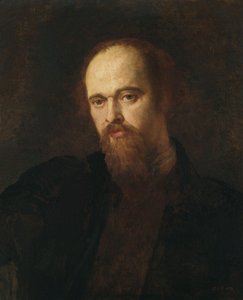
A Portrait of the Soul: Unveiling Dante Gabriel Rossetti's 1870 Self-Portrait Dante Gabriel Rossetti’s self-portrait, created in 1870, isn’t merely a likeness; it’s a carefully constructed meditation on identity, artistic aspiration, and the quiet co...
While hatching provides the initial shadow, cross-hatching introduces the architecture of depth. This technique takes the existing parallel lines and overlays a second set of lines at an angle, creating a grid-like pattern. By layering these intersecting strokes, an artist can dig deeper into the illusion of three-dimensionality. It is a method of building layers, much like adding more weight to a sculpture. The goal is not merely to darken an area, but to create a sense of density that suggests a solid, volumetric form.
The skill in cross-hatching lies in avoiding a "screen door" effect, which occurs when lines intersect at rigid, right angles. Instead, professional artists prefer oblique angles to maintain a natural, organic feel. By varying the direction, spacing, and darkness of these intersecting layers, one can transition smoothly from a highlight to a deep, recessed shadow. This layering is what allows a flat piece of paper to transform into a window of perceived depth, where certain areas appear to recede while others push forward toward the viewer.
We see this mastery in the works of the Pre-Raphaelite movement, specifically in the self-portrait by Dante Gabriel Rossetti. In his 1870 study, Rossetti does not rely on color to define his features; instead, he uses the palpable texture of cross-hatching to build the curves of his brow and the heavy folds of his clothing. The density of his lines creates a tactile quality, making the skin and fabric feel as though they possess actual weight and presence.
Texture and Surface: Using Line Direction to Mimic Reality
Intaglio ( in-TAL-ee-oh, -TAH-lee-; Italian: [inˈtaʎʎo]) is the group of printing and printmaking techniques in which an image is incised into a surface and the incised line or sunken area holds the ink. It is the direct opposite of a relief print w...
Beyond simple light and shadow, line work serves as a tool for mimicking the physical textures of the world. An artist does not use the same stroke for every surface. To represent the rough bark of a tree, one might use irregular, jagged marks, whereas the soft curve of human skin requires much more delicate, flowing strokes. This specific application is often referred to as contour hatching, where the lines follow the natural curves and anatomical forms of the object being depicted.
By changing the direction of the lines to wrap around a shape, the artist reinforces the sense of volume. If you are sketching a sphere, the lines should curve with the surface; if you are rendering a flat plane, the lines remain straight. This technique extends to more complex textures as well. Through the strategic use of intersecting lines, an artist can simulate the roughness of rocks, the fluidity of water, or the organic chaos of foliage. It is a way of sculpting texture through nothing but the movement of the hand.
This ability to define texture through line was essential in the development of intaglio printmaking. In techniques like engraving and etching, where an image is incised into a metal plate—usually copper—the artist must use the burin or acid to create lines that hold ink. The precision required for these incisions meant that every stroke had to communicate both form and material. This era of printmaking, which dominated from roughly 1550 until the mid-19th century, relied entirely on the language of the line to tell stories of texture and depth without the aid of a brush.
The Physics of Light: How Line Density Dictates Shadow and Depth
The Raw Emotion of Faith: Delacroix’s Christ on the Cross Ferdinand Victor Eugène Delacroix's “Christ on the Cross 1” isn’t a finished masterpiece; it’s a vital preparatory sketch, a glimpse into the artist’s intensely personal and profoundly moving ...
The ultimate goal of all shading techniques is to approximate the local behavior of light on an object's surface. Shading is the depiction of depth perception by varying the level of darkness across a surface. Optically, brighter areas—those with less hatching or more space between lines—appear closer to the viewer. Conversely, darker, more densely hatched areas appear to recede into the distance. This creates a visual hierarchy that guides the eye through the composition.
An artist must carefully manage the transition between light and dark. If the transition is too abrupt, the object looks faceted or artificial. If it is too smooth, the sense of structure may be lost. The most effective shading uses a range of densities to create a continuous flow of light. This involves not just the number of lines, and how they cross, but also the pressure applied to the tool. A heavy, dark stroke creates a deep shadow, while a light, wispy stroke suggests a fleeting glint of reflected light.
This dramatic use of light and shadow is perhaps most moving in Eugène Delacroix’s "Christ on the Cross 1." In this preparatory sketch, Delacroix uses a monochromatic palette dominated by shades of gray achieved through masterful hatching. There is no attempt at color; instead, he relies entirely on tonal variation to sculpt the weight of Christ's suffering. The way the light hits the torso and recedes into the shadows of the cross creates a profound sense of physical and emotional gravity.
From Metal Plates to Modern Pixels: The Evolution of Shading Techniques
Gouraud shading ( goo-ROH), named after Henri Gouraud, is an interpolation method used in computer graphics to produce continuous shading of surfaces represented by polygon meshes. In practice, Gouraud shading is most often used to achieve continuous...
The principles of hatching and cross-hatching have traveled far beyond the physical grooves of copper plates or the graphite marks on paper. In the modern era, these ancient concepts of light and shadow have been translated into the digital realm through computer graphics. One notable example is Gouraud shading, a method used to produce continuous lighting on polygon meshes. While it uses mathematical interpolation rather than physical ink, the underlying logic remains the same: calculating how light moves across a surface to create the illusion of volume.
In computer rendering, much like in traditional drawing, the challenge is to avoid "flat" appearances. Just as an artist avoids excessive right-angled lines to prevent a screen-like effect, digital shading algorithms work to smooth out the transitions between vertices so that a 3D object does not look faceted. While modern technology has moved toward even more complex models, the fundamental goal remains the same as it was for the Renaissance masters: to use the manipulation of light and darkness to convince the eye that a flat surface possesses depth.
Whether we are looking at an 15th-century woodcut or a high-resolution digital render, the core objective has never changed. We seek to understand how light interacts with form. At AllPaintingsStore.com, we appreciate this technical lineage in every hand-painted reproduction we create. Our artists use these very same principles of hatching and tonal layering to ensure that our oil paintings offer a deeper, more realistic range of tones than any digital print could ever achieve.
Meta Description: Dante Gabriel Rossetti (1828-1882), umetnik Pre-Raphaelitskog pokreta i simbolizma, poznat po svojim senzualnim slikama i epskim temama koje su oblikovale estetiku viktorijanskog doba. otkrijte njegov kulturni …
Evžen Delakroa, vodeći predstavnik romantizma! Otkrijte dramatične scene, egzotične teme i majstorsku upotrebu boja. Proslavljeni radovi: „Sloboda vodi narod“ i „Smrt Sardanapala“. #Delakroa #Romantizam #FrancuskaUmetnost
Step into the dramatic world of Gustave Doré. Explore 25 iconic masterpieces of Romanticism, from haunting Bible illustrations to epic literary engravings. Find inspiration for museum-quality art reproductions and curated decor. Discover all masterpieces on AllPaintingsStore.com.
Immerse yourself in the romantic beauty of Dante Gabriel Rossetti. Explore 25 iconic Pre-Raphaelite masterpieces, from soulful portraits to symbolic legends. Find museum-quality art reproductions and timeless decor inspiration. Discover all masterpieces on AllPaintingsStore.com.
Istražite 10 remek-dela geometrijske apstrakcije – Mondrian, Malevič i Kandinski. Otkrijte priče iza ovih ikoničnih slika i pronađite inspiraciju za dekoraciju enterijera sa AllPaintingsStore.com! Reprodukcije vrhunskog kvaliteta.
Discover the secrets of hatching and cross-hatching. Explore how master artists use layered lines to create depth, texture, and volume, from Renaissance engravings to modern masterpieces. Perfect for art enthusiasts looking to deepen their appreciation for fine art techniques.


 The Silent Language of Line: Mastering Hatching and Cross-Hatching for Depth and Texture
 Self portrait
 Intaglio (printmaking)
 Christ on the cross 1
 Gouraud shading