The Spectrum of Abstraction: Navigating the Continuum of Form
Abstraction is not a singular destination but a broad continuum of departure from reality. It represents a shift in how an artist engages with the subject, moving from the literal depiction of a recognizable object toward a visual language composed of shape, form, color, and line. This departure can be subtle, such as the way Fauvism deliberately alters color to express emotion rather than accuracy, or it can be total, where the work bears no trace of the physical world. In the realm of geometric abstraction, the artist often moves away from naturalistic entities entirely, seeking a logic that exists independently of the eye's expectation.
This movement toward the intangible finds an early echo in the landscapes of J.M.W. Turner. While Turner remained rooted in the depiction of nature, his later works often dissolved recognizable forms into overwhelming suggestions of light and scale. He transformed the sublime into something nearly abstract, prioritizing the atmospheric effect over the literal detail of the scenery. Today, this same tension between the recognizable and the abstract allows collectors to choose works that range from the partially representational to the purely non-objective.
The Geometry of Essence: Reducing Nature to Basic Solids
Paul Cézanne. French Post-Impressionist who used color modulation and geometric forms to capture Mont Sainte-Victoire through repetitive, constructive strokes.
The drive to find the underlying structure of the world often leads the artist toward the most fundamental shapes: the cube, the sphere, and the cone. This approach suggests that the complexity of nature is merely a surface layer covering a more stable, mathematical reality. By stripping away the superficial details of a landscape or a still life, the artist attempts to reach the core essence of the subject. This reductionism is not about simplification for the sake of ease, but about finding a more profound truth through structural clarity.
This conceptual foundation was famously articulated by Paul Cézanne, who believed that all depiction of nature could be reduced to these primary solids. His investigations into the structural integrity of objects paved the way for the radical transformations seen in Cubism, where forms were altered and fragmented to show multiple perspectives simultaneously. Modern collectors often seek this geometric clarity to provide a sense of order and architectural stability within a curated space.
The Non-Objective Ideal: The Search for Pure Feeling
At the furthest end of the abstraction spectrum lies the non-objective, where the goal is to achieve a state of pure artistic feeling, unburdened by the weight of the real world. This is the realm of Suprematism, a movement that sought to liberate art from the "dead weight" of representation. For these artists, the canvas is not a window into a scene, but a field for the expression of spiritual or emotional energy. The use of the square, in particular, became a vessel for this pursuit, representing a departure from the chaos of the visible world into a realm of pure sensation.
Kazimir Malevich’s 1915 work, Black Square, serves as the definitive historical anchor for this pursuit. By presenting a nearly void-like composition, Malevich challenged the very definition of what a painting could be, moving away from the descriptive toward the conceptual. This pursuit of the "pure" continues to influence contemporary collectors who value works that prioritize internal resonance and the autonomy of the visual element over narrative content.
The Logic of the Grid: Order and Balance in Neo-Plasticism
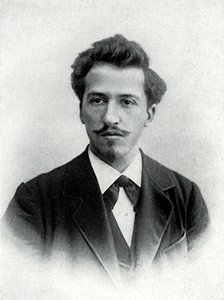
Piet Mondrian. Dutch Neoplasticist who replaced natural landscapes with rhythmic grids of primary colors and intersecting black lines to find universal order.
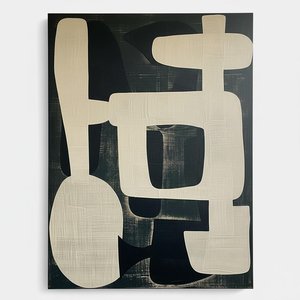
While some artists sought the spiritual through the void, others sought it through the rigorous application of order. This is most evident in the development of Neo-Plasticism, which aimed to find the plastic expression of true reality by destroying the appearance of the natural world. This method relies on a strict vocabulary: horizontal and vertical lines paired with primary colors and rectangles. The result is a composition governed by a sense of equilibrium and mathematical precision, where every element is essential to the stability of the whole.
Piet Mondrian was the primary architect of this language, evolving his style between 1915 and 1919 to move away from conventional landscapes toward a highly disciplined grid. His work sought to create a universal harmony that could be applied not just to canvas, but to the very environment of the future. For the modern interior, such works provide a sophisticated, rhythmic structure that complements contemporary architectural lines.
Biomorphic Fluidity: The Vitality of Organic Shapes
Henri Matisse. French Fauvist known for vibrant, non-naturalistic colors and expressive cut-paper collages that transformed his later years of illness.
In contrast to the rigid certainty of the grid, organic abstraction embraces the fluid, the curved, and the unpredictable. These biomorphic forms suggest life and movement without explicitly depicting a specific organism. They utilize the language of the swirl, the wave, and the irregular contour to evoke a sense of growth or biological energy. This style bridges the gap between the mathematical and the living, offering a way to express the dynamism of nature through a stylized, non-literal lens.
Henri Matisse demonstrated this intersection in his 1953 work, The Snail. Through his technique of cutting shapes from painted paper, he utilized bold colors and geometric patterns that, while abstract, were deeply inspired by the rhythmic spirals found in nature. This ability to balance the structured with the fluid allows organic abstraction to feel both intentional and alive, making it a versatile choice for spaces that require a sense of natural vitality.
Chromatic Resonance: The Emotional Power of Color Fields
Mark Rothko. American Abstract Expressionist known for luminous, layered color field paintings of soft edges and large, rectangular blocks of color.
Color is perhaps the most direct tool an artist possesses for communicating emotion. In Color Field painting, the focus shifts away from shape and line toward the immersive power of hue and saturation. Here, large areas of color are used to create a sense of depth and atmosphere, often inviting a state of existential contemplation. The boundaries between forms may be sharp, or they may bleed into one another, creating a sense of infinite space that draws the viewer into a meditative state.
This approach finds its roots in the expressive use of color seen in Fauvism, where color was liberated from its descriptive function to serve purely emotional ends. Later, artists like Mark Rothko expanded this into a profound exploration of human feeling, using layered applications of pigment to create a sense of luminous depth. For the collector, color field works offer a way to manipulate the mood and temperature of a room through pure chromatic presence.
Curating Abstraction: Scale, Texture, and Spatial Impact
Selecting abstract art for a professional or residential environment requires an understanding of how form and scale interact with the surrounding architecture. A large-scale, multi-panel composition can act as a structural element, breaking up a long wall and creating a sense of movement, a technique often used in modern hotel lobbies and corporate halls. Conversely, smaller, more intimate works can serve as focal points that demand close, detailed inspection.
The tactile quality of the work also plays a significant role in its impact. A hand-painted oil reproduction offers a physical depth through visible brushstrokes and the texture of the impasto, providing a level of sophistication that a flat print cannot replicate. Whether through the precision of a geometric grid or the soft, blurred lines of an organic form, the choice of abstraction is ultimately a choice of how one wishes to direct the energy of a space.
AllPaintingsStore.com provides a comprehensive selection of these diverse modes of abstraction, from the structured logic of geometric works to the fluid grace of organic forms. Our catalog includes a wide range of styles, including hand-painted oil reproductions and high-quality prints, allowing you to find the exact visual language required for your project. For those seeking bespoke solutions, our custom commission service allows you to tailor colors and styles to your specific architectural needs.
Immerse yourself in the profound emotion of Mark Rothko's greatest works. Explore 25 iconic Abstract Expressionist masterpieces, from color field textures to legendary canvases. Find inspiration for museum-quality art reproductions and decor. Discover all masterpieces on AllPaintingsStore.com.



 Paul Cézanne
 Black Square (1930)
 Piet Mondrian
 Henri Matisse
 Mark Rothko


