


1


Ažurirano: новембар 2026 · rangirano prema našem koeficijentu popularnosti (pretrage, posete i porudžbine za svako delo) · 13 dela Anton Einsle u našem katalogu
Brzi odgovor
Portrait of Joseph Anton zu Waldburg-Wolfegg and his family (1816) je najpoznatije delo umetnika Anton Einsle. Portrait of an Officer (1829) je na drugom mestu, Portrait of a Man with a White Collar (1830) na trećem. Naš katalog sadrži 13 dela umetnika Anton Einsle; evo 11 najpoznatijih, rangiranih prema godini i muzeju u kojem se nalaze, kako bi vam pomogli da odaberete onaj koji želite da naručite.


5 muzeja u kojima se nalazi najviše slika sa ove stranice.
| Muzej | Grad | Radovi umetnika Anton Einsle | Slike iz ovog spiska |
|---|---|---|---|
| Ernest Zmeták Art Gallery | Nové Zámky | 1 | Portrait of an Officer |
 Slovačka nacionalna galerija |
Bratislava | 1 | Portrait of a Man with a White Collar |
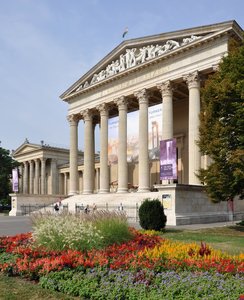 Szépművészeti Múzeum |
Budimpešta | 1 | Woman in a Red Dress |
 National Gallery of Ireland |
Dublin | 1 | Portrait of Anna von Minarelli-Fitzgerald |
 Mađarska akademija nauka |
Budimpešta | 1 | Portrait of Ferenc Kölcsey |
Izaberite deceniju da biste videli njene najpoznatije slike.
Portrait of Joseph Anton zu Waldburg-Wolfegg and his family (1816) zauzima prvo mesto, a prate ga Portrait of an Officer (1829) i Portrait of a Man with a White Collar (1830).
Anton Einsle je imao 15 godina: Portrait of Joseph Anton zu Waldburg-Wolfegg and his family je datiran 1816, a Anton Einsle je rođen 1801.
Portrait of Joseph Anton zu Waldburg-Wolfegg and his family, Portrait of an Officer, Portrait of a Man with a White Collar, Woman in a Red Dress, Girl on a Daybed in Front of the Mirror, Portrait of Anna von Minarelli-Fitzgerald, Emperor Franz Joseph I in the Gala Uniform of an Austrian Field Marshal, Anna Regenhart, Jakob Regenhart i Self-Portrait. Godina i muzej za svako od njih navedeni su u rangiranju iznad.
U našem katalogu se nalazi 13 dela umetnika Anton Einsle, datiranih od 1816 do 1864.
Pretežno u Ernest Zmeták Art Gallery (Nové Zámky), Slovačka nacionalna galerija (Bratislava) i Szépművészeti Múzeum (Budimpešta). Za kompletnu listu pogledajte tabelu muzeja iznad.
U periodima 1830s: 3 od 11 slika rangiranih ovde datiraju iz tog vremena, uključujući Portrait of a Man with a White Collar.
Najstarije na ovoj stranici: Portrait of Joseph Anton zu Waldburg-Wolfegg and his family (1816). Najnovije: Self-Portrait (1864).
Da. Svaka slika na ovoj stranici može se naručiti kao ručno slikana uljana reprodukcija ili kao štampa. Otvorite sliku, odaberite veličinu i izvršite porudžbinu.
Born in Vienna on 30 January 1801, Anton Einsle entered a world of precise craftsmanship as the son of Matthias Einsle, a manufacturer of surgical instruments. This domestic environment of technical accuracy provided a quiet backdrop to a childhood that would soon pivot toward the fine arts. His talent emerged with an early clarity, leading him to the Academy of Fine Arts in Vienna at the age of 13. It was within these institutional walls that the foundations of his professional life were laid, as he began to navigate the rigorous demands of formal artistic instruction.
Under the guidance of Josef Klieber, Einsle refined his technical abilities and developed the discipline required for high-level portraiture. His progress was marked by an unusual speed; by the age of 16, he was already receiving commissions. This early professional recognition suggested a maturity of hand and eye that would define his subsequent career. He moved through his training with a focused intent, transitioning from a student of the Academy to a painter capable of meeting the expectations of a demanding clientele.
In 1832, Einsle moved to Pest-Buda, a transition that would define the middle years of his career. His presence in the city brought him into the inner circles of the Hungarian nobility. He became a protégé of Palatine Joseph of Hungary, eventually earning a position as the family’s favorite portraitist. This period of intense activity in Pest-Buda allowed him to secure a steady stream of commissions from both secular and church dignitaries, establishing his reputation far beyond the borders of Austria.
His success in Hungary eventually drew him back to Vienna in 1838. This return marked a significant professional ascent, as he was appointed official court painter that same year. His status within the artistic establishment continued to grow; in 1843, he was elected as a full member of the Academy of Fine Arts. His life became a series of high-level engagements with the imperial family and the aristocracy, cementing his place in the social fabric of the era.
Einsle’s career was defined by his proximity to the centers of power in the Austrian Empire. His talent for capturing the likeness of the high aristocracy and the nobility secured him a position of significant influence. By 1838, his standing was formalized when he was appointed as the official court painter. This role granted him a level of access rarely afforded to artists, including the privilege of maintaining his own studio within the Hofburg.
His relationship with the imperial family was particularly profound. He became the official portraitist of Kaiser Franz Joseph I, a position that required him to document the young monarch during the formative years of his reign. During the first two years of the emperor's rule, Einsle produced more than thirty portraits of Franz Joseph, capturing the evolving image of the sovereign. This steady stream of commissions ensured that his hand was present at the very heart of the Habsburg court.
The trajectory of Einsle’s brushwork reflects the shifting aesthetic sensibilities of the nineteenth century. In his formative years, his hand was guided by the principles of late neoclassical painting. This early period saw him absorbing the stylistic nuances of Michael Moritz Daffinger and Friedrich von Amerling, whose influences shaped his initial approach to form and composition. His early works often adhered to these structured, classical traditions, establishing a technical foundation that would support his later, more nuanced developments.
As his career progressed, Einsle emerged as a leading figure of the Biedermeier period. His style evolved to embrace the specific requirements of this era, moving toward the creation of detailed and elegant portraits. He possessed a particular ability to capture the dignity of his subjects through a refined sense of poise and meticulous attention to detail. This transition from the rigidities of neoclassicism to the more intimate, polished sensibilities of the Biedermeier style allowed him to navigate the expectations of both the high aristocracy and the imperial court with ease.
His technical proficiency was particularly evident in his ability to render textures and the subtle nuances of light. Whether working in oil on canvas or in the delicate medium of watercolor, he maintained a consistent focus on clarity and grace. This precision was essential for a painter whose livelihood depended on the likenesses of the most prominent figures of the Austrian and Hungarian nobility.
The breadth of Einsle's output reflects the shifting demands of the mid-19th century, moving from the formal requirements of the imperial court to more intimate subjects. In 1851, he captured the likeness of Emperor Franz Joseph I, a portrait painted when the monarch was only twenty-one years old. This work sits alongside his depictions of the high aristocracy, such as the 1848 portrait of Ferencz Szepessy. His ability to navigate the expectations of his patrons allowed him to move seamlessly between the public duties of a court painter and the private needs of his subjects.
His technical range is evident in the varied formats he employed to satisfy different commissions. He produced an oil painting of Archduke Alexander Leopold in 1837, demonstrating his command over the formal portraiture required by the Habsburg circle. Even within the domestic sphere, his hand was steady and observant. This is seen in the 1854 work Sleeping Child and the oil on canvas of his daughter, Anna Einsle, painted about 1865.
The physical presence of Einsle’s oeuvre remains distributed across several significant institutions, reflecting the geographic reach of his professional life. In Vienna, his portraits are held by the Heeresgeschichtliches Museum. His presence in the capital is a direct reflection of his status as a court painter, with many of his subjects finding their way into these official collections.
The reach of his brush extends into Hungary, where the Hungarian National Gallery in Budapest maintains a collection of his paintings. This presence in Budapest speaks to the years he spent as a protégé of the Hungarian nobility. His works are also found in the Residenzgalerie in Salzburg, following the donation of twelve paintings by his descendants in 2025. Beyond these specific sites, his paintings are held in many museums throughout Austria and abroad, ensuring his visual record remains part of various international collections.
