Pengatillbaka-garanti · 30 dagar Fri frakt i hela världen
446 261konstverk 30 640konstnärer 4 753museer 32språk
Land
Valuta
Språk
Ateljé · Grundat 2015 · Paris, Frankrike
AllPaintingsStore
allpaintingsstore.com
Mitt konto Önskelista Varukorg

Hans Holbein den yngre

1497 - 1543

Kortfattad information

  • Works on APS: 340
  • Creative periods: mature period
  • Room fit:
    • vardagsrum
    • vardagsrummet
  • Gift suitability: other-none
  • Emotional tone: reflekterande
  • Color intensity: balanserad
  • Best occasions: accent
  • Lifespan: 46 years
  • Typical colors: drivved
  • Died: 1543
  • Top-ranked work: Ambasadörerna
  • Visa mer…
  • Born: 1497, Augsburg, Tyskland
  • Museums on APS:
    • National Gallery of Art
    • National Gallery
    • National Gallery of Art
    • National Gallery
    • National Gallery of Art
  • Also known as: Hans Holbein der Jüngere
  • Mediums: akryl på duk
  • Copyright status: Public domain
  • Nationality: Tyskland
  • Top 3 works:
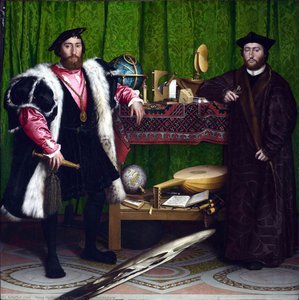
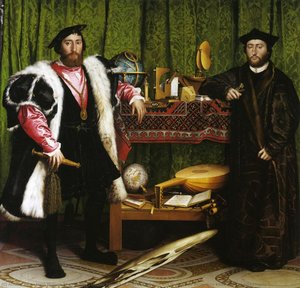
    • Ambasadörerna
    • Dubbelporträtt av Jean de Dinteville och Georges de Selve (även känt som Ambassadörerna)
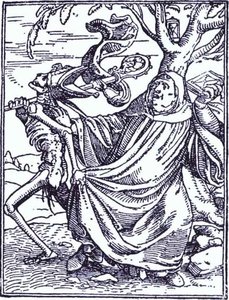
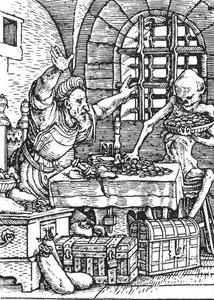
    • Död och Prästen
  • Vibe: elegant
  • Movements: northern renaissance
  • Art period: Renässansen

Konstquiz

Det finns endast ett korrekt svar på varje fråga.

Fråga 1:
Var föddes Hans Holbein den yngre?
Fråga 2:
Vilken konstnärsstil är Hans Holbein den yngre mest känd för?
Fråga 3:
Vilken framstående figur introducerade Holbein till engelska samhället när han kom till England år 1526?
Fråga 4:
Holbeins stil blandade konstnärstraditioner från vilka områden?
Fråga 5:
Vad är ett särskilt kännetecknande för Holbeins porträttverk, bortom deras realistiska återgivning?

A Life Etched in Detail: The World of Hans Holbein the Younger

Hans Holbein the Younger (1497/8 – 1543) was a German-Swiss painter and printmaker who worked in the Northern Renaissance—a master portraitist whose work continues to resonate with breathtaking realism and psychological depth. His upbringing within an artistically gifted family laid the foundation for his exceptional talent; his father, Hans Holbein the Elder, was a respected painter and printmaker who instilled in young Hans a meticulous approach to observation and technique. This early training wasn’t merely about mastering brushstrokes or mixing pigments—it was about learning to *see*, to capture not just likeness but the very essence of a subject. Holbein's initial artistic explorations occurred within his father’s workshop, where he honed his skills before embarking on a journey that would lead him through Switzerland and ultimately to the heart of the English court.
From Basel to the Tudor Court: A Rising Star

Holbein’s formative years were spent in Basel, Switzerland, where he established himself as an independent artist with a burgeoning reputation. He excelled not only in portraiture but also in religious art—creating monumental murals and stained glass windows that showcased his mastery of color and composition. Perhaps most strikingly, Holbein designed the *Dance of Death* series, a macabre depiction of mortality featuring exquisitely detailed figures representing every stratum of society. These early works reveal a profound fascination with capturing human emotion and exploring themes of life and death—qualities that would permeate his entire artistic career. The influence of Italian Renaissance humanist ideals is palpable in Basel’s artistic milieu during this period, shaping Holbein's stylistic choices and broadening his intellectual horizons.

The Art of Perception: Style and Masterpieces

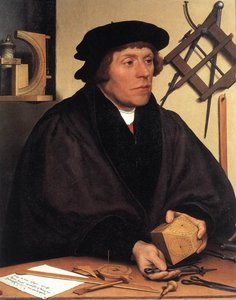
Holbein’s distinctive style is characterized by an unparalleled commitment to realism—a pursuit achieved through painstaking attention to detail in rendering textures, fabrics, and the subtle nuances of facial expressions. He didn’t simply *paint* portraits; he meticulously constructed them, layering upon layer, capturing not just physical appearances but also the personality and inner life of his sitters. His innovative compositions further enhanced the impact of his work—often employing symbolic objects or backgrounds to convey deeper meaning. The Ambassadors (1533), arguably Holbein’s most celebrated masterpiece, exemplifies this approach—a complex and symbolically rich double portrait showcasing both Holbein’s technical brilliance and intellectual depth. The anamorphic skull subtly embedded within the painting serves as a stark *memento mori*, reminding viewers of the inevitability of death. This masterful use of perspective and detail elevates the image beyond mere representation, inviting contemplation on themes of mortality and human ambition. His portraits of Henry VIII—particularly his depiction of the king’s coronation robes—became iconic representations of royal power and solidified Holbein's reputation as one of the foremost portraitists of his time.

Historical Significance: A Legacy Enduring Through Time

Holbein’s artistic journey coincided with a period of profound intellectual and religious upheaval—the Reformation—and he skillfully utilized his art to convey messages of faith and authority. His depictions of Erasmus of Rotterdam capture the humanist scholar's erudition and moral integrity, reflecting the values of the Renaissance humanism movement. Furthermore, Holbein’s meticulous documentation of historical events—such as Henry VIII’s reign—provides invaluable insights into the political landscape and cultural sensibilities of Tudor England. He remains one of the most admired and studied painters of the Renaissance—a master whose legacy continues to inspire artists today. His work transcends mere technical skill; it embodies intellectual curiosity, artistic innovation, and a profound understanding of the human condition—qualities that cemented his place as a cornerstone of Northern Renaissance art history. He didn't merely record appearances—he captured moments in time, preserving them for posterity.