A Life Dedicated to Portraiture: The World of André Bouys
André Bouys, a name perhaps less immediately recognizable than some of his Baroque contemporaries, nevertheless occupies a significant place in the history of French portraiture and engraving. Born around 1656 in Hyères, Provence, Bouys’s artistic journey was one marked by diligent study, academic recognition, and a subtle yet compelling evolution from meticulous reproduction to a distinctive personal style. While initially overshadowed by his teachers and the prevailing Dutch influence, he carved out a niche for himself depicting the lives of the French bourgeoisie with an intimacy and skill that resonated with the tastes of his era.
Bouys’s early training took place in Paris under François de Troy, a prominent painter favored by exiled James II of England. This formative period instilled in him not only technical proficiency but also an appreciation for refined elegance and detailed observation. He quickly demonstrated an aptitude for engraving, initially reproducing the works of his master and fellow studio artists. However, Bouys’s ambition extended beyond mere imitation; he sought to establish himself as a painter in his own right. His talent was undeniable, and at the remarkably young age of eleven, he began assisting de Troy with engravings, further honing his skills.
Academic Recognition and Early Success
The path to artistic legitimacy in 17th-century France led through the prestigious Académie Royale de Peinture et de Sculpture. In 1688, Bouys presented himself for membership, submitting portraits of Charles de La Fosse and Monsieur le Hongre, Adjoint Recteur. The acceptance into this esteemed institution was a testament to his growing reputation and signaled his arrival as a serious contender in the Parisian art world. This achievement provided him with access to valuable resources, commissions, and the patronage of discerning collectors.
Bouys’s early work largely focused on portraiture, a genre that allowed him to showcase his mastery of likeness and subtle psychological insight. He quickly gained favor among the upper echelons of society, capturing the dignity and status of his sitters with remarkable precision. His portraits at Versailles, including self-portraits alongside his first wife, offer glimpses into his personal life and artistic ambitions. These early works reveal a painter deeply influenced by the Dutch Golden Age masters—a characteristic shared by many French artists of the period who admired their realism and attention to detail.
The Intimacy of Genre Scenes: A Shift in Focus
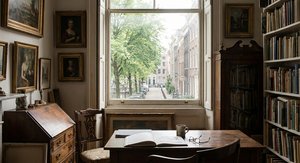
While Bouys initially achieved success as a portraitist, his artistic interests gradually expanded to encompass genre scenes and still-life compositions. This shift in focus occurred later in life, around the age of seventy, marking a fascinating evolution in his oeuvre. He began depicting bourgeois interiors with serving girls engaged in domestic activities—a subject matter that resonated with the growing affluence and social consciousness of the French middle class. These paintings were not merely depictions of everyday life; they were carefully constructed narratives imbued with subtle symbolism and moral undertones.
His most celebrated work from this period is arguably his portrait of Marin Marais, a renowned composer and viola da gamba virtuoso. This painting transcends the conventions of traditional portraiture, offering a captivating glimpse into the musician’s personality and artistic world. The composition is rich in detail, with meticulously rendered instruments, fabrics, and furnishings that evoke the refined atmosphere of Marais’s salon. Bouys's ability to capture not only physical resemblance but also the inner life of his subjects set him apart from many of his contemporaries.
Legacy and Historical Significance
André Bouys’s contributions to French art lie in his skillful blending of Dutch realism with a distinctly French sensibility. He was a master of capturing texture, light, and atmosphere, creating paintings that are both visually captivating and psychologically engaging. His genre scenes, while perhaps less well-known than his portraits, offer valuable insights into the lives and customs of the 18th-century bourgeoisie.
- Influence of Dutch Masters: Bouys’s early work demonstrates a clear influence from the Dutch Golden Age painters, particularly in his attention to detail and realism.
- Academic Training: His membership in the Académie Royale de Peinture et de Sculpture provided him with access to valuable resources and commissions.
- Portraiture as a Foundation: Bouys’s early success as a portraitist established his reputation and allowed him to develop his distinctive style.
- Genre Scenes and Social Commentary: His later genre scenes offer insights into the lives of the French middle class and reflect the social consciousness of his era.
Although he may not be a household name, André Bouys remains an important figure in the history of French Baroque art. His paintings are admired for their technical skill, psychological depth, and subtle beauty—a testament to a life dedicated to capturing the essence of human experience through the art of portraiture and genre painting.