Hızlı yanıt
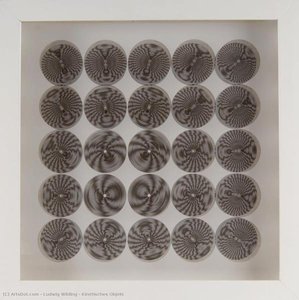
Ludwig Wilding tarafından yapılmış en ünlü tablo Kinetisches Objekt (1967)'dir. Kinetisches Objekt Nr. 20 (1967) ve Untitled from 9x5 Konkret Portfolio (1973) iki ve üç sayılarındandır. Katalogumuzdaki Ludwig Wilding imzalı 6 eser arasından, en ünlü 6 eser; her biri yılı ve müzesiyle birlikte sıralanmış olarak, sipariş vereceğiniz tabloyu seçebilmeniz için aşağıda sunulmuştur.
Sıralanmış en iyi 10 Ludwig Wilding tablosu
yıla göre Ludwig Wilding: en iyi tablolar
7 yıl, 1967 ile 1973 arası: bu sayfa üzerinde yıl yıl gösterilen, tarihli Ludwig Wilding tablolarının kapsamı budur.
Yıla göre eserler
Tablolarını görmek için bir yıl seçin.
Ludwig Wilding tabloları: sıkça sorulan sorular
Ludwig Wilding tarafından yapılmış en ünlü tablo hangisidir?Cevabı göster
Kinetisches Objekt (1967) birinci sırada yer alırken, onu Kinetisches Objekt Nr. 20 (1967) ve Untitled from 9x5 Konkret Portfolio (1973) takip ediyor.
Kinetisches Objekt yapıtı boyanırken Ludwig Wilding kaç yaşındaydı?Cevabı göster
Ludwig Wilding 40 yaşındaydı: Kinetisches Objekt 1967 tarihli bir eserdir ve Ludwig Wilding 1927 yılında doğmuştur.
Ludwig Wilding tarafından yapılmış kaç eser listeleniyor?Cevabı göster
Ludwig Wilding tarafından yapılan 6 eser, 1967 ile 1973 tarihleri arasında katalogumuzda yer almaktadır.
Ludwig Wilding'in en ünlü tabloları hangi dönemde yapılmıştır?Cevabı göster
1967 döneminde: Buradaki 6 tablodan 2 tanesi, Kinetisches Objekt dahil olmak üzere, o döneme aittir.
Ludwig Wilding üslubundaki en eski ve en yeni ünlü tablolar hangileridir?Cevabı göster
Bu sayfadaki en eski eser: Kinetisches Objekt (1967). En yeni eser: Untitled from 9x5 Konkret Portfolio (1973).
Ludwig Wilding hangi akımla ilişkilendiriliyor?Cevabı göster
Op art, bu sayfadaki sıralamaya göre seçilen tablolar temel alınarak oluşturulmuştur.
Sanatçı hakkında: Ludwig Wilding
The Genesis of a Perceptual Pioneer
Born in the German town of Grünstadt in 1927, Ludwig Wilding would eventually emerge as a master of the unseen, a sculptor of light and shadow who redefined the boundaries of visual perception. His intellectual foundation was as much rooted in philosophy as it was in pigment; his early studies in the History of Art and Philosophy at Mainz University provided a profound conceptual framework for his later explorations into the mechanics of sight. This academic rigor was soon paired with technical mastery during his time at the State Academy of Fine Arts Stuttgart, where he studied under the legendary Willi Baumeister. It was here that the seeds of geometric abstraction were sown, blending the disciplined principles of the Bauhaus movement with a burgeoning fascination for the kinetic potential of form.The Architecture of Optical Illusion
Wilding’s true genius lay in his ability to transcend the two-dimensional plane, breathing life into static objects through meticulously crafted three-dimensional structures. His work is characterized by a striking, monochromatic palette—a stark dance of black and white that serves as the stage for complex visual phenomena. These were not merely sculptures but active participants in a dialogue with the viewer. By manipulating depth and surface, Wilding created works that seemed to pulse and shift with every change in perspective or flicker of light. The technical precision required for such feats was immense, as he sought to capture the very essence of movement within a fixed medium through several key elements:- Geometric Abstraction: Utilizing clean lines and mathematical precision to guide the eye across the surface.
- Kinetic Energy: Creating the illusion of motion through subtle shifts in illumination and viewer position.
- Stereoscopic Depth: Using three-dimensional elements to challenge the boundaries between reality and illusion.


