A Legacy of Flemish Charm: The Life of Abraham Teniers
In the vibrant heart of seventeenth-century Antwerp, a period defined by the flourishing of the Flemish Baroque, Abraham Teniers emerged as a vital contributor to the rich tapestry of genre painting. Born in 1629 into one of the most prestigious artistic dynasties in Europe, his life was inextricably linked to the rhythms of the Guild of Saint Luke. As the son of the esteemed David Teniers the Elder and brother to the legendary David Teniers the Younger, Abraham was born into a world where the brush and the engraver's tool were the primary languages of expression. His early years in Antwerp, marked by his baptism on the first of March, 1629, laid the foundation for a career deeply rooted in the traditions of his kin, yet marked by a distinctively playful spirit.
The development of Abraham’s artistry was likely shaped within the very walls of his family studio. Under the tutelage of his father and older brother, he mastered the delicate nuances of capturing light, texture, and the boisterous energy of everyday life. By 1646, he had achieved the prestigious status of a wijnmeester—a master's son—within the Antwerp Guild of Saint Luke, signaling his formal acceptance into the professional elite. His technical prowess was not merely confined to the canvas; he was also an active publisher, ensuring that the visual narratives of his era reached a wider audience through printmaking.
The Playful Spirit of Genre and Singerie
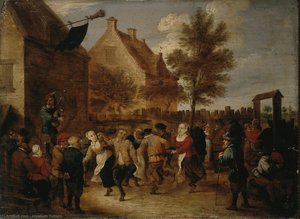
While many artists of his era sought the grandeur of historical or religious epics, Abraham Teniers found his true calling in the intimate, often humorous, depictions of common life. His repertoire was characterized by a delightful variety of themes that captured the soul of the Flemish countryside and the lively atmosphere of urban taverns. He possessed a remarkable ability to breathe life into scenes of village festivities, where peasants could be seen dancing, playing music, or simply enjoying the fruits of their labor. These works often hummed with a sense of communal joy and rhythmic movement.
Perhaps his most enchanting contribution to the genre was his mastery of singerie—the whimsical "monkey scenes" that became a hallmark of his style. In these compositions, monkeys are depicted mimicking human behaviors, dressed in finery, drinking, or engaging in sophisticated social rituals. This satirical element allowed Teniers to explore themes of folly and human nature through a lens of playful mockery. Beyond the whimsy of primates, he also captured the earthy reality of inns and guardrooms, where the smoke of pipes and the clinking of mugs provided a sensory backdrop to the lives of soldiers and travelers alike.
Social Standing and Historical Significance
Abraham Teniers was much more than a painter; he was a prominent figure in the social fabric of Antwerp. His life was marked by civic duty and cultural engagement, serving as a captain of the local schutterij (civil militia) and participating actively in the 'Olyftack' chamber of rhetoric. This involvement in the intellectual and defensive life of his city mirrored the prestige of his family name. His talent even earned him recognition at the highest levels of power; like his brother, he found favor at the court in Brussels, notably under the patronage of Archduke Leopold Wilhelm of Austria, who appointed him as a court painter.
Though his life was relatively short, ending in 1670, the impact of his work remains etched in the history of Flemish art. His ability to blend the technical precision of the Teniers tradition with a unique sense of humor and social observation ensures his place in the canon of seventeenth-century masters. Today, his works serve as windows into a bygone era, offering a nostalgic and spirited glimpse into the customs, celebrations, and satirical reflections of the Flemish Golden Age.
Питання та відповіді
Скільки творів Abraham Teniers представлено в каталозі?
Ви можете переглянути 5 творів мистецтва творів Abraham Teniers на сторінці Усі роботи митця.
Чи можу я переглянути роботи Abraham Teniers за художніми напрямами?
Сторінка Усі художні напрями групує твори Abraham Teniers за художніми напрямами.
Чи можу я дослідити використання кольору в усіх роботах Abraham Teniers?
Використання кольору в роботах Abraham Teniers, представлених на цей сайт, можна дослідити на сторінці художника Геном палітри.