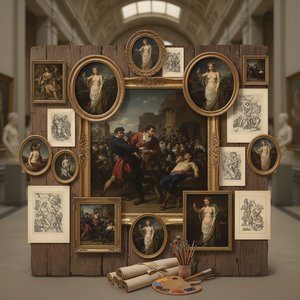
Adolf Hirémy-Hirschl: A Viennese Visionary Lost in Time
Adolf Hirémy-Hirschl (1860 – 1933) stands as a fascinating figure within the late nineteenth and early twentieth century Viennese art world—a painter whose prodigious talent was tragically overshadowed by stylistic shifts and personal circumstances. Born in Temesvár, Hungary, he emigrated to Vienna at a young age to pursue artistic studies, establishing himself firmly within the city’s vibrant academic tradition. His formative years were marked by scholarship at the Akademie der bildenden Künste, where his initial success with “Farewell: Scene from Hannibal Crossing the Alps” foreshadowed a lifetime dedicated to monumental historical and mythological canvases.
- Early Influences & Training: Hirémy-Hirschl’s artistic journey began under the tutelage of Anton Hansekampf at the Akademie der bildenden Künste, honing his skills in drawing and painting before embarking on a transformative trip to Rome in 1882. This pilgrimage proved pivotal, immersing him in the humanist ideals of antiquity and profoundly shaping his artistic vision.
- Roman Period & Artistic Breakthroughs: The Roman experience ignited Hirémy-Hirschl’s passion for portraying classical subjects with unparalleled detail and dramatic intensity. His magnum opus, “The Plague in Rome” (1884), though now lost to history, exemplifies this dedication—a sprawling canvas capturing the horrors of the Black Death with breathtaking realism and psychological depth. Despite facing challenges from the burgeoning Secession movement led by Gustav Klimt, Hirémy-Hirschl continued to produce acclaimed works, securing imperial patronage and garnering critical acclaim for his allegorical explorations of human experience.
- Vienna & The Secession Debate: As Klimt’s Secession gained momentum in Vienna, Hirémy-Hirschl wrestled with stylistic dilemmas—embracing the expressive fervor of Symbolism while retaining a commitment to academic precision. He moved to Rome in 1904, establishing himself as a respected member of the expatriate art community and dedicating his final decades to refining his craft and producing evocative drawings and watercolors.
- Notable Achievements & Legacy: Hirémy-Hirschl’s oeuvre comprises over seventy paintings exhibited at a retrospective in 1904 and included works recognized for their meticulous draughtsmanship and masterful rendering of classical forms. His monumental “Sic Transit…” (1912), an ambitious polyptych depicting the fall of Rome and the triumph of Christianity, stands as a testament to his artistic ambition and enduring influence on Viennese art history.
His heirs preserved numerous sketches and drawings until the early 1980s, revealing a wealth of unpublished material that offers invaluable insight into Hirémy-Hirschl’s creative process and artistic sensibilities. Buried in Rome's Protestant Cemetery, his grave bears the inscription “S647 Tomb Number – 393, Zone 1, Row 15,” marking the final resting place of a singular artist whose legacy continues to inspire admiration for his technical prowess and profound engagement with the grand narratives of Western civilization. Explore artworks by Hirémy Hirschl at
here.