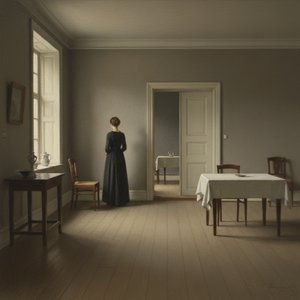
The Quietude of the Danish Interior
Hans Hilsøe lived a life defined by the subtle interplay of light and domesticity. Born in the Kingdom of Denmark in 1871, he developed a painterly language that favored the stillness of a room over the chaos of the external world. His work often focused on the intimate, formal spaces of Danish life, where the architecture of a high ceiling or the placement of a traditional chair carried more weight than grand historical narratives. He possessed a particular sensitivity to how sunlight enters a room, turning a simple moment of sewing or reading into a study of atmosphere.
His canvases frequently sought out the quiet corners of the Danish Golden Age, finding inspiration in the physical remnants of a bygone era. He was drawn to the way light falls across a floor or settles upon a woman's shoulder, creating a sense of solitude that felt both private and universal. This focus on the interior life allowed him to explore the textures of daily existence through a subdued and poetic lens.
Themes and Settings
The artist’s oeuvre is characterized by a recurring interest in specific environments and the figures that inhabit them. His compositions often centered on the following elements:
- The use of light as a primary subject, particularly in scenes involving a girl knitting or a woman sewing by a window.
- The depiction of historic domestic spaces, most notably the settings found in Bakkehuset.
- The presence of solitary figures engaged in quiet, contemplative activities such as reading or playing the piano.
- The integration of rural landscapes and garden settings into his formal interior studies.
In many of his works, the setting is not merely a backdrop but a character in itself. By painting the interiors of Bakkehuset, he captured the atmosphere of a house that once hosted the intellectual and cultural figures of his nation's history. These spaces, with their elegant furniture and structured layouts, provided him with a framework to explore the relationship between human presence and the architecture of home.
A Life in Light and Shadow
Throughout his career, Hilsøe maintained a consistent devotion to the quietude of the domestic sphere. His technical approach relied on a careful observation of how light defines form, whether it is a stream of light hitting a piece of fabric or the soft glow of a sunny living room. This dedication to the nuances of light and shadow gave his work a sense of permanence, as if he were capturing a single, unrepeatable moment of peace.
He passed away in 1942, leaving behind a body of work that remains a record of a specific, tranquil way of seeing. His paintings do not demand attention through scale or intensity; instead, they invite a slow, steady observation of the beauty found in the ordinary. Through his eyes, the simple act of a woman standing by a window becomes a profound study in stillness.
Питання та відповіді
До яких художніх напрямів належать роботи Hans Hilsøe?
Сторінка Усі художні напрями групує твори Hans Hilsøe за художніми напрямами.
Чи є загальний огляд усіх сюжетів, які малював Hans Hilsøe?
Сторінка Атлас тематик дозволяє знайти твори Hans Hilsøe за тематикою.
Де можна переглянути роботи Hans Hilsøe, згруповані за технікою виконання?
Щоб знайти всі роботи Hans Hilsøe у певній техніці, скористайтеся сторінкою За технікою виконання митця.
Які настрої передають роботи Hans Hilsøe?
Сторінка Простір настрою митця Hans Hilsøe дозволяє переглядати його роботи, відсортовані за настроєм.