The Life and Training of Roger Pocock
Born in London in 1865, Roger Pocock grew up in a city that was rapidly changing, yet his own path would eventually lead him far from the urban bustle. His early years were shaped by the artistic traditions of the time, providing him with a foundation that would support his later explorations of the natural world. He possessed a quiet determination that would serve him well as he moved from the classroom to the vast, open landscapes he would later seek to capture on canvas.
His formal education took place at the Slade School of Fine Art, a place where he learned the essential mechanics of composition and light. During his time there, he studied under Frederic Leighton and William Holman Hunt. These instructors, deeply committed to the grandeur of the British landscape tradition, instilled in him a meticulous attention to detail. This academic grounding gave Roger Pocock the technical tools necessary to translate the physical world into art, ensuring his work was built upon a disciplined understanding of structure and form.
Artistic Style and Arctic Inspirations
The pull of the far north was a constant force in Pocock’s life. During the early 20th century, he left the familiar comforts of London to seek out the raw, unsettled reaches of Spitsbergen and Greenland. These expeditions were not merely for travel; they were essential to his vision. He sought to translate the immense, lonely scale of the Arctic wilderness onto the canvas, focusing on the way light interacts with ice and stone. His work moved away from simple topographical sketches, choosing instead to capture the emotional weight of these desolate, wide-open spaces.
His technique reflected the harshness and the sudden clarity of the polar environment. He utilized a luminous color palette to mimic the way light reflects off snow and glaciers, often leaning into deep blues and greens. Rather than smooth, blended transitions, he relied on bold brushstrokes that gave his landscapes a sense of movement and texture. This approach allowed him to portray the fleeting shifts in shadow and light that define a landscape in constant flux. His paintings do not just show a place; they attempt to convey the feeling of being present within it.
Connections to the Bloomsbury Group
Pocock’s career unfolded within the intellectual circles of the Bloomsbury Group, a community that shaped much of the era's creative thought. He moved through the same social and artistic spaces as figures like Virginia Woolf, Vanessa Bell, and Edward Burne-Jones. These connections were not merely social; they represented a shared interest in exploring the deeper, more subjective layers of human experience. His presence in these circles placed him at the heart of a movement that sought to move beyond the rigid constraints of traditional academic painting.
His approach to the canvas mirrored the broader ethos of the Bloomsbury set. Rather than focusing on the literal or the strictly topographical, Pocock leaned into a more personal, emotional way of seeing. He was less interested in the exactness of a landscape and more concerned with how a place felt. This shift toward subjective truth allowed him to find a unique voice that resonated with the experimental spirit of his contemporaries. He looked toward the innovations of Claude Monet and Edvard Munch, finding in their work a way to use color and composition to express something more internal and less tied to mere observation.
Notable Works and Artistic Legacy
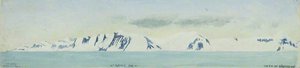
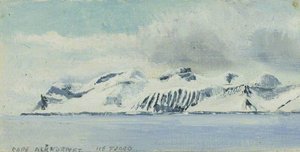
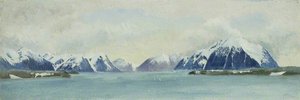
Among the pieces that define his career are The Alkhornet from within Ice Fiord and West Coast of Spitsbergen from Horn Sound. These works capture the quiet, heavy presence of the Arctic, focusing on the way light settles over desolate landscapes. His paintings often move beyond simple scenery, attempting to bridge the gap between the physical world and the philosophical ideas that occupied his mind. There is a sense of deep connection to the natural world in his brushwork, a desire to show how a landscape feels rather than just how it looks.
Pocock remains a significant voice within British Impressionism. His ability to translate the scale of the wilderness onto a canvas has left a mark on the history of landscape painting. Today, his work continues to find its way to new eyes, offering a way to see the wildness of the north through a lens of emotional truth. His paintings do not merely record a place; they hold a specific, quiet energy that still speaks to those who study the way he handled color and light.
Питання та відповіді
Чи можу я відвідати віртуальний музей творів Roger Pocock?
Можливий віртуальний візит: сторінка 3D-музей митця Roger Pocock дозволяє переглянути роботи автора у тривимірній галереї.
Де можна знайти роботи Roger Pocock, згруповані за ключовими словами?
Щоб знайти роботи Roger Pocock на певну тему, скористайтеся сторінкою митця За ключовими словами, де твори згруповані за ключовими словами.
Де я можу знайти статистику щодо творів Roger Pocock?
Статистика про роботи Roger Pocock доступна на сторінці Статистика відвідувань митця.
Чи можу я переглянути роботи Roger Pocock за кольоровим спектром?
Роботи Roger Pocock можна переглянути за кольором на сторінці Колірний спектр митця.