Гарантія повернення коштів протягом 30 днів Безкоштовна доставка по всьому світу
446 261витвори мистецтва 30 640художники 4 753музеї 32мова
Країна
Валюта
Мова
Ательє · Засн. 2015 · Париж, Франція
AllPaintingsStore
allpaintingsstore.com
Мій акаунт Список бажань Кошик

Авґуст Макке

1887 - 1914

Короткі факти

  • Best occasions: акцент
  • Mediums: олія на полотні
  • Died: 1914
  • Color intensity:
    • яскравий
    • збалансований
    • насичений
  • Lifespan: 27 years
  • Top-ranked work: Жінка в зеленому жилеті
  • Works on APS: 228
  • Nationality: Німеччина
  • Creative periods: mature period
  • Museums on APS:
    • Альбертіна
    • Альбертіна
    • Альбертіна
    • Альбертіна
    • Альбертіна
  • Розгорнути…
  • Room fit: вітальня
  • Born: 1887, Мецеде, Німеччина
  • Top 3 works:
    • Жінка в зеленому жилеті
    • Ландшафт з коровами та верблюдом
    • Ванюшки з містом на задньому плані
  • Copyright status: Public domain
  • Also known as:
    • August Robert Ludwig Macke
    • Макке
  • Gift suitability:
    • інше-не зазначено
    • other-none
  • Art period: Модерн і сучасне мистецтво
  • Typical colors: еспресо
  • Movements: expressionism

Вікторина з мистецтва

Для кожного питання є лише одна правильна відповідь.

Запитання 1:
Який художній рух найбільше вплинув на стилістичне розроблення творів Макке?
Запитання 2:
Який художник суттєво вплинув на Макке завдяки своєму стилю хроматичного кубізму, також відомому як орфізм?
Запитання 3:
В якому році August Macke трагічно загинув у Першій світовій війні?
Запитання 4:
Якою діяльністю Макке заробляв грошей на початку своєї кар'єри?
Запитання 5:
Який стиль Макке характеризується прагненням передати емоційний резонанс пейзажів та повсякденного життя, наповнених відчуттям радості та оптимізму?

A Life Cut Short: The Vibrant World of August Macke

August Robert Ludwig Macke, a name inextricably linked to the brief but intensely vibrant era of German Expressionism, lived a life tragically curtailed by the horrors of World War I. Born in Meschede, Westphalia, on January 3, 1887, his artistic journey was one of rapid transformation and passionate exploration – a relentless pursuit of capturing not just what he saw, but how he *felt* about it. From his early years spent amidst the coal-mining landscape of his hometown to his formative years in Bonn and later Düsseldorf, Macke’s life was shaped by an insatiable curiosity for new styles and a profound desire to translate the emotional resonance of the world onto canvas. His formal training at the Düsseldorf Art Academy (1904-1906) under Adolf Maennchen provided him with a solid foundation, but it was through independent study, travel, and encounters with groundbreaking artists that his unique voice truly began to emerge.

Influences and Artistic Evolution

Macke’s artistic trajectory was profoundly shaped by the currents of early 20th-century art. A pivotal moment arrived in Paris in 1912, where he encountered Robert Delaunay, a leading figure in Orphism – a branch of Cubism that prioritized pure abstraction and dazzling color harmonies. This encounter proved transformative, introducing Macke to the concept of simultaneous contrast and fundamentally altering his approach to composition. He began experimenting with broken planes of color, fragmented forms, and an emphasis on capturing the *feeling* of light and space rather than strict representational accuracy. Simultaneously, his close friendship with Franz Marc, a key member of Der Blaue Reiter (The Blue Rider), drew him into the orbit of Wassily Kandinsky and other avant-garde thinkers. While Macke’s style diverged from Kandinsky's more purely abstract explorations, he embraced the group’s spirit of artistic freedom and its exploration of spiritual themes. His early works often reflected this influence, displaying a sensitivity to color and form that foreshadowed his later developments. He also absorbed elements of Fauvism, particularly in his use of bold, non-naturalistic colors, and Futurism's emphasis on dynamism and movement.

The Blue Rider and the Pursuit of Harmony

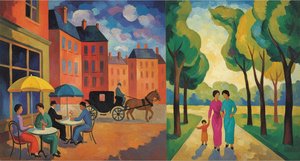
As an integral member of Der Blaue Reiter, Macke played a crucial role in shaping the group’s artistic direction and disseminating its radical ideas. The Blue Rider collective sought to break free from traditional academic constraints and explore new ways of expressing emotion and spirituality through art. Macke contributed significantly to their exhibitions and publications, helping to establish the movement's reputation for innovation and experimentation. However, he wasn’t simply a passive participant; he forged his own distinctive path within the group. Unlike some of his colleagues who leaned towards darker, more angst-ridden themes, Macke consistently sought to portray beauty and harmony in the world around him – capturing the joy of sunlight on water, the vitality of rural life, and the simple pleasures of everyday existence. His paintings, such as *Bathing Girls with Town in the Background*, exemplify this approach: vibrant colors, simplified forms, and a sense of idyllic tranquility characterize his work. He masterfully blended elements of Fauvism, Cubism, and Futurism into a uniquely personal style, creating compositions that are both visually arresting and emotionally resonant. Woman in a Green Jacket, painted in 1913, is another prime example – a portrait radiating warmth and vitality through its bold color palette and confident brushwork.

A Tragic End and Lasting Legacy

The outbreak of World War I brought an abrupt and devastating end to Macke’s promising career. Driven by patriotic fervor, he volunteered for military service in 1914, a decision that ultimately led to his tragic demise. He was killed in action on September 26th, near Champagne, France, at the young age of 27 – just weeks after arriving on the front lines. His final painting, *Farewell*, poignantly captures the somber mood that enveloped Europe as war engulfed the continent. Despite his untimely death, August Macke’s artistic legacy endures. He remains a significant figure in the history of Expressionism, celebrated for his vibrant colors, dynamic compositions, and optimistic vision. His paintings offer a powerful glimpse into a world on the cusp of change – a world grappling with uncertainty yet still imbued with beauty and hope.

Exploring Macke’s World Today

Today, August Macke's works are held in prestigious collections across the globe, including the Staatsgalerie Moderner Kunst in Munich, the Museum Ludwig in Cologne, and the Kunsthaus Zürich. Several museums dedicated to Expressionism prominently feature his paintings, providing visitors with a valuable opportunity to experience the power of his art firsthand. The Westfälisches Landesmuseum Münster and the Kunstmuseum Bonn are particularly noteworthy for their extensive holdings of Macke’s work. His influence can be seen in the continued exploration of color and emotion by contemporary artists. Resources like Artnet and Wikipedia provide invaluable biographical information and insights into his artistic development, allowing art enthusiasts to delve deeper into his world and appreciate the enduring appeal of this remarkable artist whose life was tragically cut short but whose legacy continues to shine brightly.