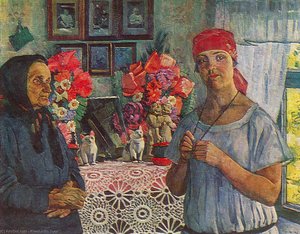
Early Life and Artistic Foundations
Konstantin Fyodorovich Yuon, born October 24, 1875 in Moscow, emerged from a family steeped in both Swiss-Russian heritage and artistic inclination. His brother, Paul Juon, would achieve renown as a composer, hinting at the creative currents flowing through their upbringing. From a young age, Konstantin demonstrated an affinity for visual expression, nurtured by a mother who fostered artistic pursuits within the home. This early exposure laid the groundwork for his formal education at the Moscow School of Painting, Sculpture and Architecture from 1892 to 1898. There, he came under the tutelage of distinguished masters like Konstantin Savitsky and Konstantin Korovin, absorbing their techniques and philosophies that would shape his initial artistic trajectory. These formative years weren’t confined to Russia; Yuon embarked on journeys to Western Europe, particularly Paris, where he encountered the burgeoning Impressionist movement. While captivated by artists such as Camille Pissarro, he didn't simply imitate—he synthesized these influences with a uniquely Russian sensibility, forging his own distinct style.
- Family Background: Yuon’s father was an employee of the insurance company, of Swiss-Russian origin (the surname *Juon* being of Walser origin), and his mother – of German family. This intertwined heritage instilled in him a profound appreciation for diverse artistic traditions.
- Education: He attended the Moscow School of Painting, Sculpture and Architecture from 1892 to 1898 where Konstantin Savitsky and Konstantin Korovin imparted invaluable knowledge and fostered his artistic development.
- Early Influences: The teachings of Savitsky and Korovin profoundly impacted Yuon’s stylistic choices, grounding him in the traditions of Russian academic painting.
From Symbolism to Soviet Realism
Yuon’s early work is characterized by an evocative blend of Impressionistic landscapes infused with subtle Symbolist undertones. Paintings like
To the Trinity (1903) and
Tverskoy Boulevard (1909) exemplify this period, capturing fleeting moments of light and atmosphere while hinting at deeper emotional resonances. He wasn’t content to remain solely within the realm of Impressionism; Yuon began experimenting with lyrical landscapes that incorporated elements drawn from traditional Russian art forms—the delicate precision of Palekh miniature painting and the spiritual depth of icon artistry. This fusion created a visual language uniquely his own, steeped in national identity yet open to innovation.
- Symbolist Tendencies: Yuon’s landscapes often conveyed profound emotional states through carefully considered color palettes and compositional arrangements—a hallmark of Symbolism's expressive aims.
- Fusion with Tradition: He skillfully blended Impressionistic techniques with stylistic elements reminiscent of Palekh miniature painting and icon artistry, reflecting Russia’s rich artistic heritage.
Notable Paintings: To the Trinity (1903),
Tverskoy Boulevard (1909),
New Planet (1912) – These works demonstrate Yuon's mastery of Impressionistic landscape painting and his exploration of Symbolist themes.
A Multifaceted Career and Institutional Leadership
Yuon’s artistic pursuits extended beyond the easel; he established a prestigious art school in Moscow, nurturing young talent and fostering the dissemination of artistic knowledge. He served as director of the Research Institute of the Academy of Arts (1948–1950), shaping the intellectual landscape of Soviet culture. Furthermore, Yuon held positions of considerable influence within the Union of Russian Artists (1956–1958) and the Association of Artists of Revolutionary Russia, actively guiding artistic policy during a pivotal moment in Soviet history.
- Art Education: He founded Moscow’s “Classes Drawing and Painting” school, attracting gifted students who would become prominent figures in Russian art.
- Academic Roles: Yuon served as director of the Research Institute of the Academy of Arts, contributing to scholarly research and artistic discourse.
- Organizational Leadership: He spearheaded the Union of Russian Artists and the Association of Artists of Revolutionary Russia, shaping the direction of Soviet art during the Cold War era.
Recognition: Yuon received numerous awards and honors for his contributions to Russian culture, including the Stalin Prize (1943) and the Order of Lenin—symbols of national esteem.
Legacy and Enduring Influence
Konstantin Yuon’s artistic legacy remains vibrant—a testament to an artist who seamlessly blended Impressionistic aesthetics with Symbolist spirituality and ultimately embraced Socialist Realism's commitment to social purpose. His paintings continue to inspire admiration for their technical brilliance and emotional resonance, securing his place as one of Russia’s most celebrated visual artists. He stands as a pivotal figure in Russian art history, bridging the gap between artistic traditions and ideological imperatives—a lasting tribute to Yuon’s remarkable creative journey.