The Post-War Crucible: The Emergence of Color Field from Abstract Expressionism
 Beyond the Brushstroke: A Definitive Guide to the Emotional Power of Color Field Painting
The Genesis of Abstraction: From Post-War Trauma to the Rise of Color Field Beyond Representation: Exploring the Emotional Landscape of Abstract Expressionism The Genesis of Feeling: Post-War America and the Rise of Abstract Expressionism The Raw Emo...
To understand the genesis of Color Field painting, one must first confront the heavy, fractured atmosphere of the mid-2 permitan century. The aftermath of World War II left a profound scar on the collective human psyche, creating a world grappling with unprecedented trauma, existential uncertainty, and the shattering of established social norms. In this climate of disillusionment, the New York art scene of the 1940s and 50s became a crucible for a seismic rupture from tradition. This was the era of Abstract Expressionism, a movement that rejected representational, religious, and classical motifs in favor of a defiant embrace of subjectivity.
Initially, this revolution manifested through the visceral, spontaneous energy of Action Painting. Artists like Jackson Pollock utilized drips and energetic gestures to turn the canvas into an arena of physical event, seeking to express inner anxieties and the subconscious mind. However, as the movement matured, a distinct current began to emerge—one that sought to move away from the theatricality and self-consciousness of the gestural brushstroke. This was the birth of Color Field painting, a movement born not from a desire for chaos, but from a search for a more fundamental, unmediated truth within the medium itself.
Beyond the Gesture: Defining the Aesthetics of Chromatic Abstraction
--- title: Colour field painting | Tate url: https://www.tate.org.uk/art/art-terms/c/colour-field-painting hostname: tate.org.uk description: Tate glossary definition for colour field painting: Term used to describe the work of abstract painters work...
Color Field painting represents a deliberate, disciplined stripping away of all extraneous elements to focus solely on the power of color. While its predecessor, Action Painting, emphasized the physical act of creation and the artist's struggle, Color Field painters sought to capture the essence of being through the unmediated power of color itself. It was not merely an abandonment of figuration; it was a pursuit of pure perception. These artists believed that color, when liberated from narrative constraints or recognizable imagery, could evoke profound emotional responses directly within the viewer.
The defining characteristics of this style are found in its large areas of more or less flat single colors and its rejection of the highly personal or painterly application associated with earlier gestural works. By eliminating the "hand" of the artist—the visible, frantic brushstroke—the work achieves a sense of timelessness and vastness. This approach transformed the canvas from a window into a world into an environment in itself. The focus shifted from the event of painting to the presence of color, creating a meditative space where the boundaries between the artwork and the observer begin to dissolve.
The Architecture of Emotion: Analyzing Masterworks by Rothko, Newman, and Still
 Abstract Expressionism's 10 Defining Masterpieces |
Introduction To gaze upon these ten canvases is to step into a realm where emotion reigns supreme, where the very act of painting became a visceral outpouring of the human spirit. The Abstract Expressionist movement, born in the aftermath of World Wa...
At the heart of this movement stand three titans whose work defines the very soul of chromatic abstraction: Mark Rothko, Barnett Newman, and Clyfford Still. To gaze upon their canvases is to step into a realm where emotion reigns supreme. For Mark Rothko, color was a vessel for the most basic human emotions—tragedy, ecstasy, and doom. His luminous, soft-edged rectangles of color seem to hover on the surface of the canvas, creating a sense of depth that invites the viewer into a state of profound contemplation.
Barnett Newman approached the canvas with a different kind of architectural rigor. He utilized "zips"—vertical bands of color that traverse the composition—to define space and create a sense of human scale within the vastness of his monochromatic fields. His work demands an encounter with the sublime, forcing the viewer to confront the sheer magnitude of the void. Meanwhile, Clyfford Still’s work offered a more rugged, textured approach, with jagged, flame-like shapes of color that seem to erupt from the canvas, embodying a raw, elemental energy. Together, these masters utilized the architecture of color to build cathedrals of emotion, proving that abstraction could reach depths of spiritual significance previously reserved for religious iconography.
The Evolution of Form: From Gestural Action Painting to Post-Painterly Abstraction
 Chromatic Atmospheres: Exploring the Philosophical Foundations of Color Field Painting
The Genesis of Abstraction: From Expressionism to Color Field Color-field painting | Abstract Expressionism, Minimalism, Post ... --- title: Color-field painting | Abstract Expressionism, Minimalism, Post-Painterly Abstraction, Artists, Mark Rothko, ...
As the 1960s approached, the movement underwent a further refinement, moving toward what critic Clement Greenberg famously termed "Post-Painterly Abstraction." This evolution saw artists like Helen Frankenthaler, Morris Louis, and Kenneth Noland pushing the boundaries of the medium even further. They sought to eliminate both the emotional, mythic, or religious content of the earlier movement and the highly personal application associated with it. The focus became even more purely abstract, emphasizing the physical properties of the paint and the flatness of the support.
Helen Frankenthaler’s revolutionary "soak-stain" technique—pouring thinned oil paint onto unprimed canvas—allowed the pigment to become one with the fabric, erasing the distinction between image and ground. This method paved the way for a new generation of artists who embraced a more lyrical, fluid approach to abstraction. The movement transitioned from the heavy, existential weight of the post-war years toward a more luminous, optical exploration of light and space. This progression demonstrates that abstraction is not a static destination but a continuous, evolving dialogue between the artist's intent and the physical reality of the medium.
The Sensory Experience: How Large-Scale Color Fields Transform Architectural Space
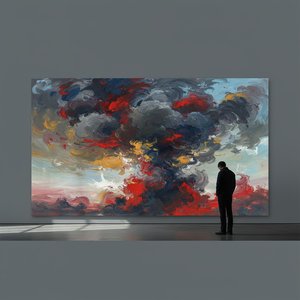
The true power of Color Field painting is realized only when experienced in person, particularly when confronted by its monumental scale. These are not merely paintings to be looked at; they are environments to be inhabited. The sheer size of the canvases demands a bodily engagement from the viewer, inviting a direct, almost primal connection with the work. When a large-scale Color Field painting occupies a wall, it does more than decorate a room—it redefines the very atmosphere of the architectural space.
The vast expansat of color can expand a room, creating an illusion of infinite depth, or it can ground a space with its intense, saturated weight. For collectors and enthusiasts seeking to bring this transformative power into their own environments, the tactile depth of a hand-painted oil reproduction offers a unique opportunity. Unlike a flat print, a masterfully executed oil painting on canvas retains the subtle textures and tonal ranges that allow the light to interact with the pigment, much like the original masterpieces. Whether through a single commanding piece or a multi-panel arrangement designed for a wide wall, the integration of Color Field aesthetics allows for the creation of a sanctuary of color and thought within any modern interior.
At AllPaintingsStore.com, we are dedicated to preserving this legacy of human creativity. Our mission is to make fine art accessible to everyone through museum-quality, hand-painted reproductions. Each of our works is meticulously crafted by artists holding degrees from prestigious academies, ensuring that the soul and texture of the original—the visible brushstrokes and deep tonal ranges—are captured with academic excellence. From custom commissions that allow you to "remix" art history to large-scale murals for architectural projects, we provide a bridge between the profound history of abstraction and the modern collector.