The Soul of Austrian Expressionism: The Life and Legacy of Anton Faistauer
In the turbulent landscape of early 20th-century Europe, few artists captured the profound psychological shifts of the era as poignantly as Anton Faistauer. Born in 1887 to a farming family near Maishofen, his path was not originally destined for the canvas; he initially harbored ambitions of entering the priesthood. However, fate intervened through a transformative encounter with Albert Paris Gütersloh at the gymnasium in Bolzano. This meeting ignited a passion for painting that would eventually lead him away from theology and toward the radical frontiers of the avant-garde. His formal training, which took him from the private Robert Scheffer Akademie to the prestigious Academy of Fine Arts in Vienna under masters like Alois Delug and Christian Griepenkerl, provided him with a technical foundation that he would later use to dismantle academic tradition.
Faistauer’s artistic identity was forged in rebellion. In 1909, he famously resigned from the Academy, a move that signaled his refusal to adhere to conservative, stagnant dogmas. Alongside luminaries such as Egon Schiele and Anton Kolig, he became a founding member of the Neukunstgruppe, a collective dedicated to protesting academic conventions and advocating for a more visceral, expressive mode of creation. This period of wandering and exploration—stretching through Ticino, Northern Italy, and Berlin—allowed him to absorb diverse influences, refining a style that blended the raw emotion of Expressionism with a unique, symbolic depth. His work began to move beyond mere representation, seeking instead to capture the spiritual and emotional essence of his subjects.
A Journey Through Light, Shadow, and War
The trajectory of Faistauer’s life was irrevocably altered by the shadows of World War I. Forced back to Maishofen and eventually drafted into the Austro-Hungarian army, he served in a capacity deemed "unsuitable" for combat, yet even amidst the upheaval of war, his creative spirit remained unextinguished. During this period, he maintained a profound connection to the art world, collaborating with Schiele on war art exhibitions and contributing to the reorganization of the Heeresgeschichtliches Museum. These years of forced stillness and military duty paradoxically provided a space for him to deepen his engagement with the symbolic power of art, using the era's collective trauma as a backdrop for his evolving visual language.
The post-war years brought both new beginnings and profound personal tragedy. Settling in Salzburg, Faistauer co-founded the radical group Der Wassermann, continuing his pursuit of experimental aesthetics. Yet, the triumphs of his professional life were often shadowed by loss; the death of his first wife on the eve of their inaugural exhibition cast a long gloom over his later years. Despite facing debilitating lung and stomach disorders that necessitated frequent therapeutic retreats to Bolzano, Faistauer’s productivity remained remarkable. He achieved significant recognition through major commissions, including breathtaking frescoes for the Kleines Festspielhaus in Salzburg and works for religious and aristocratic settings in Bamberg and Vienna.
Technique and the Expressionist Vision
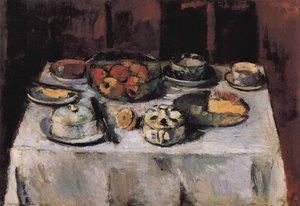
To look upon a Faistauer painting is to witness a masterclass in texture and emotional resonance. His technique often utilized a rich, textured impasto that gave his surfaces a tactile, living quality. Whether he was rendering a somber portrait or a quiet still life, his use of color was never merely decorative; it was deeply symbolic. In works such as German Gedeckter Tisch, one can observe a post-impressionistic approach where flattened perspectives and vibrant hues create a sense of structured intimacy. Conversely, his watercolors, like the poignant German Anbetung, demonstrate an ability to use transparency and light to evoke religious and spiritual fervor.
The enduring significance of Anton Faistauer lies in his ability to bridge the gap between the traditional and the radical. He did not simply reject the past; he reinterpreted it through a modern lens, infusing classical themes with the anxieties and intensities of the modern age. His legacy remains etched in the history of Austrian Expressionism, serving as a testament to an artist who, despite personal hardship and historical upheaval, remained steadfast in his quest to reveal the hidden truths of the human condition through the transformative power of paint.
问答详情
我可以在其所有作品中研究 Anton Faistauer 对色彩的运用吗?
Anton Faistauer 作品的色彩特征展示在艺术家的 色彩基因 页面上。
在哪里可以按关键词浏览 Anton Faistauer 的作品?
Anton Faistauer 的 关键词分类 页面通过关键词对艺术家的作品进行了分类。
我可以通过色调来浏览 Anton Faistauer 的作品吗?
按色调浏览 页面按色调将 Anton Faistauer 的艺术作品进行了分类。