100天退款保障 全球免运费
612379艺术品 52886艺术家 5406博物馆 32语言

雅克·利纳尔

1597 - 1645

基本信息

  • Topics explored:
    • still life
    • flowers
    • fruit
    • seashells
    • vase
  • Movements: baroque
  • Museums on this site:
    • 卢浮宫
    • 提森·博爾涅米薩博物館
    • 蒙特利尔美术馆
    • 印第安纳波利斯艺术博物馆
    • 普拉多博物馆
  • Died: 1645
  • Also known as:
    • 雅克·利纳德
    • Lienard
    • Linard
  • Copyright status: Public domain
  • Emotional tone: 沉思
  • Works on this site: 18

A Pioneer of French Still Life: The World of Jacques Linard

Jacques Linard, a name perhaps less instantly recognizable than some of his Baroque contemporaries, occupies a pivotal position in the development of still life painting in 17th-century France. Born in Troyes in 1597 and passing away in Paris in 1645, Linard wasn’t merely documenting objects; he was crafting poetic meditations on beauty, transience, and the burgeoning scientific curiosity of his age. His early life remains somewhat shrouded in mystery, though we know his father, Jehan Linard, was also a painter active in Troyes, suggesting an initial artistic grounding within the family workshop. Records place him in Paris by the 1620s, quickly establishing himself as a skilled artist and becoming part of the vibrant artistic community clustered around the Île de la Cité and later Saint-Nicolas-des-Champs. His marriage in 1626 to Marguerite Tréhoire, daughter of Parisian master painter Romain Tréhoire, further solidified his connections within the art world. By 1631, he had achieved the prestigious title of *Peintre et Valet de Chambre du Roi* under Louis XIII, a position that afforded him both recognition and financial stability.

From Flemish Roots to French Elegance

Linard’s artistic development was deeply influenced by the Northern Realist tradition, particularly the exquisite still lifes of Jan Brueghel the Elder. The meticulous detail, vibrant colors, and careful arrangement of objects characteristic of Brueghel are clearly visible in Linard's early works. However, he wasn’t simply a copyist. He infused his paintings with a distinctly French sensibility—a refined elegance and clarity that set him apart from his Flemish predecessors. While the Dutch masters were simultaneously revolutionizing still life with their hyperrealism and symbolic depth, Linard carved out a unique niche by blending meticulous observation with a poetic grace. His compositions often feature a harmonious balance of light and shadow, creating an atmosphere of quiet contemplation. He was among the first in France to explore thematic arrangements centered around the “Five Senses” and the “Four Elements,” transforming commonplace objects into allegorical representations of human experience.

The Language of Objects: Symbolism and Meaning

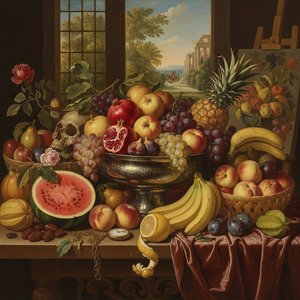
Linard’s still lifes are far from mere depictions of fruit, flowers, or shells. They are imbued with a rich layer of symbolism that reflects the intellectual currents of his time. Exotic fruits like peaches and grapes weren't just visually appealing; they represented abundance, prosperity, and even sensual pleasure. Shells, prized as *mirabilia*—rare and fascinating objects collected by connoisseurs—evoked luxury, travel, and the wonders of the natural world. Coral, with its resemblance to blood vessels, carried religious connotations, symbolizing Christ’s sacrifice and protection against evil. The inclusion of musical instruments or playing cards hinted at the fleeting nature of earthly delights. His paintings invite viewers not just to admire their beauty but also to contemplate deeper themes of mortality, spirituality, and the passage of time. This subtle yet profound symbolism distinguishes his work from purely decorative still lifes.

A Lasting Legacy: Inspiring a Generation

Though only around fifty works are definitively attributed to Linard today, his influence on French painting was considerable. He is credited with pioneering the thematic still life in France and inspiring artists like Louise Moillon, who would become the most celebrated female still-life painter of her era. Linard’s ability to combine meticulous realism with poetic elegance established a new standard for the genre. His compositions often featured delicate brushwork and vibrant colors, creating an atmosphere of quiet contemplation that resonated with contemporary audiences. Works like “Basket of Flowers,” now housed in the Louvre, demonstrate his mastery of technique and his keen eye for detail. The poem inscribed on a cup within one painting—a verse by the famous Chinese poet Su Shi—reveals a broader cultural awareness and intellectual curiosity. His paintings weren’t simply about what they depicted; they were about how those depictions connected to a wider world of knowledge, beauty, and meaning. Linard's legacy lies not just in his beautiful creations but also in his role as a catalyst for the flourishing of still life painting in 17th-century France.

趣味测试

每道题只有一个正确答案。

题目 1:
雅克·利纳尔出生在哪个城市?
题目 2:
雅克·利纳尔擅长创作哪种类型的绘画?
题目 3:
雅克·利纳尔主要活跃在哪个世纪?
题目 4:
利纳尔在1631年被任命了什么职位?
题目 5:
利纳尔的作品被认为启发了哪位艺术家?

问答详情

雅克·利纳尔 使用了哪些媒介?

本网站上列出的 雅克·利纳尔 的作品主要采用 布面油画 及 油彩 创作。

我可以购买 雅克·利纳尔 作品的复制品吗?

是的。请查看雅克·利纳尔绘画复制品目录,提供手绘油画及版画两种形式。

雅克·利纳尔 属于哪种艺术流派?

雅克·利纳尔 是 著名的 Baroque 艺术家之一。

雅克·利纳尔 出生于何时何地?

雅克·利纳尔 于 1597 出生于 特鲁瓦。

雅克·利纳尔 的创作时期属于哪个历史阶段?

雅克·利纳尔 的创作活跃于 近代早期 时期,这一时期确立了艺术家在艺术史上的地位。

雅克·利纳尔 去世于何时?

雅克·利纳尔于1645逝世,享年约48岁。

雅克·利纳尔 最早和最晚的画作是什么?

雅克·利纳尔 最常描绘的主题是什么?

雅克·利纳尔作品中最常出现的题材包括 still life, flowers 及 fruit。点击查看 雅克·利纳尔 所创作的题材。

雅克·利纳尔 最著名的画作有哪些?