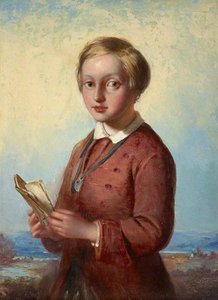
Early Life, Family and Artistic Training
James Eckford Lauder was born on 15 August 1811 at Silvermills, Edinburgh. He was the fifth and youngest son of John Lauder of Silvermills and Helen née Tait. Growing up within a family connected to the local tannery trade, he was surrounded by the industrious rhythms of Edinburgh. His path toward a life of painting was quietly shaped by his elder brother, Robert Scott Lauder, who recognized the boy's early inclinations and fostered his passion for art. This familial encouragement provided the necessary foundation for a career that would eventually move beyond the confines of his domestic origins.
His formal education began at the Edinburgh Academy, where he studied from 1824 to 1828. During these formative years, he developed the technical discipline required for professional work. He refined his skills under the tutelage of William Allan and Thomas Duncan, two figures who helped instill in him a respect for classical ideals. This period of study was essential in preparing him for the complexities of composition and form that would define his later output.
Professional Recognition and Academy Membership
Upon returning to Edinburgh from his years in Italy, Lauder established himself within the institutional framework of the Scottish art scene. He became an annual contributor to the Exhibitions of the Royal Scottish Academy, a presence that signaled his growing influence in the local landscape. His reach extended beyond his home city through occasional exhibitions at the Royal Academy in London, where his work drew significant attention from the public and his peers alike.
His ascent within the Royal Scottish Academy was marked by steady professional advancement. In 1839, he was elected an associate of the Academy, a distinction that recognized his technical proficiency and his place among the leading painters of the era. By 1846, he achieved the status of a full member, earning the right to use the postnominal 'RSA' after his name. This membership solidified his standing within the academic establishment during the mid-Victorian period.
His reputation was further bolstered by competitive success in prestigious venues. In 1847, he entered a competition at Westminster Hall, where his work was awarded a premium of two hundred pounds. This recognition highlighted his ability to engage with the broader British artistic community through both painting and engraving.
Key Works and Literary Themes
Lauder’s brush was frequently guided by the literary landscapes of Sir Walter Scott. He sought to translate the romanticized history of Scotland into visual narratives, often drawing his subject matter directly from the novelist's works. This preoccupation with storytelling allowed him to explore dramatic human emotions through historical settings. His ability to render these scenes helped establish his reputation for portraying significant moments with a sense of gravity and purpose.
His output was not limited to the literary realm; he also turned his attention to portraits and depictions of industrial progress. In 1855, he painted James Watt and the Steam Engine, a work that captured a defining moment of the nineteenth century. This departure from historical fiction toward contemporary technological advancement demonstrated the breadth of his interests. Whether depicting a quiet domestic scene or a monumental figure of science, his compositions remained focused on the character of the subject.
Several of his most significant paintings highlight his technical command over light and narrative. These works include:
- Scene from The Two Gentlemen of Verona (1841)
- Hagar
- The Wise and Foolish Virgins
Later Years and Death in Edinburgh
The final years of James Eckford Lauder’s life were marked by a quiet, solitary existence. He never married, remaining focused on the demands of his craft and the professional circles of the Scottish art scene. His dedication to his work was absolute, a commitment that eventually took its toll on his physical strength. On 27 March 1869, he passed away at 16 Salisbury Street in Edinburgh. The cause of death was recorded as exhaustion, a quiet end for a man who had spent his life translating complex narratives into visual form.
He was laid to rest in Warriston Cemetery. There, he lies alongside his brother, Robert Scott Lauder, in a shared resting place on the eastern edge of the westmost path. Their proximity in death reflects the deep bond that had fueled his early career, as it was his brother who had first recognized his talent and encouraged his studies in Italy. Even in his final years, the shadow of his family's artistic lineage remained a constant, grounding him to the city of his birth.
Legacy and Presence in Museums
The physical remnants of Lauder’s career are distributed across several significant collections, ensuring his presence in the study of Scottish art. His works are held within the National Gallery of Scotland and the Scottish National Portrait Gallery in Edinburgh. These institutions preserve the visual record of his engagement with the historical and literary themes that defined his professional life. Beyond the borders of Scotland, his paintings are part of the collection at the Walker Art Gallery in Liverpool.
His artistic legacy continues to resonate with audiences worldwide. Through these various repositories, his ability to translate narrative scenes into oil and panel remains accessible to scholars and viewers alike. The preservation of his output in such prominent galleries ensures that his specific contribution to the mid-Victorian era remains a part of the public record.