The Architect of Royal Identity: The Life and Legacy of Marcin Kober
In the grand, sweeping tapestry of Central European history, few artists have played as vital a role in weaving the visual identity of monarchs as Marcin Kober. Born around 1550 in the vibrant city of Wrocław, Poland, Kober was far more than a mere chronicler of faces; he was a pioneer who transformed the way power was perceived and recorded. His journey began not in the courts of kings, but through the rigorous discipline of the guild system. As a young journeyman, he traveled through Germany, absorbing the diverse techniques and stylistic nuances of various workshops. This period of wandering was essential, providing him with a cosmopolitan artistic vocabulary that would later allow him to bridge the gap between the local traditions of the Polish-Lithuanian Commonwealth and the sophisticated, Spanish-influenced aesthetics of the Habsburg courts.
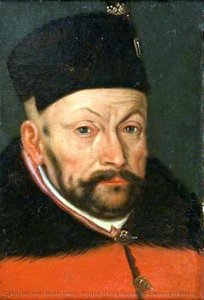
The true metamorphosis of Kober’s career occurred when his path intersected with the highest echelons of European royalty. By 1583, he had arrived in the Polish-Lithuanian Commonwealth, quickly ascending to the position of court painter for King Stephen Báthory and Queen Anna Jagiellon. It was during this era that Kober began to develop what would become known as the "Báthory School." His work during this period was characterized by a profound sense of Renaissance realism, where the physical likeness of the subject was married to a symbolic grandeur. He did not simply paint skin and fabric; he painted authority, legitimacy, and the divine right of kings. His ability to capture the commanding presence of Báthory established a visual language for Polish royalty that would endure for well over a century.
A Master of Courtly Elegance and Symbolism
Kober’s artistic evolution was deeply shaped by his time in Prague, a city that served as a melting pot of international styles under the reign of Emperor Rudolf II. In the vibrant atmosphere of the Imperial court, Kober encountered the subtle, decorative elegance of Spanish portraiture, which favored a meticulous attention to detail and a refined use of color. This influence is palpable in his later works, where the heavy, regal textures of velvet and lace are rendered with such precision that they seem almost tactile. His portraits became masterclasses in psychological depth; he possessed a rare ability to present a sovereign as both an untouchable icon of state and a human being possessing quiet strength and introspective grace.
The breadth of his technical mastery is perhaps best seen in the diversity of his formats. While his large-scale royal portraits commanded the halls of palaces, Kober also excelled in the intimate medium of miniatures. His Miniature of Queen Anna Habsburg serves as a breathtaking example of how he could condense an entire aura of majesty into a small, oval frame. In these smaller works, every brushstroke carries weight, using light and shadow to create a sense of three-dimensional life that transcends the physical limitations of the medium. His work was never merely decorative; it was a carefully constructed instrument of diplomacy and propaganda, designed to project an image of stability and continuity during turbulent political eras.
Historical Significance and the Polish Portrait Tradition
The historical importance of Marcin Kober cannot be overstated. Before his emergence, portraiture in Poland had not yet established itself as a dominant or specialized branch of fine art. Kober changed this trajectory forever, acting as the precursor to the Polish Sarmatian portrait genre. By integrating the sophisticated humanist ideals of the Renaissance with the specific cultural identity of the Polish nobility, he provided the foundation upon which future generations of Polish artists would build. His influence can be traced through the decades, as the iconography he established for the Vasa dynasty became the standard for how the Commonwealth viewed its own leadership.
Even as his career took him across borders—from the workshops of Germany to the Imperial splendor of Prague and back to the royal centers of Kraków and Warsaw—his core mission remained the same: the documentation of a changing world through the lens of royal dignity. Today, his works reside in prestigious museums across Europe, serving as silent witnesses to the grandeur of a bygone era. To study Kober is to study the very birth of a national artistic identity, making him one of the most significant figures in the history of Central European portraiture.
问答详情
Marcin Kober 是否还有其他别名或曾用名?
Marcin Kober 也被称为 Martin Kober。
我可以通过色谱来探索 Marcin Kober 的作品吗?
您可以在Marcin Kober的色彩索引页面上按色彩探索其作品。
在哪里可以按技法分类浏览 Marcin Kober 的作品?
若要查找Marcin Kober在特定媒介下的所有作品,请访问艺术家的所有媒介页面。