The Life and Style of William D Moore
The artistic output of William D Moore is defined by a focused period of production during the early 1930s. His catalog reveals a painter preoccupied with the quietude of domestic arrangements and the structural simplicity of the natural world. Between 1931 and 1932, he produced a series of works that moved from the specific to the general, capturing moments of stillness through varied subjects. His hand was as comfortable with the delicate petals of a floral arrangement as it was with the more formal presence of a portrait.
In his still life compositions, Moore sought to find order within the arrangement of objects. He rendered Still Life, Flowers about 1932, a work that shares a thematic kinship with his Tulips and Daffodils from about 1932. These studies of botanical life were accompanied by other explorations of the genre, including Still Life, Vase of Flowers and a more direct Still Life, both dating from about 1932. These works suggest a disciplined observation of light and form as it settles upon the inanimate.
Beyond the arrangement of objects, Moore turned his attention to the human element and the broader landscape. His portraiture includes Miss Doris Moore, a piece that provides a personal counterpoint to his more observational studies. The intimacy of his subject matter is further reflected in Mother, painted about 1932. Whether through the study of a single figure or the careful placement of a vase, his work from this era remains anchored in the tangible realities of his immediate surroundings.
Notable Works and Landscapes of Derbyshire
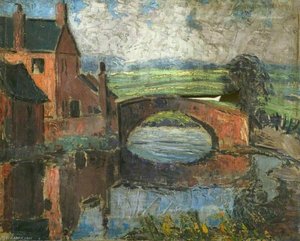
The artist’s connection to the English countryside is most clearly seen in his depictions of Derbyshire. Around 1931, he captured the industrial character of the region in Bennerley Ironworks, Derbyshire. This period also saw him turning his attention to more serene rural settings, such as Bridge, Cotmanhay, Derbyshire, painted about 1931. These works suggest a man deeply observant of the shifting textures of the landscape, from the heavy presence of industry to the quietude of a village setting.
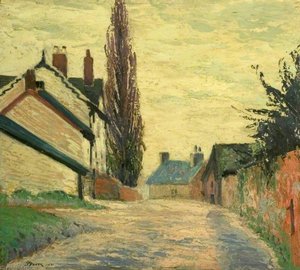
His interest in local life extended to the depiction of communal spaces and transit. He produced a Derbyshire Village about 1931, offering a glimpse into the organized structures of rural existence. By about 1932, his focus shifted toward the movement of the road in Heanor Lane, Derbyshire. Even in his more atmospheric compositions, such as Winter, dated about 1931, there is a sense of the starkness found in the natural world. These pieces reflect a steady, methodical approach to the environment surrounding him.
Beyond the borders of Derbyshire, his vision reached into neighboring territories. He painted A Leicestershire Village, though the date of this work remains unknown. Through these various landscapes and local scenes, he documented a specific era of English topography, recording the interplay between the built environment and the natural terrain.
问答详情
William D Moore 的作品受欢迎程度如何?
有关 William D Moore 作品的统计数据,请参阅艺术家的 统计数据 页面。
在哪里可以按颜色分类查看William D Moore的艺术作品?
您可以在William D Moore的色彩索引页面上按色彩探索其作品。
在哪里可以按氛围浏览 William D Moore 的作品?
艺术家的 情境空间 页面按氛围分类展示了 William D Moore 的艺术作品。
目前目录中共有多少件 William D Moore 的作品可供浏览?
您可以在 全部作品 页面浏览由 William D Moore 创作的 13 件作品 件作品。