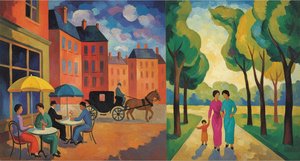
1913. Acrylic On Canvas, 810.0 x 1050.0 cm. Kunstpalast.

§ 1بيانات الكتالوج

- 810.0 x 1050.0 cm


§ 2تجريدي
وصف القطعة المقتناة
Experience 'Four Girls' by August Macke – a vibrant 1913 painting capturing youthful joy amidst nature’s beauty. A masterpiece of German Expressionism, showcasing color and form in Bonn.
 عرض المزيد
السيرة الذاتية للفنان
اكتشف لوحات أوغست ماكه التعبيرية النابضة بالحياة (1887-1914). تأثر بالفوفية والأورفية، ورسم الحياة الحديثة بألوان جريئة وبراعة فنية. شخصية رئيسية في حركة الفارس الأزرق.
§ 3تعليق
August Macke’s “Four Girls”: A Window into German Expressionism
August Macke's "Four Girls," painted in 1913, stands as a pivotal work within the artist’s trajectory and a compelling example of the burgeoning movement towards abstraction that was reshaping European art at the time. Created during a remarkably productive period in Bonn, this painting embodies Macke’s shift away from purely representational forms toward a more emotionally charged and visually dynamic style – a hallmark of his engagement with both German Expressionism and the innovative approaches emerging from Paris.
- A Moment of Leisure: The scene depicts four young women enjoying an idyllic moment in a woodland setting. Their relaxed postures and apparent camaraderie evoke a sense of youthful joy and freedom, capturing a fleeting instance of everyday life with remarkable sensitivity.
- Rhythmic Colour Harmonies: Macke’s masterful use of colour is central to the painting's impact. Drawing inspiration from Robert Delaunay’s Orphism – a movement characterized by its exploration of simultaneous contrasts and rhythmic colour combinations – Macke employs bold, saturated hues that vibrate with energy and create a powerful visual effect.
- Simplified Forms: The figures themselves are rendered in simplified forms, almost icon-like in their clarity. This deliberate reduction of detail contributes to the painting’s decorative quality and emphasizes its ornamental two-dimensionality, reflecting Macke's move away from traditional perspective and realism.
The Context of a Shifting Artistic Landscape
Painted in 1913, “Four Girls” reflects a crucial moment in art history – the collision of Impressionism’s influence with the rising tide of German Expressionism. Macke, like many artists of his generation, was grappling with the rapid changes occurring in Paris and seeking to synthesize these diverse influences into a uniquely German aesthetic. The painting's rhythmic colour harmonies and simplified forms align with the Blaue Reiter group’s exploration of abstraction and emotional expression, while simultaneously retaining a distinctly Impressionistic sensibility in its focus on light and atmosphere.
Macke’s artistic journey was profoundly shaped by his travels and intellectual explorations. His time in Tunis in 1914 further intensified his experimentation with transparency, flatness, and abstract forms, anticipating the developments of Cubism and Abstraction that would dominate the art world in the years to come.
Technique and Materials
Macke’s technique is characterized by a confident brushstroke and a deliberate layering of colour. He employed a palette knife alongside traditional brushes to build up thick impasto surfaces, creating a tactile quality that adds to the painting's visual richness. The use of pure pigments, combined with Macke’s innovative approach to colour mixing, results in vibrant, luminous tones that seem to shimmer and vibrate on the canvas. The scale of this artwork – 810 x 1050 cm – further amplifies its impact, allowing for an immersive experience of colour and form.
Symbolism and Emotional Resonance
"Four Girls" transcends a simple portrait; it’s a meditation on youth, leisure, and the beauty of nature. The presence of the dog and handbag adds subtle details that enhance the sense of everyday life and human connection. Macke's ability to capture not just the outward appearance of his subjects but also their inner emotions is what elevates this work beyond mere representation. It speaks to a yearning for simplicity, harmony, and the joy of shared experience – themes that resonate deeply with viewers even today.
الأسئلة والأجوبة
إلى أي مرحلة من مراحل تطور أوغست ماكه ينتمي العمل "Four Girls"؟
ينتمي العمل "Four Girls" إلى الفترة Late Period من مسيرة أوغست ماكه المهنية، مما يربط هذا العمل بمراحل تطور الفنان الفني.
متى أُبدع "Four Girls" للفنان أوغست ماكه وما هو أسلوبه الفني؟
أُنجزت لوحة "Four Girls" في عام 1913، ضمن حركة German Expressionism.
ما هو اللون الطاغي على "Four Girls"؟
يتخلل اللون Ochre to Sepia أرجاء لوحة "Four Girls" للفنان أوغست ماكه.


 التبديل إلى نسخة مطبوعة


 بالنسبة للأعمال الفنية أو النسخ المطبوعة التي يتجاوز طول أي من أضلاعها 105 سم (حوالي 41 بوصة)، سيتم شحن الإطار كمجموعة مفككة؛ حيث تضمن هذه الطريقة سلامة التوصيل وتمنع حدوث أي أضرار أثناء النقل.