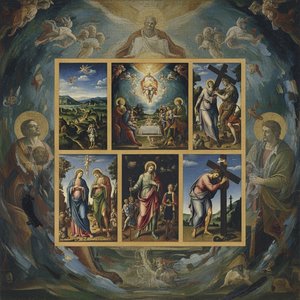
The Bridge Between Two Worlds
Pedro Berruguete stands as a pivotal figure in the annals of Spanish art history, serving as the essential conduit between the solemn grandeur of the Gothic tradition and the burgeoning optimism of the Italian Renaissance. Born in Paredes de Nava, Castile, his life unfolded during a transformative era when the visual language of Europe was undergoing a profound metamorphosis. While the exact details of his early years remain somewhat shrouded in the vagueness characteristic of many artists of his time, his lineage traced back to noble families, providing him with a foundation that would eventually allow him to reshape the artistic landscape of Spain.
His artistic journey is defined by a remarkable duality. Berruguete emerged from the shadow of Gothic painting, absorbing its expressive fervor, meticulous detail, and spiritual intensity. Yet, he was simultaneously captivated by the humanist ideals and geometric precision championed by the Florentine masters. This synthesis created an eclectic style that was uniquely his own—a mixture of Flemish techniques, Spanish Gothic elements, and the light and space mastered in Italy. In his hands, stylized figures and heavy drapery coexisted with a new, sophisticated understanding of atmosphere and architectural framing.
A Journey Through Italy and Castile
The trajectory of Berruguete’s career was significantly altered by his travels to Italy, most notably around 1480. Evidence suggests he spent time within the vibrant artistic environment of Federico III da Montefeltro's court in Urbino. It was here that the influence of the Italian Renaissance truly permeated his technique. Immersed in a world of classical models and the works of masters like Melozzo da Forlì, Berruguete learned to manipulate light and space with newfound grace. Though he retained his Flemish training—evident in his use of tempera grassa and an exquisite attention to texture—his work began to reflect the structural clarity and humanistic depth found in the Italian peninsula.
Upon returning to Spain around 1482, Berruguete established himself as a leading master in cities such as Toledo and Ávila. He became a sought-after creator of breathtaking retablo panels for Castilian churches, demonstrating a technical prowess that could convey profound spiritual narratives to the faithful. His commissions were not merely decorative but served as monumental religious landmarks. Whether working on the walls of the Toledo Cathedral or the altarpieces in his native Paredes de Nava, he brought a sense of dignity and elegance to every surface, often utilizing brocadeado and gold decoration to elevate the sacred subjects he depicted.
Legacy and Artistic Significance
Beyond his individual canvases, Berruguete’s historical significance is cemented by his role as a patriarch of Spanish art. He was the father of Alonso Berruguete, who would go on to become arguably Spain’s greatest sculptor of the Renaissance. This familial connection established a powerful tradition of artistic innovation within Castile, where the mastery of the father nurtured the revolutionary talent of the son. The distinction between Berruguete el Viejo and his son reflects the broader cultural shift occurring in Spain, as older masters provided the foundation upon which new, more dynamic styles could be built.
The attribution of his works remains a complex task for historians due to the absence of signatures, yet his unmistakable style—characterized by unique facial features, focused gazes, and a masterful use of architectural depth—links him to numerous masterpieces. His oeuvre captures the very essence of an era marked by religious upheaval and intellectual rebirth. From the dramatic tension in his depictions of the early Inquisition to the serene majesty of his religious imagery, Pedro Berruguete remains a beacon of artistic transition, embodying a nation that was learning to embrace new horizons while deeply honoring its venerable past.
الأسئلة والأجوبة
في أي حقبة تاريخية عمل بيدرو بيرغويتي؟
عمل بيدرو بيرغويتي خلال حقبة عصر النهضة. وتحدد هذه الحقبة موقع نشاط الفنان في التاريخ.
هل يوجد سجل زمني لمسيرة بيدرو بيرغويتي؟
يتوفر عرض زمني لأعمال بيدرو بيرغويتي عبر صفحة سجل زمني الخاصة بالفنان، حيث تتدفق الأعمال الفنية بترتيب إنتاجها، فصلاً تلو الآخر.
من أي بلد ينتمي بيدرو بيرغويتي؟
وُلد بيدرو بيرغويتي في إسبانيا.