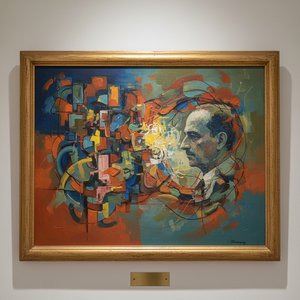
The Soul of Catalonia: The Life and Art of Dionisio Baixeras Verdaguer
Dionisio Baixeras i Verdaguer, a name synonymous with the tender observation of human existence, stands as a luminous figure in the tapestry of Catalan art history. Born in Barcelona in 1862, Baixeras did not merely paint scenes; he captured the very breath of his era. His journey began within the hallowed halls of the La Lonja School of Fine Arts, where he was nurtured by the disciplined hands of masters such as Agustín Rigalt, Martí Alsina, and Antonio Caba. These early mentors instilled in him a profound respect for the foundations of classical technique, yet Baixeras possessed an innate restlessness that would eventually lead him far beyond the borders of his native city to seek new light and broader horizons.
The trajectory of his career was irrevocably altered by his transformative years in Paris. Moving to the French capital at the age of twenty-four, Baixeras immersed himself in a landscape of intense artistic experimentation. It was here that he encountered the profound realism of Jean-François Millet and the naturalistic precision of Jules Bastien-LePage and Pascal Dagnan-Bouveret. These masters taught him that there was a sacred dignity to be found in the mundane—that a peasant’s toil or a fisherman’s rest held as much narrative weight as any grand historical epic. This Parisian influence infused his work with a delicate balance of Impressionist light and a steadfast commitment to the truth of the human condition, a duality that would become his artistic hallmark.
A Tapestry of Everyday Life and Orientalist Echoes
Upon his return to Barcelona, Baixeras emerged as a central pillar of the vibrant Cercle Artístic de Sant Lluc. This influential collective, which included luminaries like the Llimona brothers and even the visionary architect Antoni Gaudí, provided a fertile ground for his burgeoning style. His oeuvre became a masterful exploration of Costumbrismo—the depiction of local customs and daily life—intertwined with the exotic allure of Orientalism. He possessed a unique ability to pivot between the intimate domesticity of Catalan fishing families and the grand, evocative atmospheres of historical Moorish Spain.
His canvases often serve as windows into a vanishing world. Whether he was rendering the salt-sprayed textures of maritime landscapes or the quiet shadows of an interior, his brushwork remained meticulously detailed yet emotionally resonant. Some of his most celebrated achievements include:
- Boatmen of Barcelona: A work that marked his international debut at the Paris Salon of 1886, capturing the dignified labor of mariners with a vantage point so intimate it invites the viewer onto the boat itself.
- Abd al-Rahman III Receiving the Ambassador: A stunning display of his Orientalist mastery, where he reconstructed the grandeur of the Cordoban court with historical reverence.
- En la Playa: An evocative piece that showcases his ability to weave together the textures of sand, sea, and the rhythmic pulse of family life along the Spanish coast.
Legacy and Historical Significance
The enduring significance of Dionisio Baixeras Verdaguer lies in his role as a bridge between traditions. He successfully synthesized the rigorous naturalism of the late 19th century with the burgeoning light-filled sensibilities of the modern age. His work does not merely document history; it preserves the emotional atmosphere of a period defined by transition. Through his eyes, we witness the quiet strength of the working class and the romanticized splendor of a shared Mediterranean heritage.
Today, his legacy is preserved in prestigious institutions such as the Metropolitan Museum of Art in New York and the Musée d'art et d'industrie de Roubaix in France. As we look upon his paintings, we are reminded that true artistry lies in the ability to find the extraordinary within the ordinary, turning a simple moment on a Catalan beach or a conversation between boatmen into an eternal fragment of human history.
الأسئلة والأجوبة
كيف يمكنني متابعة أعمال Dionisio Baixeras Verdaguer عاماً بعد عام؟
يوجد جدول زمني لأعمال Dionisio Baixeras Verdaguer: حيث ترتب صفحة الخط الزمني للأعمال الفنية الخاصة بالفنان الأعمال الفنية حسب تاريخ إنشائها.
هل يمكنني زيارة متحف افتراضي لأعمال Dionisio Baixeras Verdaguer؟
تُعد متحف ثلاثي الأبعاد الخاصة بـ Dionisio Baixeras Verdaguer صفحة تعرض أعمال الفنان في معرض افتراضي ثلاثي الأبعاد.
كم عدد الأعمال الفنية المتاحة لتصفحها لـ Dionisio Baixeras Verdaguer؟
يمكنك تصفح 7 أعمال فنية من أعمال Dionisio Baixeras Verdaguer في صفحة جميع الأعمال الفنية.