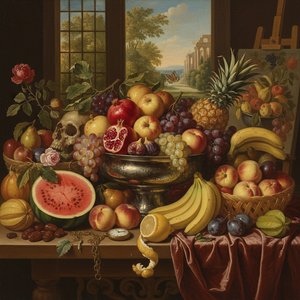
Emilie Preyer: A Delicate Dance Between Observation and Impression
Emilie Preyer (1849–1930) stands as a testament to the quiet brilliance of Düsseldorf’s artistic landscape at the turn of the century—a painter who captured fleeting beauty with remarkable precision and imbued her canvases with an undeniable sense of atmosphere. Born on 6 June 1849 in Düsseldorf, Germany, she was raised within a family steeped in profound artistic tradition. This lineage of craftsmanship was perhaps her most significant early inheritance; she benefited from the direct tutelage of her father, Johann Wilhelm Preyer, himself a celebrated master of still life and a prominent figure of the Düsseldorf school. Under his guidance, Emilie developed a meticulous eye for botanical detail, establishing a lifelong dedication to the nuanced study of the natural world.
Her oeuvre primarily consisted of stunning floral arrangements and fruit studies—particularly peaches, apricots, and grapes—executed with a masterful, almost meditative technique. While her contemporaries in the Impressionist movement often sought to capture the immediate, fractured sensory experience of light, Preyer’s style leaned towards a more contemplative observation. She prioritized subtle gradations of color and light to convey the true essence of her subjects rather than merely replicating their surface appearance. This deliberate restraint lends her paintings an enduring quality, allowing them to resist the ephemeral nature of fleeting moments and instead offer a sense of permanent, serene elegance.
The Intersection of Tradition and Art Nouveau
As her career progressed, Preyer’s work began to reflect the broader cultural shifts occurring across Europe. A significant element informing her artistic vision was the burgeoning Art Nouveau movement. The flowing lines, organic forms, and decorative motifs characteristic of this era found a natural resonance within her compositions. One can observe this influence in the graceful curves of petals and the rhythmic arrangement of branches, which mirrored the stylistic ideals of the time. This connection speaks to a broader cultural preoccupation with natural beauty and the elevation of craftsmanship during Preyer’s lifetime.
Her technical development was marked by an ability to balance the rigid precision of her father's Biedermeier-influenced training with a softer, more atmospheric approach. Her paintings often feature:
- Lush botanical textures: The velvety skin of a peach or the translucent sheen of a grape cluster.
- Atmospheric light: A soft, diffused glow that breathes life into still compositions.
- Compositional harmony: An arrangement of elements that feels both organic and carefully curated.
Legacy and International Recognition
Throughout her long and productive career, Emilie Preyer achieved considerable acclaim within German artistic circles. Her works were exhibited regularly at Düsseldorf’s Kunsthalle, earning recognition from prominent collectors and critics alike. Beyond the borders of Germany, she secured a significant following among American patrons, who were deeply moved by her ability to translate the serene elegance of nature into much-coveted fine art. This international reach ensured that her influence extended far beyond the Rhine.
Preyer’s historical significance lies in her role as a bridge between the meticulous realism of the 19th-century Düsseldorf school and the more decorative, fluid sensibilities of the early 20th century. She died on 23 September 1930, in her beloved Düsseldorf, leaving behind a body of work that remains a masterclass in the art of seeing. Today, her paintings serve as windows into a lost era of quiet observation, reminding us of the profound beauty found in the simplest of natural forms.
الأسئلة والأجوبة
كيف يمكنني العثور على أعمال Emilie Preyer ضمن لوحة ألوان محددة؟
يمكنك تصفح أعمال Emilie Preyer حسب لوحة الألوان في صفحة حسب لوحة الألوان الخاصة بالفنان.
هل يمكنني زيارة متحف افتراضي لأعمال Emilie Preyer؟
الزيارة الافتراضية ممكنة: حيث تعرض صفحة متحف ثلاثي الأبعاد الخاصة بـ Emilie Preyer أعمال الفنان في معرض ثلاثي الأبعاد.
هل يوجد تسلسل زمني لأعمال Emilie Preyer؟
يمكن مشاهدة أعمال Emilie Preyer الفنية مرتبة زمنياً في صفحة الخط الزمني للأعمال الفنية الخاصة بالفنان.