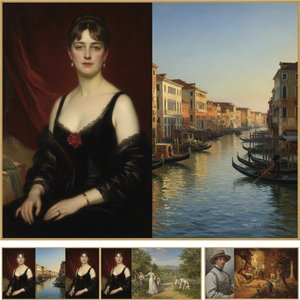
A Legacy of Royal Splendor: The Life and Art of John Partridge
In the grand, sweeping tapestry of the Victorian era, few artists captured the dignified essence of the age quite like John Partridge. Born in Glasgow in 1789, Partridge emerged from a family steeped in intellectual and creative pursuits, carrying with him a lineage that would see his brother rise to prominence in the medical sciences and his nephew find fame in the theatrical arts. His journey into the heart of the British art world began not merely as an observer, but as a dedicated student of the craft, honing his vision under the esteemed portraitist Thomas Phillips. By 1815, when he debuted ‘Miss Foote in the Character of Lucilla’ at the Royal Academy, Partridge had already begun to signal the arrival of a master who could blend the meticulous precision of academic realism with a profound, soulful depth.
The evolution of Partridge’s artistry was profoundly shaped by his transformative years spent wandering through the sun-drenched landscapes and storied galleries of Italy. Between 1823 and 1827, the artist immersed himself in the cultural treasures of Florence, Venice, and Rome, an experience that acted as a spiritual and technical rebirth. It was during this period that he moved beyond the mere replication of likenesses to engage deeply with the ghosts of the Renaissance. By sketching landscapes and creating meticulous copies of works by Correggio, Raphael, Rubens, Tintage, and Titian, Partridge absorbed the dramatic interplay of light and shadow—the chiaroscuro—that would become a hallmark of his mature style. This classical foundation allowed him to infuse his portraits with an atmospheric weight, making each sitter appear not just as a person, but as a figure of historical permanence.
The Architect of Victorian Identity
Upon his return to London, Partridge’s career ascended to the highest echelons of society. His strategic move to the prestigious Brook Street, near the heart of the aristocracy, placed him in the very orbit of his future subjects. The artist possessed a rare ability to navigate the delicate balance between capturing a person's physical accuracy and projecting their social authority. This skill earned him the extraordinary distinction of being named ‘portrait painter-extraordinary’ to Queen Victoria in 1843. His canvases from this era, including those of the Queen herself and Prince Albert, serve as vital historical windows, documenting the regal poise and the opulent textures of mid-19th-century royal life.
Beyond the royal court, Partridge’s portfolio was a Who's Who of Victorian influence. His brush captured the gravity of political titans such as Henry 3rd Viscount Palmerston and the intellectual weight of figures like Sir John Forbes. Each portrait was a masterclass in narrative detail:
- The Use of Light: Utilizing dramatic lighting to draw the viewer's eye to the psychological center of the sitter.
- Textural Realism: A profound ability to render the heavy silks, intricate laces, and polished metals of aristocratic attire.
- Emotional Resonance: Moving beyond static poses to capture a sense of character, dignity, and even the quiet vulnerability of his subjects.
As we look back upon the life of John Partridge, we see more than just a successful portraitist; we see an artist who acted as a chronicler of an empire. Through his mastery of Renaissance-inspired techniques and his unwavering commitment to the dignity of his subjects, he ensured that the faces of the Victorian era would remain vibrant and breathing long after the era itself had passed into history. His work remains a testament to a time when art was the primary vessel for capturing the soul of a nation.
الأسئلة والأجوبة
هل تتوفر جولة افتراضية ثلاثية الأبعاد لأعمال John Partridge؟
يمكن مشاهدة أعمال John Partridge الفنية في معرض ثلاثي الأبعاد عبر صفحة متحف ثلاثي الأبعاد الخاصة بالفنان.
أين يمكن العثور على أعمال John Partridge الفنية مصنفة حسب التقنية؟
للعثور على جميع أعمال John Partridge في وسيط فني معين، يرجى زيارة صفحة جميع الوسائط الخاصة بالفنان.
أين يمكنني مشاهدة جميع الأعمال الفنية لـ John Partridge؟
يمكن تصفح جميع أعمال John Partridge على هذا الموقع من خلال صفحة جميع الأعمال الفنية الخاصة بالفنان.