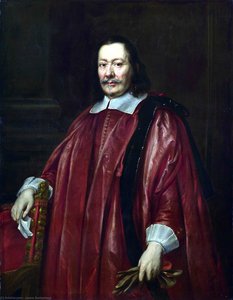
Early Life and Training
Justus Sustermans, Joost Suttermans or Suttermans (born Antwerp, Belgium 1597 – died 1681 Florence) was a Flemish Baroque painter and draughtsman whose career spanned over six decades and cemented his reputation as the foremost portrait painter in Italy during his time. Born into an artistic family—his father, Frans Sutermans, was also a painter—Justus’s upbringing instilled within him a profound appreciation for visual art from a young age. He began his artistic journey in Antwerp, where he was profoundly influenced by the monumental canvases of Peter Paul Rubens and Anthony van Dyck, artists who epitomized the grandeur and dynamism of the Baroque aesthetic. This formative period equipped him with foundational skills and exposed him to stylistic innovations that would shape his distinctive oeuvre.Style and Technique
Sustermans’ artistic style is characterized by a bold embrace of color palettes and dramatic chiaroscuro—the interplay between light and shadow—techniques that were hallmarks of the Baroque era. Unlike some contemporaries who favored meticulous detail, Sustermans prioritized capturing the essence of his subjects through expressive brushstrokes and masterful use of tonal gradation. His canvases pulsated with vitality, conveying not merely likeness but also psychological depth and emotional resonance. He skillfully employed glazing techniques to achieve luminous surfaces and create a sense of atmospheric perspective, mirroring the artistic conventions prevalent in Antwerp and Florence during his lifetime. The meticulous observation of anatomy combined with an intuitive understanding of human emotion distinguished Sustermans’ work from many others of his time.Notable Works
Justus Sustermans achieved international acclaim primarily through his portraits of members of the Medici family, securing him a prestigious position as their court painter. His depictions of Cosimo III de' Medici and Margherita de' Medici stand as masterpieces of Baroque portraiture, showcasing remarkable realism and conveying an unparalleled sense of dignity and composure. These paintings exemplify Sustermans’ ability to distill complex character traits into visually arresting compositions—a testament to his artistic prowess. Beyond portraits, Sustermans produced a diverse range of artworks encompassing history paintings, genre scenes depicting everyday life, still lifes brimming with meticulous detail, and animal studies imbued with scientific observation. His monumental *The Florentine Senate's Pledge of Allegiance to Ferdinando II de’ Medici*, commissioned by the Grand Duke himself, exemplifies his ambition and technical mastery—a sprawling canvas that captures a pivotal moment in Florentine history. Furthermore, Sustermans’ portraits of Galileo Galilei are considered among the most psychologically astute representations of scientific genius of their era.Influence and Legacy
Justus Sustermans exerted considerable influence on subsequent generations of artists, particularly Anthony van Dyck, who admired Sustermans' bold style and expressive technique. His meticulous attention to detail and his masterful use of chiaroscuro served as inspiration for many painters working in the Dutch Golden Age. Sustermans’ legacy extends beyond individual artworks; he established a workshop that produced numerous copies of celebrated paintings—a practice common during the Baroque period—contributing to the dissemination of artistic ideas across Europe. His portraits of the Medici family continue to captivate audiences today, offering invaluable insights into the cultural and political landscape of 17th-century Italy. Sustermans’ contribution to art history is recognized as a cornerstone of Baroque portraiture, securing his place among the most revered artists of his time.الأسئلة والأجوبة
أين يمكن استكشاف أعمال Justus Sustermans الفنية المصنفة حسب الكلمات المفتاحية؟
يمكن استكشاف أعمال Justus Sustermans عبر الكلمات المفتاحية في صفحة حسب الكلمات المفتاحية الخاصة بالفنان، حيث تجمع كل كلمة مفتاحية الأعمال الفنية ذات الصلة.
ما هي أكثر الأعمال الفنية مشاهدةً لـ Justus Sustermans؟
يمكنكم الاطلاع على إحصائيات أعمال Justus Sustermans عبر صفحة إحصائيات الزيارات الخاصة بالفنان.
أين يمكنني مشاهدة المخطط اللوني لأعمال Justus Sustermans؟
يمكن استكشاف أسلوب Justus Sustermans في استخدام الألوان عبر الأعمال المدرجة في هذا الموقع من خلال صفحة بصمة الألوان الفنية الخاصة بالفنان.