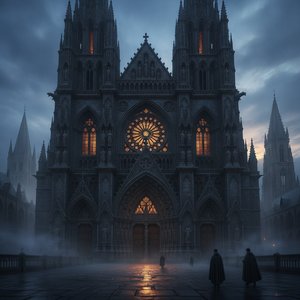
A Master of Catalan Gothic Splendor
The history of Catalan art finds one of its most profound and luminous voices in the work of Jaume Huguet. A painter of immense spiritual depth, Huguet emerged from the town of Valls, where his early life was shaped by significant personal loss. Orphaned at a young age, he was brought under the guardianship of his uncle, Pere Huguet, a fellow painter who served as both kin and tutor. This early apprenticeship laid the foundation for a career that would eventually define the aesthetic of the late Gothic period in Catalonia. As he moved from Tarragona to the vibrant artistic hub of Barcelona, Huguet found himself at the crossroads of tradition and innovation, absorbing the modern trends that were beginning to sweep through the Mediterranean.
His artistic journey was marked by a remarkable period of wandering and growth. Between 1440 and 1445, his hand reached into the workshops of Zaragoza and Tarragona, where he encountered the influential Flemish style brought by Luis Dalmau. This encounter with Northern European sensibilities—characterized by a meticulous attention to detail and a certain tactile realism—would blend seamlessly with the established Gothic formalism of his homeland. The result was a unique painterly language: one that maintained the solemnity and grandeur of the Gothic tradition while embracing a burgeoning sense of naturalism and light.
The Divine Narrative in Paint and Gold
To observe a work by Huguet is to enter a realm where the earthly and the celestial are inextricably linked. His mastery of technique, often utilizing egg tempera on wood panels, allowed for an incredible precision that could render the heavy, luxurious folds of liturgical vestments and the shimmering textures of gold leaf with breathtaking clarity. In masterpieces such as Sts Abdon and Sennen, he employs a rhythmic, hypnotic foundation of checkered floors to ground his holy figures, while simultaneously using a golden sky to lift the viewer toward a divine plane. This interplay of light and pigment creates an atmosphere that is nothing short of ethereal, transforming religious iconography into an immersive spiritual experience.
Huguet’s repertoire was vast, ranging from monumental altarpieces to intimate devotional panels. His ability to command both scale and detail is evident in his diverse body of work:
- The Archangel St Michael: A celestial sentinel rendered with heroic posture, framed by stylized foliage and a radiant, textured gold leaf that seems to emanate an inner light.
- The Consecration of St Augustine: A monumental achievement that captures the grandeur and solemnity of papal ceremonies, blending Gothic formalism with emerging Renaissance influences.
- Martyrdom of Saint Bartholomew, Calvary and Death of Saint Mary Magdalene: A sweeping, cinematic triptych that invites the viewer on a spiritual pilgrimage through sacred narrative.
Legacy and Historical Significance
The enduring significance of Jaume Huguet lies in his role as a bridge between eras. He was an artist who could honor the rigid, symbolic requirements of medieval piety while preparing the way for the more humanistic approaches of the future. His workshop became a cornerstone of Catalan production, with works like the Saint Augustine Altarpiece involving collaborations with skilled artists such as Pau Vergós to meet the immense demands of religious guilds and monasteries.
Though much of his early documented work has been lost to time—such as the high altarpiece for the Church of Sant Antoni Abat destroyed in 1909—his surviving legacy remains preserved in the most prestigious institutions. Through the collections of the Museu Nacional d'Art de Catalunya and various monastic sites, Huguet’s vision continues to illuminate the history of Spanish art, offering a window into a period of immense artistic fervor and spiritual devotion.
الأسئلة والأجوبة
كم عدد الأعمال الفنية المتاحة لتصفحها لـ جاومي هوغيت؟
يمكنك تصفح 27 أعمال فنية من أعمال جاومي هوغيت في صفحة جميع الأعمال الفنية.
أين يمكنني مشاهدة أعمال جاومي هوغيت الفنية في معرض ثلاثي الأبعاد؟
يمكن مشاهدة أعمال جاومي هوغيت الفنية في معرض ثلاثي الأبعاد عبر صفحة متحف ثلاثي الأبعاد الخاصة بالفنان.
كيف يمكنني مشاهدة جميع الأعمال الفنية التي أبدعها جاومي هوغيت؟
يمكن تصفح جميع أعمال جاومي هوغيت على هذا الموقع من خلال صفحة جميع الأعمال الفنية الخاصة بالفنان.