A Life Immersed in the Scottish Countryside: The World of Robert Alexander
Robert Alexander, born in 1840 in the small village of Dalgarven near Kilwinning in Ayrshire, Scotland, was an artist whose work became synonymous with the gentle warmth of domestic life and the rugged beauty of his homeland. His path to becoming a celebrated painter wasn’t conventional; rather than formal art schooling, Alexander began as an apprentice to a house-painter in Irvine, learning the fundamentals of landscape painting alongside more practical skills. This early grounding instilled in him not only technical proficiency but also a keen observation of light and form that would later characterize his distinctive style. He subsequently found employment with the Royal Scottish Museum in Edinburgh, further honing his abilities before dedicating himself fully to easel painting around 1868 – the year he first exhibited at the prestigious Royal Scottish Academy.Capturing the Essence of Animals: A Rising Star
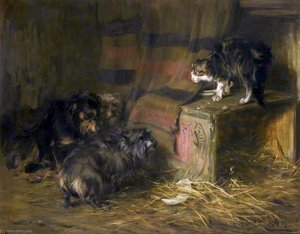
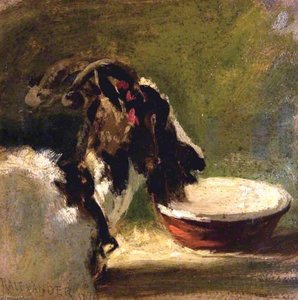
Alexander quickly distinguished himself by focusing on animal subjects, particularly dogs and horses. He didn’t merely *depict* these creatures; he sought to capture their personalities, their inherent dignity, and their connection to the rural world around them. His work resonated with a growing Victorian audience that appreciated both realism and sentimentality. He possessed an exceptional skill for portraying expressive eyes and textured coats, bringing his subjects vividly to life on canvas. This talent led to consistent exhibitions at the RSA – over 125 works were displayed throughout his lifetime – establishing him as a prominent figure in Scottish art circles. His election as an Associate of the Royal Scottish Academy (ARSA) in 1878 and then as a full Royal Scottish Academician (RSA) in 1888 solidified his position within the artistic establishment.Impressionistic Touches and Pastoral Charm
While firmly rooted in realism, Alexander’s work demonstrates a clear influence of Impressionism. This is not to say he abandoned precise detail altogether, but rather that he embraced a looser brushstroke and a more nuanced understanding of light and color. His paintings often evoke a sense of atmosphere, capturing the fleeting moments of everyday life with remarkable sensitivity. Works like “Goat and Kids” exemplify this approach – a serene scene rendered with earthy tones and a delicate play of sunlight. He wasn’t interested in grand historical narratives or dramatic compositions; instead, he found beauty in the simple rhythms of rural existence: feeding horses, quiet moments within barns, and the tender bonds between animals and people. His paintings offer a glimpse into a world where life moved at a slower pace, and nature held a central place.Legacy and Historical Significance
Robert Alexander’s contribution to Scottish animal painting is undeniable. He elevated the genre beyond mere portraiture, infusing his work with both artistic skill and emotional depth. He was not simply recording what he saw; he was interpreting it through a lens of warmth, understanding, and genuine affection. His paintings provide valuable insights into Victorian rural life and the evolving relationship between humans and animals. Furthermore, Alexander’s influence extended to his own family – his son, John Edwin Alexander, also became a successful artist, continuing the legacy of capturing the beauty of the Scottish countryside. Today, Robert Alexander's works are cherished for their charm, realism, and ability to transport viewers to a simpler, more idyllic time. His paintings continue to be exhibited and admired, ensuring that his vision of Scotland’s pastoral heart endures.الأسئلة والأجوبة
هل يمكنني تصفح أعمال Robert L Alexander حسب لوحة الألوان؟
تجمع صفحة حسب لوحة الألوان أعمال Robert L Alexander الفنية حسب لوحات ألوانها.
هل يوجد تسلسل زمني لأعمال Robert L Alexander؟
يمكن مشاهدة أعمال Robert L Alexander الفنية مرتبة زمنياً في صفحة الخط الزمني للأعمال الفنية الخاصة بالفنان.
ما مدى شهرة الأعمال الفنية لـ Robert L Alexander؟
تعرض صفحة الإحصائيات الخاصة بـ Robert L Alexander إحصائيات مستخرجة من الأعمال الفنية للفنان المدرجة على هذا الموقع.