


 Преглед в реален мащаб
 Сподели
 Сподели
 Подробности
 Ръководство

 Изтегляне
 Подобни артикули
 Рентгенова снимка
 Слайдшоу
 Статистика
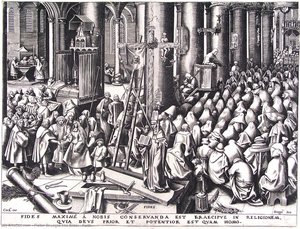
The Calvinist Iconoclastic Riot of August 20, 1566
 1588
1588 186.0 x 276.0 cm
 Британски музей
 Разгърни целия текст
Ръчно изработена маслена репродукция
Ръчно рисувана маслена картина върху платно във вашия размер и рамка, изработена по поръчка от нашите художници. ( Избор на принт Превключване към дигитално изображение)




































Изберете от нашите предварително зададени размери, които съответстват на оригиналните пропорции на произведението.

Можете да въведете свои собствени размери, за да паснат на конкретна рамка или пространство. Ако избраният от вас размер не съответства на пропорциите на оригиналното изображение, ние ще изрежем произведението или ще разширим картината с допълнителни ръчно рисувани елементи. Дигитален макет ще бъде изпратен за ваше одобрение преди започване на производството.
Моля, обърнете внимание, че предпрогледа на екрана не отразява действителното изрязване или разширяване. Само макетът ще покаже точно финалната композиция.
Въпреки че са налични персонализирани размери, препоръчваме да изберете размер от предварително дефинирания списък, за да запазите оригиналните пропорции.
След получаване на поръчка, екипът на AllPaintingsStore.com ще изпрати имейл до клиента с инструкции и ще предостави примерен макет за преглед.
Доставка по целия свят () в рамките на 3-4 седмици вместо стандартните 5 седмици. (21 Септември). Без компромис с качеството.

Безплатна експресна доставка по целия свят

Висококачествено ленено платно

Пълно застраховане на доставката

Гаранция за възстановяване на митнически такси

Гаранция за пълно съответствие на цветовете

Политика за връщане в рамките на 100 дни (само при дефекти)

100% Гаранция за връщане на сумата

Отстъпка при поръчка на повече произведения
 Опцията със стъкло е налична само за размери под 110 см

The Calvinist Iconoclastic Riot of August 20, 1566
Техника на репродукция
Размер на репродукцията
-


Крайна цена
$ 258
Свързани произведения




Биография на художника
The Chronicler of Chaos: The Life and Legacy of Frans Hogenberg
In the turbulent heart of the sixteenth century, as Europe was being reshaped by the fires of the Protestant Reformation and the shifting borders of empires, there arose a visual storyteller whose work served as both a mirror to contemporary violence and a window into the expanding world. Frans Hogenberg (1535–1590) was far more than a mere painter; he was a Flemish-German master of the engraver’s needle, a cartographer of human conflict, and a witness to the profound transformations of his age. Born in Me chelen, Flanders, Hogenberg’s early years were steeped in the rich artistic traditions of the Low Countries. While much of his early training remains shrouded in the mists of history, scholars often point to the masterful influence of Pieter Bruegel the Elder. From this lineage, Hogenberg inherited a profound capacity for observing the nuances of reality—a skill he would later refine into a breathtakingly detailed panoramic style that could capture the sprawling scale of a siege or the quiet dignity of a city skyline with equal precision.
Hogenberg’s life was inextricably linked to the political and religious upheavals of his time. As a Protestant living through the height of the Reformation, he found himself at the center of the storm. His sympathies were not merely private; they were etched into copper. Following his involvement in printing engravings that supported the Beeldenstorm—the iconoclastic riots that swept through the Netherlands—he faced the wrath of the Duke of Alba and was banned from Antwerp in 1568. This period of exile, which saw him journeying to London before eventually settling in Cologne, did not stifle his creativity but rather expanded his horizons, allowing him to become a truly European artist whose work bridged the gap between Flemish realism and German precision.
Mastery of the Engraved Perspective
The true genius of Hogenberg lay in his ability to manipulate perspective to convey both immense scale and intimate detail. He became renowned for his monumental panoramic battle scenes, works that functioned as early forms of visual journalism. These were not merely depictions of war; they were psychological landscapes. In pieces such as The Siege of Antwerp, commissioned by the Holy Roman Emperor Maximilian I, Hogenberg utilized meticulous shading and a sweeping bird's-eye view to illustrate the terrifying complexity of siege warfare. He possessed a rare technical prowess that allowed him to guide the viewer’s eye through vast, crowded battlefields, making the chaos of cavalry charges and the grim reality of fortifications feel palpably present.
Beyond the smoke of combat, Hogenberg’s repertoire was remarkably diverse, showcasing an artist deeply attuned to the changing face of the continent. His work encompassed:
- Topographical Views: He possessed a cartographic eye, creating stunningly accurate renderings of cities like Mantua and Kraków, capturing the unique architectural character and atmospheric essence of each location.
- Historical Allegories: Through symbolic imagery, he explored the deeper philosophical and political meanings behind the events of his era.
- Portraiture and Landscapes: His ability to capture the subtle emotional states of his subjects and the serene beauty of the natural world provided a necessary balance to his more violent subject matter.
A Lasting Impression on the Map of History
Hogenberg’s historical significance extends far beyond the aesthetic value of his individual prints. He was a vital collaborator in some of the most important cartographic achievements of the Renaissance. His work with Abraham Ortelius on the Theatrum Orbis Terrarum and his contributions to the Civitates Orbis Terrarum alongside Georg Braun helped establish a new standard for how the world was visualized. By engraving the maps that would define European understanding of geography, he participated in the very act of mapping the modern age.
As we look back upon his prolific career, we see an artist who refused to remain a passive observer. Whether through the defiant etchings that led to his exile or the grand, sweeping vistas that celebrated the majesty of European cities, Frans Hogenberg captured the pulse of a continent in transition. His legacy remains etched in the fine lines of his engravings—a permanent record of a time when the world was being torn apart and rebuilt, one meticulously detailed landscape at a time.

frans hogenberg
1535 - 1590 , Belgium
Бързи факти
- Artistic Movement Or Style: Panoramic Battle Scenes
- Artists Or Movements Influenced By This Artist: ['Renaissance Art']
- Artists Who Influenced This Artist:
- Albrecht Dürer
- Lucas Cranach the Elder
- Date Of Birth: 1535
- Full Name: Frans Hogenberg
- Nationality: Flemish
- Notable Artworks:
- The Calvinist Iconoclastic Riot of August 20, 1566
- River Landscape with Iron Mining Scene
- View of Mantua
- Place Of Birth: Mechelen, Belgium

