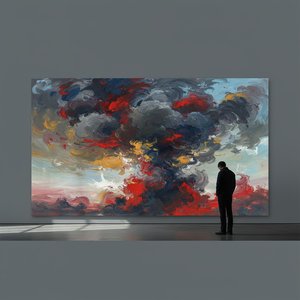
1968. Oil On Canvas, 57.0 x 76.0 cm. Национална галерия на изкуството.

§ 1Catalogue data
 Oil On Canvas
- WallArt
- Abstract Expressionism
 1968
1968- Modern
 57.0 x 76.0 cm
 Национална галерия на изкуството
Това произведение е защитено от авторско право
Изкуството, представено на тази страница, е защитено от законите за авторско право, което означава, че не можем законно да създаваме или продаваме идентични репродукции. Тази защита се прилага съгласно международни споразумения като Бернска конвенция и от националното законодателство, включително разпоредбите на Закон за авторското право на САЩ – Раздел 17.
Като уважителна и законна алтернатива, ние предлагаме изработени по поръчка, ръчно рисувани произведения на изкуството, вдъхновени от оригинала. Нашите умени и професионални артисти внимателно изучават стила, настроението и артистичната същност на оригиналното произведение, за да създадат ново, уникално творческо произведение, което предизвиква същото чувство – оставайки в същото време самостоятелно оригинално творение.
Този метод е напълно съвместим с законите за авторско право, тъй като не включва копиране или дублиране на защитеното произведение. Вместо това става въпрос за творческа реинтерпретация – нова картина, която е вдъхновена от оригинала, но не е идентична с него.
 Прочетете повече
§ 2Abstract
Описание на колекционерския предмет
Fred Williams’ "Burning Tree Stump" (1968) captures Australian bushfires in abstract expressionism. Explore layered forms, muted tones & raw emotion of this iconic landscape piece.
Биография на художника
Открийте Фредерик Роналд Уилямс, ключов австралийски художник с емблематични пейзажи и е칭. Проучете неговия изключителен творчески път.
§ 3Commentary
The Embers of Memory: Reimagining Fred Williams
In the evocative depths of "Burning Tree Stump" (1968), the viewer is not merely observing a landscape, but is instead pulled into the visceral heart of an Australian bushfire. Frederick Ronald Williams, one of Australia’s most profound twentieth-century landscapists, achieves here a masterful synthesis of abstract expressionism and raw, elemental truth. The painting does not rely on the literal depiction of flame or smoke; rather, it utilizes a sophisticated language of layered forms and muted tones to capture the very essence of destruction and rebirth. As the eye wanders across the canvas, one encounters a densely populated scene where shapes emerge from a field like ghosts of the bush, creating a sense of movement that is both chaotic and strangely rhythmic.
The technique employed by Williams is nothing short of hypnotic. Utilizing a wet-on-wet approach, he allows oil paints to bleed and merge directly upon the canvas, a method that facilitates the organic, amorphous shapes that define this piece. There is a beautiful tension between thick, tactile impasto patches and delicate, translucent washes, providing a structural depth that invites close inspection. The perspective is intentionally flattened, eschewing traditional linear depth in favor of a gestural abstraction where space is suggested through shifts in color density and the overlapping of organic forms. This creates an immersive experience, as if the viewer is standing amidst the swirling heat and settling ash of a landscape in transition.
A Palette of Somber Elegance
For the discerning collector or interior designer, the color story of "Burning Tree Stump" offers a sophisticated anchor for any high-end space. The palette is dominated by a soulful arrangement of muted browns, charcoal grays, and soft off-whites, evoking the scorched earth and heavy skies of an overcast Australian afternoon. Yet, within this somber atmosphere, Williams introduces subtle, unexpected punctuations of blue and hints of crimson. These small splashes of color act as emotional sparks, preventing the composition from becoming static and instead imbuing it with a flickering, living energy.
Beyond its aesthetic brilliance, the painting carries a profound symbolic weight. It speaks to the collective experience of a continent shaped by fire, touching upon themes of anonymity, resilience, and the disorientation of nature's most powerful forces. The way the figures—or perhaps they are merely fragments of trees and earth—cluster in the foreground creates a sense of being part of a larger, shared consciousness. To possess a reproduction of this work is to bring more than just decoration into a room; it is to invite a conversation about history, the raw power of the natural world, and the enduring beauty found within the aftermath of change.
Въпроси и отговори
Какво историческо място заема "Burning tree stump"?
„Burning tree stump“ на Фредерик Роналд Уилямс принадлежи към художественото течение Abstract Expressionism, в рамките на епохата Modern. Заедно те определят мястото на произведението в историята на изкуството.
„Burning tree stump“ на Фредерик Роналд Уилямс портретна, пейзажна или квадратна композиция ли е?
„Burning tree stump“ на Фредерик Роналд Уилямс е Landscape композиция. Пропорциите си заслужават да бъдат проверени преди избор на размер на принта.
На кой период от кариерата на Фредерик Роналд Уилямс принадлежи „Burning tree stump“?
„Burning tree stump“ принадлежи към Mature Period от кариерата на Фредерик Роналд Уилямс. Тази класификация свързва творбата с развитието на художника.


![Untitled (rome [wall]) (1961) — Цай Твъмбли, Abstract Expressionism](/media/artworks/images-thumb/02/29/022976d5294bf560184bd33a69805420.jpg)

 Превключване към принт


 За произведения на изкуството или репродукции, чийто размер е над 105 см (приблизително 41 инча) във всяка страна, рамката ще бъде изпратена в разглобен вид като комплект за сглобяване. Този метод гарантира безопасна доставка и предотвратява повреди по време на транспортиране.