Гаранция за връщане на сумата · 100 дни Безплатна доставка по целия свят
449587произведения на изкуството 30613художници 4660музеи 32езици
Валута
    Език
      Ателие · Основан през 2015 г. · Париж, Франция
      AllPaintingsStore
      allpaintingsstore.com
      Catalogue entry

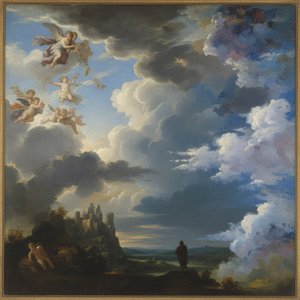
      Study for Clouds (Contre-jour)

      1970. Oil On Canvas, 80.0 x 100.0 cm.

      Fig. 1. Герхард Рихтер, Study for Clouds (Contre-jour), 1970. Shown as the reproduction you are specifying: , .

      § 1Catalogue data

      § 2Abstract

      Описание на колекционерския предмет

      Explore Gerhard Richter's 'Study for Clouds (Contre-jour)' – an evocative oil painting capturing the ethereal beauty of sunset clouds with masterful layering and dramatic lighting. Discover more about this iconic piece.

      Биография на художника

      Герхард Рихтер – немски художник, известен с абстрактни и фотореалистични картини, концепцията за "Капиталистична реалност" и цветните схеми. Влиятелен артист, изследващ съвременността чрез изкуството.

      § 3Commentary

      A Window into Richter’s Soul: The Poetic Study of Light and Form

      Gerhard Richter's *Study for Clouds (Contre-jour)*, executed in 1970, stands as a testament to his pioneering approach within Abstract Expressionism. More than just a depiction of natural phenomena—a sunset viewed through swirling clouds—it’s an exploration of perception itself, capturing the elusive beauty and transformative power of light against textured surfaces.

      • Subject Matter: The artwork centers on a simple yet profound observation: the dramatic interplay between sunlight and cloud formations. Richter eschews representational accuracy, prioritizing instead the emotional resonance of color and texture.
      • Style & Technique: Richter’s masterful use of oil paint—applied in multiple layers with meticulous blending—creates an illusionistic surface that mimics the organic irregularities of clouds. The technique is characterized by a deliberate ambiguity; it's neither fully abstract nor entirely realistic, existing somewhere between these two poles.
      • Color Palette: Dominated by cool blues and grays, punctuated by flashes of pale yellow where sunlight penetrates the cloud cover, the palette reflects the subdued grandeur of twilight. Richter’s color choices are carefully calibrated to convey mood and atmosphere—a sense of quiet contemplation amidst a dynamic visual experience.

      The Influence of Friedrich and Beyond

      Richter's work is deeply rooted in the Romantic tradition, particularly influenced by Caspar David Friedrich’s landscapes imbued with sublime emotion. Like Friedrich, Richter seeks to capture the awe-inspiring grandeur of nature while simultaneously conveying a feeling of vulnerability and insignificance. However, Richter departs from Friedrich’s meticulous detail, favoring instead a looser brushstroke that emphasizes tonal variation and textural depth.

      • Historical Context: Created during the formative years of Richter's artistic career—a period marked by experimentation and intellectual engagement—the painting reflects the broader stylistic currents of the time. It aligns with the burgeoning interest in abstraction as a means of expressing subjective experience.
      • Symbolism: Clouds themselves hold symbolic significance, representing change, impermanence, and the sublime beauty of the natural world. Richter’s depiction captures this essence—a fleeting glimpse of light and color that evokes feelings of wonder and melancholy.

      A Meditation on Perception

      *Study for Clouds (Contre-jour)* isn't merely a visual representation; it's an invitation to contemplate the nature of perception. Richter’s technique—characterized by layering, blurring, and subtle tonal shifts—challenges viewers to consider how our senses interpret reality. The painting encourages us to appreciate the beauty of imperfection and to embrace the ambiguity inherent in artistic expression.

      • Materials Used: Oil paint on canvas – Richter’s choice of medium underscores his commitment to capturing the materiality of the artwork itself, mirroring the textures and nuances of the observed landscape.
      • Perspective & Depth: Atmospheric perspective—the gradual lightening and diminishing of color intensity as distance increases—creates a convincing illusion of depth, immersing the viewer in the contemplative mood of the scene.

      Въпроси и отговори

      Мога ли да видя „Study for Clouds (Contre-jour)“ на Герхард Рихтер върху моята собствена стена преди покупка?

      Можете да прегледате „Study for Clouds (Contre-jour)“ на Герхард Рихтер върху вашата собствена стена чрез страницата за Преглед с AR на произведението, използвайки добавена реалност на съвместимо устройство.

      По-скоро светла или по-скоро тъмна е „Study for Clouds (Contre-jour)“ като цяло?

      Записаните стойности за „Study for Clouds (Contre-jour)“ на Герхард Рихтер са: яркост bright, луминанс Gentle Luminance.

      Колко души разглеждат "Study for Clouds (Contre-jour)"?

      Статистиката за „Study for Clouds (Contre-jour)“ на Герхард Рихтер се намира на страницата Статистика на произведението: месечни посещения на творбата, посещения на произведенията на художника, както и разпределение на последните посетители по държава и език.

      § 4The artist

      Герхард Рихтер

      Герхард Рихтер

      1932 - , Германия

      Quick facts about Герхард Рихтер

      • Artistic Movement Or Style:
        • Фотореализъм
        • Абстракция
      • Artists Or Movements Influenced By This Artist: ['Съвременни художници']
      • Artists Who Influenced This Artist:
        • Пикасо
        • Арп
      • Date Of Birth: 9 февруари 1932
      • Full Name: Gerhard Richter
      • Nationality: Германец
      • Notable Artworks:
        • Abstraktes Bild
        • Gilbert
      • Place Of Birth: Дрезден, Германия

      Биография на художника

      A Life Shaped by Division: The Early Years and Artistic Formation of Gerhard Richter

      Gerhard Richter’s life story is inextricably woven into the complex tapestry of 20th-century Germany, a nation perpetually grappling with its past. Born in Dresden in 1932, his childhood unfolded under the looming shadow of rising National Socialism, an experience that profoundly shaped his artistic sensibility and worldview. The displacement inherent to wartime – his family’s repeated moves during those turbulent years – instilled within him a deep-seated sense of uncertainty and a questioning spirit, qualities that would consistently inform his art for decades. The idyllic landscapes he first knew in Reichenau and Waltersdorf were soon shattered by conflict, leaving an indelible mark on his psyche. His father, while not actively involved in the Nazi party, navigated the challenging realities of life under authoritarian rule as a schoolteacher, while his mother nurtured within him a love for literature and music – a counterpoint to the prevailing ideological pressures. This duality—a pragmatic acceptance of circumstance alongside a yearning for cultural expression—became a defining characteristic of Richter’s artistic approach, a tension he continually explored in his work. He began formal training at the Dresden Academy of Fine Arts in 1951, initially immersed in the rigid tradition of socialist realism mandated by the East German state. Even within this constrained environment, however, a quiet rebellion simmered beneath the surface, fueled by a growing dissatisfaction with ideological constraints and a desire to push beyond prescribed boundaries.

      Escaping Constraints: Düsseldorf and the Exploration of Style

      A pivotal moment arrived in 1961. Alongside his wife, Marianne Eufinger, Richter made the courageous decision to flee East Germany, seeking refuge in the vibrant and experimental art scene of Düsseldorf. This move represented a radical transformation in his artistic trajectory. The West German landscape offered an environment where experimentation wasn’t merely tolerated but actively encouraged – a stark contrast to the stifling control he had experienced in the East. In Düsseldorf, Richter encountered a dynamic community of artists, each grappling with their own questions about identity, representation, and the legacy of history. He quickly began dismantling the conventions of socialist realism, embarking on a period of intense exploration that would define his early mature work. This era was characterized by a fascinating oscillation between seemingly disparate approaches: from meticulously detailed photorealism, painstakingly recreating photographic images with astonishing precision, to abstract compositions bursting with bold colors and dynamic brushstrokes. Crucially, he collaborated closely with Sigmar Polke, forging a powerful artistic partnership that resulted in the coining of the term ‘Capitalist Realism’ – a deliberately ambiguous label reflecting their shared skepticism towards established artistic norms and their fascination with imagery from advertising and mass media. This period wasn't about finding *a* style; it was about questioning the very concept of stylistic coherence, embracing contradiction as a fundamental element of artistic expression.

      Blurring Boundaries: Photorealism, Abstraction, and the Power of Chance

      Richter’s artistic vocabulary expanded dramatically throughout the 1960s and beyond, encompassing an astonishing range of techniques and themes. His photorealistic paintings – often based on family photographs or images from newspapers – are not simply copies of reality; they are intricate investigations into the nature of perception and representation. By rendering these images with a clinical detachment, he forces viewers to confront the inherent ambiguity of photographic truth—is it a faithful record, or merely an interpretation? Simultaneously, Richter delved deeper into abstraction, creating canvases layered with vibrant colors and gestural marks. These abstract works are often produced using a unique technique involving squeegees – tools typically used for cleaning windows – which he drags across the surface of the canvas, manipulating the paint in unpredictable ways. This embrace of chance and spontaneity became central to his artistic philosophy, allowing him to relinquish control and invite unexpected outcomes. His ‘Color Charts,’ systematic arrangements of colored squares, further challenged traditional notions of artistic expression, questioning the very definition of painting itself—is it about individual aesthetic preferences, or simply about exploring the inherent properties of color? Throughout this period, Richter consistently sought to disrupt established visual conventions, pushing the boundaries of what was considered “art.”

      The Weight of History and the Search for Meaning

      Richter’s work is profoundly shaped by his personal history and the tumultuous events that unfolded in Germany during his formative years. The war left an indelible mark on his family—his aunt and uncles perished, and his father struggled to find employment after returning from imprisonment. This experience instilled within him a deep awareness of loss, displacement, and the fragility of human existence. He frequently revisited these themes in his art, not through overt political statements, but through subtle gestures and evocative imagery. His early photographs of Dresden—often depicting the ruins of the city—are particularly poignant, capturing both the devastation and the resilience of its inhabitants. Later works, such as his ‘Self-Portraits,’ explore the complexities of identity and memory, grappling with questions about personal history and collective trauma. Richter’s art is not simply a reflection of historical events; it's an attempt to grapple with their enduring impact on the human psyche—a constant negotiation between remembrance and oblivion.

      A Lasting Legacy: Influence and Critical Acclaim

      Gerhard Richter’s influence on contemporary art is undeniable, solidifying his position as one of the most important artists of our time. His willingness to challenge conventions, his relentless experimentation with technique, and his profound engagement with historical and political themes have established him as a towering figure in the 20th and 21st centuries. He has consistently resisted easy categorization, defying attempts to confine his work within a single stylistic framework—a testament to his intellectual rigor and artistic independence. Richter’s paintings regularly command record prices at auction, reflecting not only their aesthetic value but also their cultural significance. Beyond the market, however, lies a deeper resonance: Richter's art speaks to the complexities of modern existence, grappling with issues of memory, identity, and the search for meaning in an increasingly fragmented world. He doesn’t offer easy answers; instead, he poses challenging questions, prompting viewers to confront their own preconceptions and engage in critical dialogue. His legacy is not simply about creating beautiful objects; it's about expanding the possibilities of painting itself—a constant exploration of perception, representation, and the very nature of art.

      § 5Comparanda

      § 6Questions

      Бърза информация

      • Dimensions: 80 × 100 cm
      • Artistic style: Realist abstraction
      • Artist: Gerhard Richter
      • Location: Private Collection
      • Influences: Romantic Landscape Painting
      • Notable elements or techniques: Atmospheric perspective; Layered painting

      Тест за познания по изкуство

      За всеки въпрос има само един верен отговор.

      Въпрос 1:
      What artistic movement is Gerhard Richter’s ‘Study for Clouds (Contre-jour)’ associated with?
      Въпрос 2:
      The technique employed by Richter in this piece is primarily characterized by:
      Въпрос 3:
      What does the term ‘contre-jour’ refer to in relation to the artwork?
      Въпрос 4:
      What is a symbolic representation conveyed by the depiction of clouds in ‘Study for Clouds (Contre-jour)?
      Въпрос 5:
      Where was Gerhard Richter born?

      § 7Cite this entry

      AllPaintingsStore.com, “Герхард Рихтер, Study for Clouds (Contre-jour) (1970)”, https://allpaintingsstore.com/bg/art/gerhard-richter-study-for-clouds-contre-jour-D2XRB9-en/ArtistReproduction/ (accessed 2 Октомври 2026).

      § 8The reproduction

      Ръчно изработена маслена репродукция

      Ръчно рисувана маслена картина върху платно във вашия размер и рамка, изработена по поръчка от нашите художници. ( Превключване към принт Превключване към дигитално изображение)

      It is specified on the order sheet in the margin; the present state of that sheet reads as follows.

      Study for Clouds (Contre-jour)

      Вид репродукция

      Размер на репродукцията

      -

      Елитен старши художник

      Повече детайлност, изящество и допълнително време за производство

      -

      Рамка за репродукция

      -

      -

      За произведения на изкуството или репродукции, чийто размер е над 105 см (приблизително 41 инча) във всяка страна, рамката ще бъде изпратена в разглобен вид като комплект за сглобяване. Този метод гарантира безопасна доставка и предотвратява повреди по време на транспортиране.

      Изисква се професионално сглобяване – това не е продукт за самостоятелна изработка (DIY).
      Комплектът трябва да бъде сглобен, а платното – опънато от опитен професионален багер, като се използва дървено лепило (не е включено в комплекта), клещи за опъване на платно и затягащи скоби, за да се поддържа правотата на подрамника, докато лепилото изсъхне. Неправилното сглобяване или неравномерното опъване на платното може трайно да повреди произведението и не е покрито от нашата гаранция.

      • Всички елементи от масивна дървесина са включени, прецизно изрязани по размер.

      • Сглобява се с предоставените винтове, както и с лепило за дърво за ъгловите връзки, което не е включено в комплекта и трябва да бъде осигурено от вашия рамкар.

      • Изискват се професионални инструменти, които не са включени: щипка за опъване на платно (натягач) и скоби за фиксиране на подрамниците под прав ъгъл, докато лепилото изсъхне.

      Важно:
      За сглобяването на ъглите е необходимо лепило за дърво, рейките трябва да се фиксират с клещи (затягащи скоби, докато лепилото изсъхне напълно, а за опъването на платното върху готовата рамка е необходим инструмент за опъване на платно. Нито един от тези артикули не е включен в комплекта. Моля, осигурете услугите на опитен професионалист по багетно окантоване, преди да поръчате този размер.

      Етикет с име

      -

      -

      Защитен лак

      Гланцов лак (подсилва цветовете и предпазва от светлина и влага)

      -

      Персонализирай моето произведение

      Примери за възможности за персонализация: Заменете лицето със снимка на клиента; Добавете домашен любимец (например, заменете котка с куче); Включете скрито съобщение във фона; Променете пейзажа или елементите на фона.

      -

      Спешно

      Доставка по целия свят () в рамките на 3-4 седмици вместо стандартните 5 седмици. (30 Октомври). Без компромис с качеството.

      -

      Експресна доставка

      Доставка по целия свят () в рамките на 5 седмици. (6 Ноември).

      Включена

      Обща цена

      € 227

      Included with every order

      • Безплатна експресна доставка по целия свят
      • Висококачествено ленено платно
      • Пълно застраховане на доставката
      • Гаранция за възстановяване на митнически такси
      • Гаранция за пълно съответствие на цветовете
      • Политика за връщане в рамките на 100 дни (само при дефекти)
      • 100% Гаранция за връщане на сумата
      • Оферта за отстъпка при поръчка на повече бройки
      Order sheet