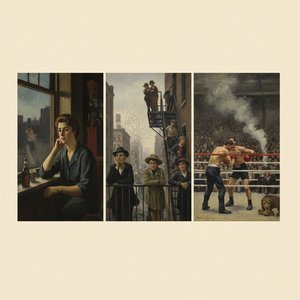
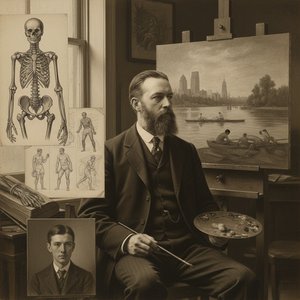
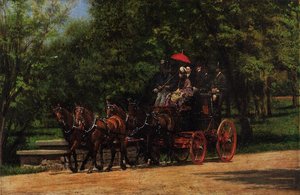
1874. Oil. Метрополитън Музей на изкуствата.

§ 1Каталожни данни


§ 2Абстракция
Описание на колекционерския предмет
Delve into Thomas Eakins's masterful realism with 'Pushing for Rail,' capturing the grit and dedication of American laborers. Explore his anatomical precision & iconic legacy.
 Прочети повече
Биография на художника
Томас Ейкънс (1844-1916) е американски реалист, известен с детайлните си портрети, динамичните картини на гребци и анатомичната прецизност. Разкрийте неговото творчество!
§ 3Коментар
The Weight of Perseverance: A Masterpiece of American Realism
In the quiet, damp expanses of the New Jersey marshes near the Delaware River, a profound drama of human endurance unfolds within Thomas Eakins’s 1874 masterpiece, Pushing for Rail. This is not merely a depiction of manual labor; it is an evocative window into the soul of American Realism. The painting captures a singular, breathless moment where nine men are locked in a collective struggle, straining against the immense weight of a heavy rail being hauled through a sodden, marshy landscape. Eakins, a painter who sought to dissect reality with the precision of a surgeon, does not look away from the grit or the sweat. Instead, he invites the viewer into the very center of the exertion, making the physical heaviness of the iron and the resistance of the mud feel almost tangible.
The emotional resonance of the work lies in its quiet dignity. There is no grand heroism here, only the unvarnished truth of camaraderie and the shared determination required to overcome monumental obstacles. For the collector or the lover of fine art, this piece offers a meditative quality—a reminder that strength is often found in the most ordinary, repetitive, and grueling of tasks. It is a painting that commands respect through its stillness, even as it depicts intense motion and muscular tension.
Anatomy of Light and Shadow
Technically, Pushing for Rail is a triumph of anatomical accuracy and atmospheric mastery. Eakins was famously obsessed with the underlying structure of the human form, and here, his scientific eye shines through every sinew and strained muscle. Through a masterful use of chiaroscroll—the dramatic interplay between light and shadow—he highlights the physical toll of the labor, casting deep shadows that emphasize the curvature of backs and the grip of hands. This anatomical precision lends the figures a monumental quality, elevating these working men to the status of classical subjects.
The artist’s palette is intentionally muted, dominated by earthy browns, deep mossy greens, and the hazy grays of a damp afternoon. By skillfully blending his oils, Eakins creates an atmospheric haze that suggests the humidity and the heavy air of the marshland. This technique allows the background to recede into a soft, Impressionistic blur, ensuring that the viewer’s focus remains anchored on the central figures. For those looking to integrate such a piece into a sophisticated interior, its earthy tones provide a grounding, organic warmth that complements both modern minimalist spaces and traditional, classic decors.
A Snapshot of an Era in Transition
To understand Pushing for Rail is to understand the tension of the Gilded Age. Emerging from the Darby School, Eakins’s work reflects the burgeoning industrial progress that was rapidly reshaping the American landscape. The heavy rail itself serves as a potent symbol of this era—a harbinger of technological advancement and the relentless march of urbanization. Yet, by focusing on the human cost and the physical effort required to move such objects, Eakins captures the friction between man and machine.
The painting stands as a testament to a time when progress was measured in sweat and collective will. It is an intellectually stimulating piece that invites deep conversation about history, labor, and the resilience of the human spirit. Whether displayed as a focal point in a gallery or as a soulful addition to a private study, this reproduction brings with it the weight of history and the timeless beauty of uncompromising truth.
Въпроси и отговори
Какво историческо място заема "Pushing for Rail"?
Исторически „Pushing for Rail“ е произведение от Contemporary Realism, принадлежащо към по-широката епоха на 19th Century.
Към кой стил принадлежи "Pushing for Rail"?
„Pushing for Rail“ на Томас Ейкънс принадлежи към художественото направление Contemporary Realism. Това движение определя стилистичния контекст на произведението.
Как се свързва сюжетът на „Pushing for Rail“ с типичните за Томас Ейкънс теми?
"Pushing for Rail" изобразява painting, agriculture, laborers, horses, dogs, marshland, realism, observation, докато утвърдените теми на Томас Ейкънс са realism, observation, huntingscenes, americantradition, scientificaccuracy. Сравнението между двете показва как произведението се свързва с обичайните сюжети на художника.




 Превключване към принт


 За произведения на изкуството или репродукции, чийто размер е над 105 см (приблизително 41 инча) във всяка страна, рамката ще бъде изпратена в разглобен вид като комплект за сглобяване. Този метод гарантира безопасна доставка и предотвратява повреди по време на транспортиране.