

6th Lord Byron (Томас Филипс)
Oil On Canvas.

Ръчно писана с маслени бои от €169 за 36 x 28 cm
Достъпно и като художествена репродукция от €40
- Безплатна експресна доставка по целия свят
- Доставка в рамките на 4 до 5 седмици
- 100-дневен период за връщане и гаранция за възстановяване на сумата
- Оценено 4.9/5 от 241 клиенти на ArtShopReviews.com
§ 1Каталожни данни


§ 2Абстракция
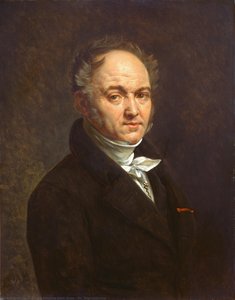
6th Lord Byron на Томас Филипс, описание на картината
A somber oil portrait of a man in a dark coat and white cravat, rendered with soft blending and dramatic chiaroscuro lighting.
 Прочетете пълното описание на 6th Lord Byron от Томас Филипс
Томас Филипс: биография
Томас Филипс (1770-1845) е британски портретист и исторически художник, известен със своята прецизност и реалистични портрети на влиятелни личности като Бъртън. #БританскоИзкуство #ПортретнаЖивопис
§ 3Коментар
The Portrait of the 6th Lord Byron
In this portrait, titled 6th Lord Byron, the English painter Thomas Phillips captures the likeness of George Gordon Byron, 6th Baron Byron. The work presents a formal study of the man, focusing on his upper body and his steady, serious gaze. Phillips, who was born in Dudley, United Kingdom, in 1770, brings a meticulous attention to the subject's features and the textures of his attire. The sitter is positioned slightly off-center, looking toward his left, which lends a sense of quiet introspection to the composition.
The artist, who passed away in London on 20 April 1845, utilizes a dark, receding background to ensure the viewer's attention remains fixed upon the subject. This choice of lighting creates a chiaroscuro effect, highlighting the contours of the face and the white of the shirt against the darker tones of the coat. There is a palpable sense of dignity in the subject's expression, a quality Phillips often sought when portraying the prominent figures of his era. The painting remains a significant example of the artist's ability to render both physical presence and character through oil on canvas.
Composition and Visual Elements
The composition focuses on the subject's upper body, with the figure cropped just below the waist. He is positioned slightly off-center, gazing toward his left with a serious expression that suggests a sense of dignity and status. This deliberate placement avoids a static, frontal view, lending a quiet gravity to his presence. The dark background recedes into obscurity, which serves to emphasize the figure and create a palpable sense of depth within the frame.
Lighting is used with precision, concentrated primarily on the man's face and upper body. This creates a chiaroscuro effect, where strong contrasts between light and shadow define his features and the folds of his attire. The interplay of light and dark provides a sculptural quality to the portrait, pulling the viewer's attention toward the sitter's contemplative gaze and the subtle textures of his clothing.
Technique and Artistic Style
Executed in oil on canvas, this portrait adheres closely to the formal traditions of the late 18th and early 19th centuries. The artist employs a meticulous realism, focusing on the precise rendering of the subject's features and the specific textures of his attire. Through a disciplined application of paint, the work achieves a smooth finish where brushstrokes remain largely invisible to the eye. This controlled approach allows the viewer to focus entirely on the character and presence of the sitter rather than the hand of the painter.
The technical proficiency is most evident in the handling of light and material. There is a sophisticated contrast between the surfaces depicted; the artist has successfully captured the subtle sheen of the white shirt against the matte quality of the dark coat. This interplay of light and shadow, achieved through careful blending and the layering of paint, provides the figure with a tangible, three-dimensional presence. The result is a portrait that prioritizes a quiet, dignified accuracy over dramatic flourish.
Related Works by Thomas Phillips
The artist's engagement with the Romantic era is perhaps most visible through his various depictions of the poet. In 1813, he produced Lord Byron in Albanian Dress, a work that captures the subject in traditional costume. This particular theme was revisited in a 1835 version of Lord Byron in Albanian Dress, which is currently held in the National Portrait Gallery, London. He also completed a Portrait of Lord Byron in 1814, offering a different perspective on the same figure.
Beyond his portraits of literary figures, Phillips demonstrated a keen ability to render the likenesses of significant intellectuals and professionals. His 1807 portrait of William Blake remains a notable example of his skill. He continued this practice into the following decades, producing a portrait of Sir Francis Chantrey in 1818 and a work featuring George Crabbe in 1819.
Въпроси и отговори
Тази репродукция на 6th Lord Byron ръчно ли е рисувана или е принтирана?
Изработено на ръка: професионален художник репродуцира 6th Lord Byron с маслени бои върху ленен хол.
Какъв размер да избера за 6th Lord Byron?
Размерите варират от 35.9 x 27.9 cm (€169) до 249.4 x 193.7 cm (€1534); в таблицата на тази страница са изброени основните размери и техните цени.
Колко време отнема доставката?
Доставката отнема от 4 до 5 седмици с безплатна експресна доставка до цял свят; на тази страница е предлагана опция за спешно производство. Можете да върнете продукта в рамките на 100 дни за пълен възстановяване на сумата, без никакви условия.
Каква техника е използвал(а) Томас Филипс за 6th Lord Byron?
Oil On Canvas




 Принтирана репродукция


 За произведения на изкуството или репродукции, чийто размер е над 105 см (приблизително 41 инча) във всяка страна, рамката ще бъде изпратена в разглобен вид като комплект за сглобяване. Този метод гарантира безопасна доставка и предотвратява повреди по време на транспортиране.


