Гаранция за връщане на сумата · 100 дни Безплатна доставка по целия свят
449587произведения на изкуството 30613художници 4660музеи 32езици
Catalogue entry

Secretary

1948. Oil On Paper, 62.0 x 92.0 cm.

Fig. 1. Уилям де Кунинг, Secretary, 1948. Shown as the reproduction you are specifying: , .

§ 1Catalogue data

Размери
62.0 x 92.0 cm

§ 2Abstract

Описание на колекционерския предмет

A visceral study of psychological tension, Willem de Kooning’s 1948 Abstract Expressionist masterpiece Secretary uses aggressive brushstrokes and bold color to invite you to explore the depths of postwar American art.

Биография на художника

Уилем де Кунинг (1904-1997) е ключова фигура в абстрактния експресионизъм. Известен с динамичните картини, серията "Жена" и влиянието си върху Ню Йоркската школа. Разгледайте творчеството му!

§ 3Commentary

A Study in Tension: The Visceral World of Willem de Kooning’s ‘Secretary’

In the pantheon of Abstract Expressionism, few works capture the raw, fractured energy of the postwar era quite like Willem de Kooning’s Secretary. Executed in 1948, this masterpiece is far more than a mere portrait of a woman at her desk; it is a profound psychological landscape rendered in oil and charcoal. As one gazes upon the canvas, the viewer is immediately thrust into a world where form and emotion collide. De Kooning, a titan of the New York School, utilizes aggressive brushstrokes and fragmented shapes to dismantle the boundaries between the subject and her environment. The painting serves as a cornerstone of an era that sought to liberate art from academic rigidity, favoring instead the spontaneous, the improvisational, and the deeply personal.

The technical execution of Secretary is a testament to De Kooning’s mastery of texture and movement. By applying oil and charcoal onto paper mounted on fiberboard, the artist achieved a tactile richness that breathes life into the composition. There is an unmistakable sense of action painting here—a technique where the very act of creation becomes visible through thick, gestural marks and layered pigments. The way the colors bleed and intersect suggests a restless energy, mirroring the internal turbulence of the subject. For the discerning collector or interior designer, this piece offers a commanding presence, bringing a sophisticated edge of mid-century modernism and intellectual depth to any curated space.

Symbolism and the Subconscious Mind

Beyond its striking visual impact, Secretary is steeped in the intellectual ferment of its time, drawing heavily from the currents of Surrealism and Jungian psychology. The composition is a delicate dance of contrasts; the stark, unsettling yellow background acts as a jarring counterpoint to the muted, somber reds of the woman’s dress. This chromatic tension creates a sense of unease, reflecting the societal anxieties regarding identity and gender roles in the wake of World War II. The figure herself, though seated in a seemingly mundane position, appears caught in a moment of profound internal conflict. Her face remains obscured, inviting the viewer to project their own emotions onto her silent, downward gaze.

Every element within the frame contributes to this atmosphere of psychological complexity. The presence of clocks on the wall introduces a subtle layer of temporal pressure, suggesting the relentless march of time and the weight of duty. Even the fragmented furniture and scattered shapes contribute to a sense of disintegration, as if the physical world is dissolving into the subconscious. To possess a reproduction of such a work is to invite a conversation about the human condition into one's home—a piece that does not merely decorate a wall but challenges the spirit and inspires deep contemplation.

An Essential Acquisition for the Modern Collector

For those seeking to infuse their interiors with art that possesses both historical gravity and contemporary relevance, Secretary stands as an unparalleled choice. It embodies the transition from figurative representation to pure abstraction, making it a pivotal piece of art history. Whether placed in a minimalist gallery setting or a richly textured study, the painting’s dynamic energy and sophisticated palette command attention. A high-quality hand-painted reproduction allows the nuances of De Kooning’s brushwork and the subtle interplay of light and shadow to shine, offering an opportunity to live alongside one of the most influential movements in American art history.

Въпроси и отговори

Откъде идват посетителите на „Secretary“ на Уилям де Кунинг?

Страницата Статистика на „Secretary“ на Уилям де Кунинг представя статистика за публичните посещения: месечен брой прегледи на това произведение, сравнение с най-гледаните творби на автора и произход на посетителите.

Кога е създадена и от кой стил е „Secretary“ на Уилям де Кунинг?

„Secretary“ е създадена през 1948 като част от движението Abstract Expressionism.

Как е описано настроението на „Secretary“ на Уилям де Кунинг?

„Secretary“ на Уилям де Кунинг се характеризира с Dramatic настроение. Тази класификация може да помогне за съчетаването на творбата с подходяща обстановка.
§ 4The artist

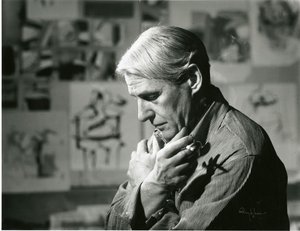
Уилям де Кунинг

Уилям де Кунинг

1904 - 1997, Нидерландия

Quick facts about Уилям де Кунинг

  • Artistic Movement Or Style: Абстрактен експресионизъм
  • Artists Or Movements Influenced By This Artist: ['New York School']
  • Artists Who Influenced This Artist:
    • Аршиле Горки
    • Stuart Davis
    • John Graham
  • Date Of Birth: 24 април 1904
  • Date Of Death: 19 март 1997
  • Full Name: Willem de Kooning
  • Nationality: Нидерландски-американец
  • Notable Artworks:
    • Woman I
    • Marilyn Monroe
    • Reclining Man (JFK)
    • Excavation
  • Place Of Birth: Роттердам, Нидерландия

Биография на художника

A Life Forged in Abstraction

Willem de Kooning, a name synonymous with the raw energy and emotional depth of Abstract Expressionism, was born in Rotterdam, Netherlands, in 1904. His early life was marked by a familial split – his parents divorced when he was young – which perhaps instilled within him a sense of restless searching that would permeate his artistic journey. Leaving formal schooling at twelve, de Kooning apprenticed with a commercial art firm, laying the groundwork for his technical skill while simultaneously fueling a desire to break free from conventional constraints. Evening classes at the Academie van Beeldende Kunsten en Technische Wetenschappen in Rotterdam provided further foundational training, but it was a yearning for something more – a bolder, more expressive language – that ultimately propelled him towards America in 1926. His arrival wasn’t straightforward; he famously stowed away on a ship, embodying the spirit of an outsider seeking new horizons. New York City became his adopted home, and its vibrant, often gritty energy profoundly shaped his evolving style. He navigated various jobs – house painter, carpenter – all while relentlessly pursuing his artistic vision, absorbing the city’s pulse into his work.

From Urban Scenes to Abstract Fury

De Kooning's early paintings reflected his immediate surroundings: urban landscapes and portraits that captured the dynamism of New York life. These works, often rendered in muted tones and characterized by a sense of movement, offered a glimpse into the burgeoning metropolis. However, these were merely stepping stones towards a more profound exploration of form and emotion. A pivotal moment came with his connection to Arshile Gorky, whose influence proved transformative. Gorky encouraged de Kooning’s experimentation with abstraction, fostering a willingness to dismantle traditional representation in pursuit of something deeper. De Kooning began to loosen his brushwork, layering colors and creating gestural marks that conveyed feeling rather than precise detail. This shift marked the beginning of a radical departure from representational art, laying the foundation for his later, more abstract works. The 1930s saw de Kooning engage with social realism and mural projects through the Works Progress Administration (WPA), a period that honed his skills but also highlighted the limitations of purely representational art. He found himself drawn to the work of Stuart Davis and John Graham, artists who were pushing boundaries in their own right, exploring new ways to capture the energy and complexity of modern life. This confluence of influences gradually steered him away from literal depiction and toward an increasingly abstract vocabulary.

The Woman Series: A Landmark Achievement

Following World War II, de Kooning emerged as a central figure in the burgeoning Abstract Expressionist movement. This period marked a turning point, culminating in his iconic “Woman” series (1950-1953). These paintings – including the monumental *Woman I*, *Woman II*, and *Woman III* – are not merely depictions of female figures; they are visceral explorations of femininity, sexuality, and the complexities of human emotion. Characterized by aggressive brushstrokes, fragmented forms, and a jarring juxtaposition of colors, the “Woman” series challenged conventional notions of beauty and representation. They were controversial, even shocking to some, but their power lay precisely in their refusal to conform. De Kooning wasn’t interested in creating idealized images; he sought to capture the raw, untamed essence of his subjects. The figures are often distorted and unsettling, reflecting a deeper psychological landscape. Alongside this series, works like *The Glazier* and *Excavation* further demonstrated his dynamic approach to painting, showcasing a masterful command of texture, color, and composition. He didn't shy away from chaos or ambiguity; instead, he embraced them as integral components of his artistic language.

Evolving Landscapes and Enduring Legacy

In the 1960s and beyond, de Kooning’s style underwent another significant evolution. While abstraction remained central to his work, landscape elements began to play a more prominent role, often rendered with a brighter palette and a looser, more fluid brushstroke. He continued to experiment relentlessly throughout his life, exploring different techniques and materials, never content to rest on his laurels. He revisited themes from earlier periods, incorporating them into new compositions with a renewed sense of freedom and experimentation. His later works – such as *Easter Monday* (1976) – demonstrate a remarkable ability to reinvent himself while remaining true to his core artistic principles. De Kooning’s historical significance is undeniable. He helped establish New York City as a global center for art, challenging the dominance of European traditions and paving the way for future generations of artists. His work continues to inspire awe and provoke debate, reminding us of the power of abstraction to convey profound emotional truths. Willem de Kooning passed away in 1997, leaving behind a vast and influential body of work that stands as a testament to his unwavering commitment to artistic innovation and his enduring legacy as one of the most important American artists of the 20th century. His paintings are not just objects; they are windows into a complex and intensely felt inner world.

Key Influences

De Kooning’s artistic development was shaped by a diverse range of influences, both formal and personal. Early exposure to commercial art instilled in him a strong sense of technical skill and an understanding of visual communication. The work of European masters like Picasso and Matisse provided inspiration for his early explorations of form and color. However, it was the encounter with Arshile Gorky that proved particularly transformative, encouraging him to abandon traditional representation and embrace abstraction. Furthermore, the vibrant energy of New York City itself – its diverse population, its rapid pace of change, its gritty underbelly – served as a constant source of stimulation and inspiration. The works of Stuart Davis and John Graham also played a significant role in shaping his artistic vision, demonstrating the possibilities of capturing modern life through abstraction.

§ 5Comparanda

§ 6Questions

Бърза информация

  • Subject or theme: Portraiture
  • Artistic style: Bold abstraction
  • Artist: Willem de Kooning
  • Dimensions: 62 x 92 cm
  • Location: Hirshhorn Museum and Sculpture Garden, Smithsonian Institution
  • Notable elements or techniques: Gestural brushstrokes; Clock motif

§ 7Cite this entry

AllPaintingsStore.com, “Уилям де Кунинг, Secretary (1948)”, https://allpaintingsstore.com/bg/art/willem-de-kooning-secretary-AS7MLH-en/ArtistReproduction/ (accessed 5 Октомври 2026).

§ 8The reproduction

Ръчно изработена маслена репродукция

Ръчно рисувана маслена картина върху платно във вашия размер и рамка, изработена по поръчка от нашите художници. ( Превключване към принт Превключване към дигитално изображение)

It is specified on the order sheet in the margin; the present state of that sheet reads as follows.

Secretary

Вид репродукция

Размер на репродукцията

-

Елитен старши художник

Повече детайлност, изящество и допълнително време за производство

-

Рамка за репродукция

-

-

За произведения на изкуството или репродукции, чийто размер е над 105 см (приблизително 41 инча) във всяка страна, рамката ще бъде изпратена в разглобен вид като комплект за сглобяване. Този метод гарантира безопасна доставка и предотвратява повреди по време на транспортиране.

Изисква се професионално сглобяване – това не е продукт за самостоятелна изработка (DIY).
Комплектът трябва да бъде сглобен, а платното – опънато от опитен професионален багер, като се използва дървено лепило (не е включено в комплекта), клещи за опъване на платно и затягащи скоби, за да се поддържа правотата на подрамника, докато лепилото изсъхне. Неправилното сглобяване или неравномерното опъване на платното може трайно да повреди произведението и не е покрито от нашата гаранция.

  • Всички елементи от масивна дървесина са включени, прецизно изрязани по размер.

  • Сглобява се с предоставените винтове, както и с лепило за дърво за ъгловите връзки, което не е включено в комплекта и трябва да бъде осигурено от вашия рамкар.

  • Изискват се професионални инструменти, които не са включени: щипка за опъване на платно (натягач) и скоби за фиксиране на подрамниците под прав ъгъл, докато лепилото изсъхне.

Важно:
За сглобяването на ъглите е необходимо лепило за дърво, рейките трябва да се фиксират с клещи (затягащи скоби, докато лепилото изсъхне напълно, а за опъването на платното върху готовата рамка е необходим инструмент за опъване на платно. Нито един от тези артикули не е включен в комплекта. Моля, осигурете услугите на опитен професионалист по багетно окантоване, преди да поръчате този размер.

Етикет с име

-

-

Защитен лак

Гланцов лак (подсилва цветовете и предпазва от светлина и влага)

-

Персонализирай моето произведение

Примери за възможности за персонализация: Заменете лицето със снимка на клиента; Добавете домашен любимец (например, заменете котка с куче); Включете скрито съобщение във фона; Променете пейзажа или елементите на фона.

-

Спешно

Доставка по целия свят () в рамките на 3-4 седмици вместо стандартните 5 седмици. (2 Ноември). Без компромис с качеството.

-

Експресна доставка

Доставка по целия свят () в рамките на 5 седмици. (9 Ноември).

Включена

Обща цена

€ 229

Included with every order

  • Безплатна експресна доставка по целия свят
  • Висококачествено ленено платно
  • Пълно застраховане на доставката
  • Гаранция за възстановяване на митнически такси
  • Гаранция за пълно съответствие на цветовете
  • Политика за връщане в рамките на 100 дни (само при дефекти)
  • 100% Гаранция за връщане на сумата
  • Оферта за отстъпка при поръчка на повече бройки
Order sheet