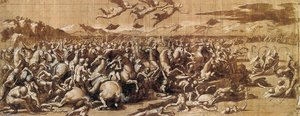
The Steward of Raphael’s Legacy
In the golden, transformative era of the Italian Renaissance, few figures embody the transition from High Renaissance harmony to the stylized elegance of Mannerism as intimately as Giovanni Francesco Penni. Known to history by the affectionate moniker “il Fattore”—the Steward—Penni was far more than a mere administrator of artistic affairs; he was a vital conduit through which the divine grace of Raphael Sanzio flowed into a new generation. Born in Florence around 1488, Penni’s early life was steeped in the meticulous traditions of his family's textile trade. This background, rooted in the appreciation of intricate patterns and decorative splendor, would later manifest in his profound ability to execute works of immense ornamental beauty and technical precision.
Penni’s destiny was irrevocably entwared with the workshop of Raphael, the epicenter of Roman artistic life. As an apprentice and eventually a principal assistant, he did not merely observe the master; he breathed the same creative atmosphere that produced the Vatican’s most celebrated frescoes. His role in the studio was so significant that he was entrusted with managing the domestic and professional affairs of the great master, a responsibility that earned him his famous nickname. This proximity allowed Penni to absorb Raphael's mastery of idealized beauty, balanced composition, and the soft, luminous skin tones that defined the era, yet Penni possessed an innate drive to push these boundaries toward the more dramatic, elongated, and complex aesthetics of the emerging Mannerist movement.
Mastery in the Vatican and Beyond
The true scale of Penni’s talent is most visible in his contributions to the monumental decorative programs of the Vatican Palace. Within the legendary Stanze di Raffaello, Penni worked alongside the master to breathe life into biblical narratives, demonstrating a technical prowess that earned him a place in Raphael's own will as an heir. His hand can be seen in the delicate execution of historical scenes, where he navigated the difficult task of maintaining the master's stylistic integrity while injecting his own sense of invention. One of his most ambitious undertakings involved completing the unfinished Cartounella della Madonna di San Francesco, a feat that showcased his ability to handle large-scale compositions with both grace and structural clarity.
Beyond the walls of the Vatican, Penni’s artistry was characterized by a singular felicity in landscape and a graceful execution that could captivate even the most discerning patrons. His works often featured:
- Dramatic Religious Narratives: Utilizing the interplay of light and shadow to heighten the emotional weight of sacred scenes.
- Ornamental Detail: A lingering influence from his Florentine roots, visible in the rich textures of fabrics and architectural elements.
- Stylized Forms: An early adoption of Mannerist tendencies, where figures began to take on more elegant, elongated, and rhythmic poses.
A Journey Through Mantua and Naples
As the artistic tides shifted following Raphael's untimely death in 1520, Penni’s career took a nomadic and transformative path. In 1526, he moved to Mantua, seeking patronage under Giulio Romano, the brilliant successor to Raphael’s mantle. While Mantua was then a laboratory for the flamboyant and often eccentric experiments of Mannerism—most notably within the walls of the Palazzo Te—Penni’s reception was marked by the complexities of navigating a changing political and artistic landscape. The resistance he faced from certain Mantuan elites suggests a man caught between two worlds: the classical stability of his training and the restless, avant-garde energy of the new age.
The final chapter of Penni’s life led him to Naples, a city that would serve as his final refuge and creative stage until his death in 1528. Though much of his fresco work has been lost to time, leaving behind a precious but fragmented legacy, the surviving oil paintings and studies reveal an artist of immense versatility. From the tender devotion found in works like Madonna with the Blue Diadem to the complex compositions of the Holy Family, Penni remains a crucial figure for understanding how the perfection of the High Renaissance evolved into the expressive, sophisticated language of Mannerism. He stands not just as an assistant to a giant, but as a master in his own right, whose brush helped bridge the gap between the classical past and the dramatic future of Italian art.
Въпроси и отговори
Мога ли да разгледам творбите на Giovan Francesco Penni чрез ключови думи?
Работите на Giovan Francesco Penni могат да бъдат разгледани по ключови думи на страницата за произведения на Giovan Francesco Penni чрез По ключови думи. Всяка ключова дума групира съответните произведения на изкуството.
Мога ли да разгледам творбите на Giovan Francesco Penni по теми?
Страницата Атлас по теми представя творбите на Giovan Francesco Penni по теми.
Мога ли да разгледам творбите на Giovan Francesco Penni според цветния спектър?
Работите на Giovan Francesco Penni могат да бъдат разгледани по цвят на страницата Спектрален индекс на художника.