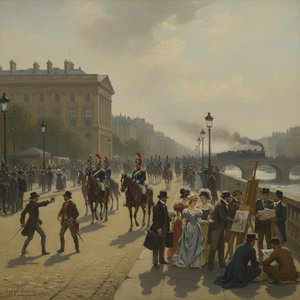
A Legacy of Devotion: The Artistry of Eugène Goyet
In the vibrant and often turbulent landscape of 19th-century French art, certain names resonate with the thunder of battle or the radical shifts of Impressionism, yet others occupy a more sacred, quiet space. Eugène Goyet (1798–1857) belonged to this latter group—a painter whose brush was guided by an unwavering sense of faith and a profound respect for the dignity of his subjects. Born in Paris, Goyet emerged not merely as a skilled technician but as a storyteller of the soul, capable of translating complex theological narratives into visual experiences that moved the hearts of the faithful and the critics alike.
Goyet’s artistic foundation was laid within the prestigious atelier of Antoine-Jean Gros, one of the most celebrated history painters of the era. Under Gros’s mentorship, Goyet mastered a style that balanced the monumental grandeur of Neoclassic tradition with an emerging sense of Romantic realism. This training instilled in him a disciplined approach to composition and a remarkable command over light and shadow, which he would later use to imbue his religious subjects with a palpable, human warmth. While his mentor often focused on the epic scale of Napoleonic triumphs, Goyet turned his gaze inward, seeking the divine within the intimate and the emotional.
The Sacred Canvas: Themes and Technique
The true essence of Goyet’s oeuvre lies in his ability to bridge the gap between the celestial and the terrestrial. His paintings of Christ and various saints were not merely static icons; they were living, breathing studies of compassion, sorrow, and spiritual ecstasy. He possessed a rare talent for capturing the subtle nuances of human emotion—the heavy brow of a suffering martyr or the serene, luminous gaze of a saint. This mastery of anatomy and drapery allowed him to create works that felt both physically grounded and spiritually transcendent.
His technical prowess was frequently recognized by the Paris Salon, where his work was regularly selected for exhibition beginning in 1827. The breadth of his talent extended beyond the purely religious into the realm of portraiture, where he demonstrated a sophisticated understanding of character and status. Notable highlights of his career include:
- The Portrait of Pope Pius IX: His most prestigious commission from 1847, which captured the solemn authority and dignified repose of the papacy with exquisite sensitivity.
- Religious Installations: Numerous paintings of Christ and saints that were commissioned for churches and public buildings throughout France, leaving a lasting imprint on the nation's religious landscape.
- Portraiture of Kinship: A moving 1833 portrait of his father, Jean-Baptiste Goyet, which earned him a silver medal and was praised by critics for its vigorous execution and resemblance to the great Flemish masters.
A Family of Artists and Historical Significance
Artistry was a shared language within the Goyet household. Eugène did not work in isolation; he was part of a vibrant family atelier located at 3 Rue de l'Abbaye in Paris. He was the son of the self-taught artist Jean-Baptiste Goyet and the husband of Zoé Goyet, a talented pastel portraitist in her own right. This domestic environment of shared creativity and mutual influence shaped his development, fostering a lifelong dedication to the craft that saw him exhibit over fifty paintings at the Salon throughout his career.
Though history may not always place him alongside the giants of the avant-garde, the significance of Eugène Goyet remains undeniable. He served as a vital link in the continuity of French academic and religious painting, preserving a sense of grace and reverence during a century of rapid social change. His works remain a testament to the power of art to serve as a vessel for faith, capturing the eternal through the meticulous application of paint and the profound observation of the human condition.
Въпроси и отговори
Колко произведения на Goyet Eugène са налични за разглеждане?
Можете да разгледате 6 произведения на изкуството творби на Goyet Eugène на страницата Всички произведения на изкуството.
В коя историческа епоха е творил Goyet Eugène?
Goyet Eugène е творил в периода на 19th Century. Този период определя историческия контекст на творчеството на художника.
Колко популярни са произведенията на Goyet Eugène?
Статистиката за творбите на Goyet Eugène е достъпна на Статистика страницата на художника.