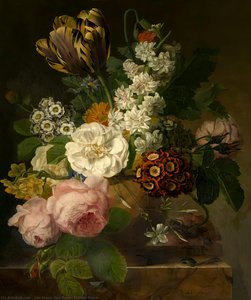
A Life Dedicated to Floral Splendor: Jan Frans van Dael
Jan Frans van Dael, born in Antwerp in 1764 and passing away in Paris in 1840, was a Flemish painter who cultivated a remarkable career specializing in the delicate art of still life—particularly flowers and fruit. While his name may not be as instantly recognizable as some of the Old Masters, Van Dael’s work embodies a refined elegance and technical skill that secured him patronage among the highest echelons of French society during the Empire and Restoration periods. His journey reflects a fascinating intersection of Flemish tradition and Parisian sophistication.
Early Training and Parisian Embrace
Van Dael's artistic beginnings were rooted in architectural drawing at the Antwerp Academy, where he distinguished himself by winning first prizes in 1784 and 1785. However, his path took a decisive turn when he relocated to Paris in 1786. Initially residing within the artists’ quarters of the Louvre, he found himself amidst a vibrant community that included fellow painters like Piat Joseph Sauvage, Gerard van Spaendonck, and Pierre-Joseph Redouté—artists who would significantly influence his development. He initially worked as a decorator, contributing to projects at prestigious châteaux such as St. Cloud, Bellevue, and Chantilly. This early experience honed his meticulous attention to detail and appreciation for decorative arts, qualities that would later define his still lifes.
The Bloom of a Unique Style
Under the guidance of van Spaendonck, Van Dael transitioned from decoration to flower painting, discovering a true calling. He regularly exhibited at the Paris Salon between 1793 and 1833, steadily gaining recognition for his compositions. His success wasn’t merely aesthetic; it was also strategic. Van Dael skillfully blended the sober composition and precise detail characteristic of Flemish flower painting—think Roelandt Savery—with a distinctly French-inspired monumentality. This fusion appealed to the tastes of an increasingly discerning clientele, including Empress Josephine, who owned five of his works, and later, Marie-Louise Bonaparte, Louis XVIII, and Charles X.
Patronage and Artistic Legacy
Van Dael’s career flourished under imperial and royal patronage. He wasn't simply *painting* flowers; he was crafting opulent displays that reflected status and refined taste. His compositions often featured a diverse array of species, meticulously studied from life, demonstrating his botanical knowledge alongside artistic skill. He became a member of the Academies of Antwerp and Amsterdam, solidifying his position within the art world. Beyond his own creations, Van Dael was also an avid collector of works by other flower artists—both contemporaries and masters like Jan Davidsz. de Heem, Abraham Mignon, Rachel Ruysch, and Jan van Huysum—suggesting a deep engagement with the history of his chosen genre.
A Lasting Impression
Jan Frans van Dael’s influence extended beyond his own brushstrokes. He nurtured a generation of pupils, including Jean Benner-Fries, Elise Bruyère, Laurent Coste, Vicomtesse Iphigénie Decaux-Milet-Moreau, Henriëtte Geertruida Knip, Elisa-Emilie Le Mire, Auguste Piquet de Brienne, Christiaan van Pol, and Jean Ulrich Tournier. He spent his entire active career in France, dying in Paris in 1840 and finding final rest alongside his friend van Spaendonck in the Père Lachaise cemetery. Today, his works can be admired in museums like Museum Smidt Van Gelder in Antwerp, offering a glimpse into the serene beauty and technical mastery of an artist who dedicated his life to capturing the ephemeral splendor of flowers.
Въпроси и отговори
Как се развива изкуството на Jan Frans Van Dael с течение на времето?
Хронологичен преглед на творчеството на Jan Frans Van Dael може да бъде открит на страницата Хронология, където произведенията са подредени по ред на създаване им, разделени на периоди.
Къде могат да бъдат намерени произведенията на Jan Frans Van Dael, разпределени по теми?
Атлас по теми на Jan Frans Van Dael е страница, която класифицира творбите на художника според техните сюжети.
В кой град и държава е роден/а Jan Frans Van Dael?
Jan Frans Van Dael е роден в Antwerp, Belgium.