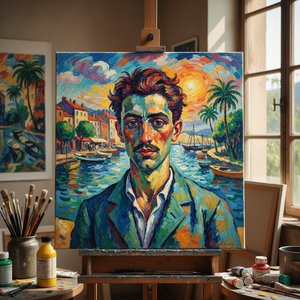
1905. Acrylic On Canvas. Philadelphia Art Museum.

§ 1Katalogová data


§ 2Abstraktní
Popis sbírného předmětu
Experience Henri Matisse and André Derain’s revolutionary Fauvist masterpiece, ‘A Dialogue of Color,’ a vibrant exploration of artistic collaboration through bold pigment and dynamic composition – perfect for art lovers seeking a unique statement piece.
 Zobrazit více
Biografie umělce
André Derain (1880-1954): Francouzský malíř, zakladatel fauvizmu s revolučními barvami a expresivní technikou. Objevte jeho londýnské obrazy a cestu k klasicismu.
§ 3Komentář
Henri Matisse and André Derain: A Dialogue of Color
The painting “Henri Matisse and André Derain,” completed in 1905 by Henri Matisse and André Derain, stands as a cornerstone of Fauvist art—a movement that irrevocably altered the course of European painting. More than just a portrait of two prominent artists, it’s an exploration of artistic collaboration and a testament to the transformative power of color as expressive language.
Matisse, already establishing himself as a visionary innovator, approached Derain with a proposition: to capture their friendship through a bold experiment in pigment. Departing from Impressionistic subtleties, they deliberately rejected blending colors on the palette, opting instead for juxtaposing pure hues—scarlet reds, ochre yellows, and deep browns—directly onto the canvas. This technique, championed by Matisse himself, prioritized visual impact over accurate representation, prioritizing emotion and sensation.
The composition itself is deceptively simple. Two men sit in chairs positioned near a beach, bathed in diffused sunlight. However, it’s the color scheme that dominates the viewer's gaze. The dominant red of Derain’s turban immediately draws attention, creating a visual anchor against which Matisse’s muted tones—primarily greens and browns—provide contrast. This deliberate imbalance isn’t merely stylistic; it symbolizes the dynamic interplay between their personalities – Derain’s assertive presence countered by Matisse’s contemplative gaze.
Historically, “Henri Matisse and André Derain” emerged during a period of fervent artistic debate. Impressionism had begun to wane, paving the way for movements like Neo-Impressionism and Symbolism. Yet, Fauvism pushed boundaries even further, rejecting academic conventions altogether. Matisse and Derain’s decision to prioritize color above form was seen as rebellious—a defiant assertion of artistic freedom against the constraints of tradition.
Beyond its formal innovations, the painting resonates with a profound emotional depth. The serene setting evokes memories of childhood summers, while the figures themselves convey a sense of quiet contemplation and companionship. Matisse’s masterful brushstrokes capture not just physical likeness but also intangible qualities—the warmth of friendship, the beauty of nature, and the enduring spirit of artistic exploration.
The painting's influence extends far beyond its time. It served as an inspiration for subsequent generations of artists who sought to harness color’s expressive potential. Today, reproductions of “Henri Matisse and André Derain” continue to captivate audiences worldwide, demonstrating the timeless appeal of this seminal work.
Otázky a odpovědi
Kolik let bylo André Derain, když vzniklo dílo „Henri Matisse“?
André Derain bylo 25 let, když v roce 1905 vytvořilo dílo „Henri Matisse“. Věk je vypočítán z roku narození umělce, 1880.
Z jaké země pochází dílo Fauvist Movement s názvem "Henri Matisse"?
Dílo „Henri Matisse“ vytvořil/a André Derain, narozený/á v Francie, v rámci směru Fauvist Movement. Původ umělce/umělkyně propojuje toto dílo s Fauvist Movement, jak jej praktikují umělci z Francie.
Jak intenzivní jsou barvy v díle „Henri Matisse“ od André Derain?
„Henri Matisse“ od André Derain má Vivid barevnou intenzitu.


 Přepnout na tisk


 U děl nebo reprodukcí, u nichž je jakákoliv strana větší než 105 cm (přibližně 41 palců), bude rám dodán jako sestava v rozloženém stavu. Tato metoda zajišťuje bezpečné doručení a chrání dílo před poškozením během přepravy.