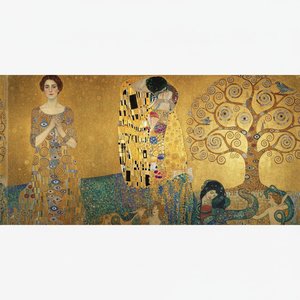
1907. Acrylic On Canvas, 430.0 x 300.0 cm.

§ 1Catalogue data

- 430.0 x 300.0 cm


§ 2Abstract
Popis sbírného předmětu
Executed in Art Nouveau style, *Philosophy* showcases Klimt’s signature blend of symbolism and realism. Its asymmetrical composition features intertwined nude figures representing stages of life, contrasted by a vast sky with a sphinx motif. The color palette utilizes earthy tones accented by gold leaf, enhancing the painting's opulent visual impact.
 Zobrazit více
Biografie umělce
Gustav Klimt (1862-1918) – rakouský malíř zlaté éry, zakladatelí Vídeňské secese. Jeho díla: *Polibek*, *Uteček*. Symbolismus, dekorativní umění a oslnivá zlatá paleta.
§ 3Commentary
Gustav Klimt’s Philosophy (Final State): A Symphony of Symbolism and Controversy
Gustav Klimt's *Philosophy*, a painting that embodies the essence of symbolism and controversy, stands as a defiant emblem of Art Nouveau’s rebellious spirit. Created between 1899 and 1907 for the University of Vienna’s Great Hall ceiling project—a commission fraught with expectation and critique—this monumental artwork transcends mere visual representation to grapple with profound philosophical questions about existence itself.
- The Visionary Composition: Klimt eschewed academic conventions, opting instead for an asymmetrical arrangement that immediately captivated and unsettled viewers. The left side depicts a procession of nude figures representing humanity’s lifecycle—from infancy to old age—a deliberate challenge to idealized depictions of the human form prevalent in his time. Conversely, the right hemisphere is dominated by a vast expanse of sky punctuated by a colossal sphinx, symbolizing mystery and the unknowable dimensions of reality.
- Art Nouveau Technique: Klimt’s masterful execution showcases the hallmarks of Art Nouveau—a style characterized by flowing lines, organic forms, and opulent ornamentation. He employed tempera on canvas, meticulously layering gold leaf onto textured surfaces to create a shimmering visual experience that mirrored the richness of Byzantine mosaics. This technique wasn't merely decorative; it served as a conduit for conveying spiritual depth and elevating the artwork beyond the mundane.
- Symbolic Resonance: The painting’s core thematic concern revolves around philosophy—understood not as rational inquiry but as an embrace of paradox and contemplation. At its heart lies a woman figure, partially veiled in darkness, representing wisdom and knowledge. Klimt deliberately obscured her face, fostering an aura of enigma and prompting viewers to confront the complexities inherent in seeking understanding.
- Historical Context & Criticism: The initial reception of *Philosophy* was overwhelmingly negative within Austria’s artistic circles. Critics denounced it as sexually provocative and deemed unsuitable for academic spaces—a judgment fueled by anxieties surrounding societal morality. Despite this vehement opposition, Klimt secured international acclaim thanks to a prestigious award at the Paris World Exhibition in 1900.
- Legacy & Preservation: Tragically, *Philosophy* perished during the devastation of World War II, leaving only preparatory sketches and photographic documentation as tangible reminders of its grandeur. Nevertheless, it remains an enduring testament to Klimt’s artistic courage—a beacon of Symbolist innovation that continues to inspire admiration for its beauty and intellectual ambition. Today, reproductions of *Philosophy* can be found in prominent museums like Museo d’Arte Moderna Ca’ Pesaro and Schloss Immendorf, allowing audiences worldwide to experience the transformative power of Klimt's vision.
Otázky a odpovědi
Kdo vytvořil "Philosophy (final state)"?
Dílo "Philosophy (final state)" vytvořil/a Gustav Klimt. Informace na této stránce popisují originální dílo umělce Gustav Klimt.
Jak lze využít dílo „Philosophy (final state)“ od Gustav Klimt při dekorování interiéru?
Dílo „Philosophy (final state)“ od Gustav Klimt se doporučuje pro Accent, ideálně do Living Room. Způsob využití a prostor společně určují, kam se reprodukce hodí.
Je dílo „Philosophy (final state)“ volné z autorských práv?
Dílo „Philosophy (final state)“ od Gustav Klimt spadá do v rámci volného užití – autorská práva vypršela. Tento stav určuje pravidla pro reprodukci obrazu tohoto díla.


 Přepnout na tisk


 U děl nebo reprodukcí, u nichž je jakákoliv strana větší než 105 cm (přibližně 41 palců), bude rám dodán jako sestava v rozloženém stavu. Tato metoda zajišťuje bezpečné doručení a chrání dílo před poškozením během přepravy.