Záruka vrácení peněz · 100 dní Doprava po celém světě zdarma
449 564umělecká díla 30 613umělci 4 660muzea 32jazyky
Záznam v katalogu

Green Lovers

1915. Gouache, 48.0 x 45.0 cm.

Obr. 1. Marc Chagall, Green Lovers, 1915. Zobrazeno jako vámi zvolená reprodukce: , .

§ 1Katalogová data

Rozměry
48.0 x 45.0 cm

§ 2Abstraktní

Popis sbírného předmětu

A tender embrace of green-clad figures defines this 1915 Synthetic Cubist masterpiece by Marc Chagall, blending geometric dreamscapes with profound intimacy that invites you to explore his legendary world of color.

Biografie umělce

Poznejte klidnou krásu obrazu „Ležící básník“ Marca Chagalla – ikonického díla z roku 1915 kombinujícího kubismus a symbolismus. Objevte jeho tajemství a emoční hloubku!

§ 3Komentář

A Tender Embrace Captured in Geometric Dreams: Exploring Marc Chagall’s “Green Lovers”

Marc Chagall's "Green Lovers," painted in 1915, stands as a cornerstone of Synthetic Cubism and an enduring testament to the artist’s singular vision. More than just a depiction of two figures sharing a kiss—though that intimate gesture is undeniably central—the painting delves into profound themes of harmony, memory, and the transformative power of imagination. Its genesis in Vitebsk, Belarus, reflects Chagall's deeply rooted connection to his Jewish heritage and informs an aesthetic sensibility characterized by fantastical imagery and vibrant color palettes.
  • Style & Influence: Chagall’s foray into Cubism wasn’t a straightforward embrace of the movement’s geometric principles; rather, he skillfully adapted them—flattening surfaces and layering overlapping planes—to convey emotional depth. This approach distinguishes him from Picasso and Braque, who pursued a more rigorously analytical interpretation of form.
  • Technique: Executed in gouache on canvas, “Green Lovers” showcases Chagall’s masterful control over color and texture. The dominant green hue isn't merely decorative; it symbolizes balance and tranquility, mirroring the serenity conveyed by the lovers’ embrace. Bold lines delineate shapes, creating a dynamic interplay that captures the intensity of their connection.
  • Symbolism: The open mouths of the figures are laden with symbolic significance—representing vulnerability, openness, and an unspoken yearning for communion. Chagall's incorporation of folkloric motifs—flying figures reminiscent of biblical narratives—further elevates the painting beyond a simple portrait, transforming it into a meditation on spirituality and human experience.

Historical Context: Cubism’s Disruptive Innovation

Painted during a period of seismic artistic upheaval, “Green Lovers” embodies the spirit of Synthetic Cubism—a reaction against Analytical Cubism's dissection of objects into geometric fragments. Artists like Chagall were actively challenging conventions and experimenting with new ways to represent reality, driven by a desire to express emotion and explore subconscious realms. This painting reflects the broader cultural anxieties of the time—the looming shadow of World War I—yet it retains an unwavering optimism rooted in Chagall’s belief in the enduring beauty of human relationships.

Emotional Resonance: A Dreamlike Portrait

“Green Lovers” transcends mere visual representation; it evokes a palpable sense of tenderness and longing. The artist's ability to distill complex emotions into simplified forms—particularly the expressive faces of the lovers—is remarkable. Consider how Chagall utilizes color – predominantly shades of blue and green – not just for aesthetic appeal but as conduits for conveying mood and atmosphere. It’s this profound emotional impact that ensures “Green Lovers” continues to resonate with audiences today, cementing Chagall's legacy as one of the most influential artists of the 20th century.

Contemporary Relevance: Inspiration for Interior Designers

Today, reproductions of "Green Lovers" offer a captivating opportunity to infuse spaces with artistic elegance and evoke feelings of warmth and connection. Its stylized depiction of intimacy—combined with its harmonious color scheme—makes it ideal for creating serene environments that celebrate beauty and human emotion. Collectors appreciate the painting’s historical significance and Chagall's pioneering contribution to modern art, recognizing it as a masterpiece of Synthetic Cubism.

Otázky a odpovědi

Je k dispozici vysokorozlišená verze ke stažení díla "Green Lovers"?

Digitální obraz díla „Green Lovers“ od Marc Chagall si můžete zakoupit na jeho stránce pro digitální objednávky Digitální snímek: stažení digitálního obrazu ve vysokém rozlišení.

O čem "Green Lovers" je a jakou atmosféru vyzařuje?

„Green Lovers“ od Marc Chagall zachycuje lovers, kiss, green, geometric, harmony, expression, folklore v Romantic náladě. Předmět a atmosféra dohromady definují toto dílo.

V jakém roce a v rámci kterého uměleckého směru bylo dílo "Green Lovers" vytvořeno?

Dílo "Green Lovers" vzniklo v roce 1915 v rámci směru Synthetic Cubism.
§ 4Autor díla

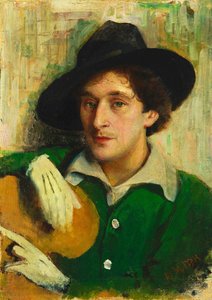
Marc Chagall

Marc Chagall

1887 - 1985, Belorusko

Rychlé informace o umělci Marc Chagall

  • Artistic Movement Or Style: Modernismus, Kubismus
  • Artists Or Movements Influenced By This Artist:
    • Surrealismus
    • Moderní umělci
  • Artists Who Influenced This Artist:
    • Bakst
    • Delaunay
    • Borovikovsky
  • Date Of Birth: 6 července 1887
  • Date Of Death: 28. března 1985
  • Full Name: Marc Chagall
  • Nationality: Rusko (nyní Bělorus)
  • Notable Artworks:
    • I a vesnice
    • Nad Vitebskem
    • Bílá křížová cesta
  • Place Of Birth: Liozna, Belarus

Biografie umělce

A Life Painted in Dreams: The World of Marc Chagall

Marc Chagall, born Moishe Shagal in 1887 in the small Belarussian town of Liozna near Vitebsk, wasn’t merely a painter; he was a poet of color, a weaver of dreams, and a chronicler of memory. His life, spanning nearly a century, mirrored the tumultuous currents of the 20th century, yet his art remained steadfastly rooted in a deeply personal vision—one infused with the folklore of his Hasidic Jewish upbringing and an unwavering belief in the power of imagination. Vitebsk itself was more than just a birthplace; it became the emotional core of his artistic universe, a recurring motif populated by flying figures, whimsical animals, and the vibrant hues of remembered landscapes. The town’s unique blend of cultures—Russian Orthodox churches alongside bustling Jewish marketplaces—forged an aesthetic sensibility that would defy easy categorization throughout his long career. Though he sought formal training first with a local sign painter and later in St. Petersburg under Léon Bakst, and then in Paris at the Académie de la Grande Chaumière, Chagall never fully embraced any single artistic movement. He absorbed elements of Cubism, Symbolism, and Fauvism, but always filtered them through his own intensely personal lens, creating a style that was uniquely, unmistakably Chagall.

Early Years and Artistic Beginnings

Chagall’s formative years were marked by hardship and displacement. Born into a Jewish family in Vitebsk, he experienced the trauma of pogroms—violent anti-Jewish riots—which instilled in him a profound awareness of persecution and loss. Despite these challenges, Chagall possessed an innate talent for drawing and painting from a young age. He initially studied at Vitebsk Art School, where he honed his skills under Bakst’s guidance, experimenting with theatrical design alongside visual art. This early exposure to the stage would profoundly influence his later work, particularly his use of stylized figures and dramatic compositions. His artistic explorations continued in St. Petersburg, where he developed a distinctive style characterized by bold colors and expressive brushstrokes—a stylistic approach that foreshadowed his groundbreaking achievements to come.

The Symbolist Influence and Early Paintings

Chagall’s artistic development was significantly shaped by the Symbolist movement, which championed emotion and imagination over realistic representation. Artists like Gustave Moreau and Edvard Munch served as important inspirations, encouraging him to delve into psychological landscapes and explore themes of spirituality and mythology. His early paintings—such as *I and the Village* (1911)—demonstrate this influence vividly. The village isn’t rendered realistically but as a fragmented collection of recollections, imbued with symbolic meaning. Recurring motifs like birds, apples, and windows reflect Chagall's preoccupation with themes of flight, fertility, and transcendence—concepts central to Jewish mysticism and folklore. These images are not merely decorative; they convey profound emotional resonance, capturing the essence of memory and experience.

Cubism and Surrealism: Bridging Formal Movements

While Chagall resisted categorization into any single artistic movement, he skillfully incorporated elements of Cubism and Surrealism into his oeuvre. He embraced Picasso’s pioneering approach to fractured perspectives and geometric abstraction, adapting it to his own expressive style. Simultaneously, he explored the dreamlike imagery and irrational juxtapositions characteristic of Surrealist art—influenced by artists like Dalí and Magritte. This fusion of styles resulted in canvases that defy conventional logic while retaining a palpable sense of emotional intensity. Works like *Over Vitebsk* (1920-1922) exemplify this synthesis, presenting a fantastical depiction of his hometown bathed in luminous colors—a testament to Chagall’s ability to transform personal experience into universal themes.

Mature Years and International Recognition

The 1930s witnessed Chagall's ascent to international fame. He established himself as a celebrated artist in Paris, where he continued to produce monumental paintings that captivated audiences worldwide. The outbreak of World War II forced him to flee occupied France for the United States, seeking refuge in New York City—a period marked by profound emotional upheaval and artistic experimentation. During his time in America, Chagall created some of his most iconic works, including *White Crucifixion* (1938), a haunting meditation on suffering and faith that powerfully captured the anxieties of the era. He returned to France after the war, receiving numerous prestigious commissions—including the ceiling of the Paris Opera—and cementing his legacy as one of the greatest artists of the 20th century. His stained glass windows for Jerusalem’s Hadassah Hebrew University Medical Center synagogue stand as a testament to his enduring vision and artistic prowess. Chagall's influence on subsequent generations of artists is undeniable; he bridged the gap between European modernism and Jewish cultural identity, becoming known as “the quintessential Jewish artist of the twentieth century.” His ability to synthesize personal experience, folklore, and universal themes continues to resonate with audiences worldwide. He left behind a body of work that is both deeply personal and universally accessible, inviting viewers to lose themselves in a world painted with dreams and illuminated by hope.

§ 5Podobná díla

§ 6Otázky

Rychlé informace

  • Title: Green Lovers
  • Subject or theme: Romantic love
  • Dimensions: 48 x 45 cm
  • Medium: Gouache
  • Artistic style: Synthetic Cubism
  • Notable elements or techniques: Bold lines, geometric planes

Artový kvíz

U každé otázky je pouze jedna správná odpověď.

Otázka 1:
In which year was Marc Chagall's 'Green Lovers' painted?
Otázka 2:
Which artistic movement is 'Green Lovers' considered a cornerstone of?
Otázka 3:
What does the dominant green hue in the painting symbolize?
Otázka 4:
What medium was used to execute 'Green Lovers'?
Otázka 5:
According to the description, what is the symbolic significance of the figures' open mouths?

§ 7Citovat tento záznam

AllPaintingsStore.com, “Marc Chagall, Green Lovers (1915)”, https://allpaintingsstore.com/cs/art/marc-chagall-green-lovers-8XYGLC-en/ArtistReproduction/ (dne 10 říjen 2026 zkontolováno).

§ 8Reprodukce díla

Ručně malovaná olejová reprodukce

Rukou malované olejné plátno v libovolném rozměru i s rámem, vyrobené našimi umělci na zakázku. ( Přepnout na tisk Přepnout na digitální obraz)

Je uvedeno na okraji objednávkového listu; aktuální stav tohoto listu zní následovně.

Green Lovers

Technika reprodukce

Rozměry reprodukce

-

Vybraní mistři umění

Vyšší míra detailu, jemnosti a delší doba výroby

-

Možnosti rámování reprodukcí

-

-

U děl nebo reprodukcí, u nichž je jakákoliv strana větší než 105 cm (přibližně 41 palců), bude rám dodán jako sestava v rozloženém stavu. Tato metoda zajišťuje bezpečné doručení a chrání dílo před poškozením během přepravy.

Vyžaduje se odborná montáž – nejedná se o produkt pro svépomocnou realizaci (DIY).
Sestava musí být složena a plátno napnuto zkušeným profesionálním rámovačem s použitím dřevěného lepidla (není součástí balení), kleští na napínání plátna a svorek pro udržení pravých úhlů křížů během schnutí lepidla. Nesprávná montáž nebo nerovnoměrné napnutí plátna může způsobit trvalé poškození uměleckého díla, které není kryto naší zárukou.

  • Jsou zahrnuty všechny lišty z masivního dřeva, přesně na míru nařezané.

  • Sestavuje se pomocí součástí balení (šroubů), plus dřevěného lepidla na rohové spoje, které není součástí balení a musí jej zajistit váš rámovač.

  • Vyžaduje se profesionální nářadí, které není součástí sady: kleště na napínání plátna a svorky pro udržení kolmosti příček během schnutí lepidla.

Důležité:
Spoje v rozích vyžadují lepidlo na dřevo, tyčinky musí být přichyceny pomocí svorek, dokud lepidlo zcela neuschne, a pro napnutí plátna na sestavený rám je zapotřebí kleští na natahování plátna. Žádný z těchto náčiní není součástí sady. Před objednáním této velikosti prosím zajistěte zkušeného profesionálního rámovače.

Popisek díla

-

-

Ochranný lak

Lesklý lak (zvýrazňuje barvy, chrání před světlem a vlhkostí)

-

Přizpůsobit své umělecké dílo

Příklady možných úprav: nahrazení obličeje fotografií zákazníka; přidání domácího mazlíčka (např. výměna kočky za psa); vložení skrytého vzkazu do pozadí; změna krajiny nebo prvků v pozadí.

-

Prioritní doručení

Celosvětové doručení () za 3–4 týdny namísto standardních 5 týdnů. (8 listopad). Bez kompromisů v kvalitě.

-

Expresní doručení

Celosvětová doprava () do 5 týdnů. (15 listopad).

V ceně

Celková cena za vybrané možnosti reprodukcí

Kč 5615

Součást každé objednávky

  • Zdarma celosvětová expresní doprava
  • Vysoce kvalitní lněné plátno
  • Kompletní pojištění přepravy
  • Záruka vrácení celního poplatku
  • Záruka věrného barevného souladu
  • 100dení lhůta pro vrácení zboží (pouze při vadách výroby)
  • 100% záruka vrácení peněz
  • Sleva při více objednávkách
Objednávací formulář