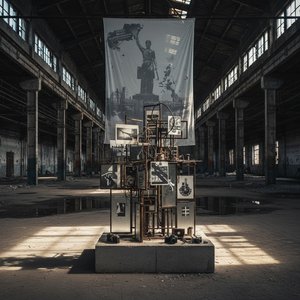
Agnieszka Kurant: Architect of the Invisible
Polish conceptual artist Agnieszka Kurant operates within a fascinating realm where reality and fiction blur, inviting viewers to contemplate the hidden economies that shape our world. Born in Łódź in 1978, her work isn’t simply about creating images; it's an intricate investigation into how systems – economic, social, and cultural – function through layers of abstraction and carefully constructed illusions. Kurant’s practice is deeply rooted in the concept of “the economy of the invisible,” a term she herself coined, referring to the complex networks and forces that operate beyond our immediate perception.
Her early life, marked by her Jewish heritage raised within a Catholic environment, profoundly influenced her artistic perspective. The revelation of her family’s history as Holocaust survivors at a young age sparked a lifelong interest in memory, identity, and the ways in which narratives are constructed and contested. This personal journey informs her broader exploration of collective intelligence – the emergent behavior of groups, whether human or non-human – and the potential for both collaboration and exploitation within these systems.
Education and Early Career
Kurant’s artistic trajectory began with a formal education in Poland, culminating in an MA in Curating from Goldsmiths College in London. This training provided her with a critical lens through which to analyze contemporary art practices and develop the conceptual framework for her own work. Her studies at Goldsmiths were pivotal in solidifying her interest in systems thinking and the intersection of technology, culture, and social dynamics.
Prior to establishing herself as an independent artist, Kurant gained valuable experience working with architecture, collaborating on the Polish Pavilion for the Venice Biennale in 2010 alongside architect Aleksandra Wasilkowska. This project exposed her to the challenges and possibilities of designing immersive environments that engage viewers on multiple levels – intellectually, emotionally, and sensorially. It also honed her skills in creating hybrid forms, a recurring motif in her later work.
The Economy of the Invisible & Phantom Islands
At the heart of Kurant’s artistic practice lies the exploration of “the economy of the invisible.” She doesn't aim to depict concrete realities but rather to expose the underlying structures and processes that govern them. Her projects often involve creating imaginary locations – phantom islands, digital networks, or speculative futures – that serve as metaphors for real-world systems. These fabricated spaces are populated with agents—molecules, animals, artificial intelligence algorithms, or crowds—that interact according to specific rules, generating emergent behaviors and revealing hidden patterns.
Her 2017 work, *Political Map of Phantom Islands*, exemplifies this approach. This series of intricately detailed maps depicts imagined territories that exist only in the realm of speculation and myth. These phantom islands are not simply whimsical creations; they represent a critique of colonial cartography and the ways in which geographical knowledge has been used to exert power and control. The work invites viewers to question the nature of reality itself, prompting them to consider how our perceptions are shaped by the maps we use to navigate the world.
Major Achievements & Recognition
Agnieszka Kurant’s work has garnered significant recognition within the international art community. She was selected as an artist in residence at MIT CAST (2017-2020), a prestigious program that fosters interdisciplinary research and artistic innovation. Her commission for the façade of the Solomon R. Guggenheim Museum in 2015, *The End of Signature*, remains a landmark achievement, transforming the museum’s exterior into a dynamic, ever-changing artwork.
Kurant's work has been exhibited extensively, including solo shows at institutions such as the Center for Contemporary Art, Tel Aviv; SculptureCenter in New York; and the Guggenheim Museum Bilbao. She is represented by Tanya Bonakdar Gallery in New York, where she continues to develop her practice and engage with a wide range of collaborators. Her work has been reviewed extensively in leading art publications like *Artforum*, *Frieze*, and *The New York Times*, cementing her position as a significant voice in contemporary conceptual art.
Looking Ahead
Agnieszka Kurant’s artistic trajectory is characterized by a relentless curiosity about the complex relationships between humans, technology, and the environment. Her ongoing projects continue to explore themes of collective intelligence, surveillance capitalism, and the future of labor and creativity. With her unique blend of conceptual rigor, technical innovation, and evocative imagery, she invites us to reconsider our understanding of reality and imagine new possibilities for a more equitable and sustainable world.
Otázky a odpovědi
Kde mohu najít statistiky o dílech umělce Agnieszka Kurant?
Stránka Statistiky pro umělce Agnieszka Kurant obsahuje statistiky vypočítané z jeho děl uvedených na tato webová stránka.
Mohu si prohlédnout díla umělce Agnieszka Kurant podle barevného spektra?
Díla umělce Agnieszka Kurant si můžete prohlédnout podle barev na jeho stránce Sestavení podle barev.
Kolik děl umělce Agnieszka Kurant je možné si prohlédnout?
Na stránce Všechná umělecká díla si můžete prohlédnout 1 uměleckých děl děl autora Agnieszka Kurant.