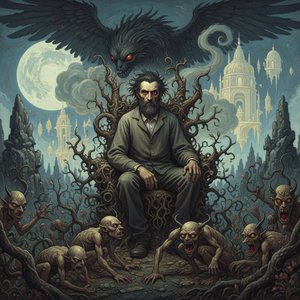
The Ethereal Vision of George Sweet
George Sweet (1909–1997) stands as a profound figure in the mid-20th-century art world, an artist whose work bridged the gap between the tangible reality of the natural world and the boundless reaches of the human subconscious. Born in Cincinnati, Ohio, Sweet’s early life was deeply intertwined with a passion for ornithology. This scientific fascination with birds did more than just provide him with subject matter; it gifted him with a unique way of seeing—a meticulous, observant eye capable of capturing the delicate tension between movement and stillness. As he matured, this biological precision began to merge with a burgeoning interest in the avant-garde, allowing him to transform the landscapes of his memory into dreamlike realms where reality feels subtly altered.
His artistic evolution was significantly shaped by his time at the Pratt Institute in New York City, where he immersed himself in an environment that championed experimentation and creative liberty. During this formative period, Sweet encountered the whispers of European Surrealism, finding deep resonance in the works of masters such as Giorgio Morandi and Yves Tanguy. Rather than adopting a purely abstract approach, Sweet chose to refine a style that prioritized atmosphere and emotional weight over mere photographic accuracy. He learned to use light and texture to evoke a sense of mystery, turning a simple vista into a stage for symbolic storytelling. His transition from the delicate, translucent layers of watercolor to the commanding presence of oil paint marked a pivotal moment in his career, as he began to tackle much larger canvases that demanded a more robust and textural application of pigment.
A Mastery of Landscape and Form
The true magic of Sweet’s oeuvre lies in his ability to render the monumental through the intimate. His landscapes are rarely just depictions of geography; they are psychological spaces. One can see this most clearly in works like Bothwell Castle, held in the St George Church collection. In this sprawling depiction of the Scottish highlands, Sweet utilizes a muted, almost spectral palette to evoke the misty grandeur of the region. Through his brush, the heather moorland and rugged rocky outcrops become more than just earth and stone; they take on an otherworldly presence, suggesting a world that exists just beyond the veil of our perception. His technique allows the viewer to feel the dampness of the mist and the ancient weight of the terrain.
Beyond the sweeping vistas of the natural world, Sweet’s exploration of the human form provided another vital dimension to his artistry. His studies of the nude, such as Seated Nude, demonstrate a profound respect for the sculptural qualities of the body and the quiet power of contemplation. In these works, the influence of Surrealism is felt through the way he treats light and shadow to create a sense of stillness that borders on the sacred. Whether he was painting the intricate details of an avian subject or the soft curves of a human figure, his work remained anchored by a singular goal: to capture the emotional essence of his subject through a lens of heightened reality.
Legacy and Artistic Significance
The historical significance of George Sweet lies in his ability to synthesize disparate influences into a cohesive, personal language. He was a pioneer who successfully navigated the complexities of American landscape painting by infusing it with the psychological depth of Surrealism. His legacy is defined by several key contributions to the art canon:
- Integration of Science and Art: His background in ornithology allowed for a level of anatomical and environmental detail that grounded his more fantastical elements in a believable reality.
- Atmospheric Innovation: He moved away from the rigid realism of his contemporaries, instead using texture and color to prioritize the emotional "mood" of a landscape.
- Cross-Continental Influence: By blending American observational traditions with European avant-garde techniques, he helped expand the boundaries of mid-century modernism.
Today, the works of George Sweet continue to captivate collectors and historians alike. He remains a celebrated figure for those who seek art that does not merely reflect the world as it is, but invites us to imagine the world as it might be in our most profound dreams.
Otázky a odpovědi
Kolik děl umělce George Sweet je možné si prohlédnout?
Na stránce Všechná umělecká díla si můžete prohlédnout 13 uměleckých děl děl autora George Sweet.
Kde mohu vidět barevný profil děl umělce George Sweet?
Použití barev v dílech umělce George Sweet uvedených na tato webová stránka můžete prozkoumat na stránce Genom palety tohoto umělce.
V jakém historickém období působil/a George Sweet?
George Sweet působil v období Modern. Toto období historicky vymezuje uměleckou činnost tohoto autora.