A Journey from Glasgow to Paris
Born in the vibrant artistic atmosphere of Glasgow in 1860, James Whitelaw Hamilton began his journey as a student at the prestigious Glasgow School of Art. His early training was shaped by the profound influences of masters like William Sharp Sutherland and John Atkinson Grimshaw, whose works instilled in him a deep reverence for the natural world. However, it was his move to Paris that truly refined his artistic vision. Under the tutelage of Aimé Morot and Pascal Dagnan-Bouveret, Hamilton absorbed the sophisticated techniques of French painting, blending a disciplined academic foundation with an emerging sensitivity to light and form.The Spirit of the Scottish Landscape
Upon returning to Scotland in 1884, Hamilton found himself at the heart of a transformative era. He became closely associated with the legendary Glasgow Boys, spending formative summers at Cockburnspath alongside contemporaries such as James Guthrie and Joseph Crawhall. This period solidified his dedication to capturing the rugged, sublime beauty of his homeland. His canvases became windows into the Scottish Highlands and misty coastal regions, where he sought to document the ephemeral qualities of the wilderness. Whether portraying the majestic Loch Long Hills or the serene stretches of Wharfedale, Hamilton’s work resonates with a profound engagement with Romantic ideals, prioritizing emotion and atmosphere over mere topographical accuracy.Technique, Light, and Atmospheric Mastery
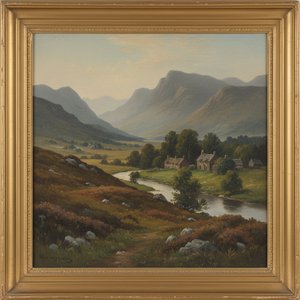
Hamilton's technical prowess is most evident in his masterful use of layered glazing, a technique that allowed him to imbue his landscapes with a luminous, almost ethereal quality. He possessed an extraordinary ability to capture the subtle nuances of light as it filtered through heavy mist or shimmered across the surface of a quiet loch. His palette was often muted and harmonious, relying on tonal depth rather than jarring colors to evoke the damp, cool air of the Scottish coast. This meticulous approach is beautifully realized in his most celebrated works:- Loch Long Hills, where autumnal tones meet mountain grandeur;
- The River Lune Near Orton, a study in serene, 19th-century realism;
- Wharfedale, capturing the earthy essence of the landscape;
- View Of A Harbour, showcasing his Impressionistic touch on coastal scenes.
A Lasting Legacy of Excellence
The significance of Hamilton's contribution to British art is reflected in the numerous accolades he received throughout his distinguished career. His election as a member of the Royal Scottish Academy and the New English Art Club marked him as a leading figure of his generation. A pivotal moment of international recognition arrived in 1897, when he was awarded a gold medal at the Munich International Exhibition, an achievement that brought his talent to the global stage. Through his dedication to the portrayal of the natural world, James Whitelaw Hamilton left behind a body of work that continues to enchant, serving as a timeless testament to the enduring beauty of the Scottish landscape and the delicate interplay of light and shadow.Otázky a odpovědi
Mohu si prohlédnout díla umělce James Whitelaw Hamilton podle barevného spektra?
Stránka Sestavení podle barev umožňuje prohlížet díla umělce James Whitelaw Hamilton rozdělená podle barvy.
Kde najdu díla umělce James Whitelaw Hamilton seskupená podle uměleckých směrů?
Díla umělce James Whitelaw Hamilton si můžete prohlédnout rozdělená podle uměleckých směrů na jeho stránce Všechna umělecká hnutí.
Kde mohu vidět díla umělce James Whitelaw Hamilton v chronologickém pořadí?
Stránka Chronologie děl představuje díla umělce James Whitelaw Hamilton seřazená chronologicky, rok po roce.