A Master of Granada: The Life and Legacy of José Risueño Alconchel
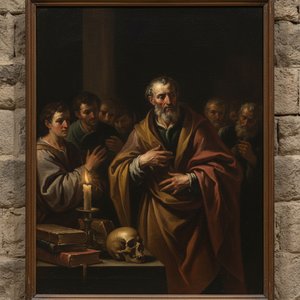
In the heart of Andalusia, amidst the golden light and storied streets of Granada, the artistic soul of José Risueño Alconchel (1665–1732) was forged. Born into a modest family of artisans in the parish of Sagrario, his early years were steeped in the tactile reality of craftsmanship. As the son of Manuel Risueño, a master carpenter, José’s childhood was likely soundtracked by the rhythmic sounds of the workshop—the scraping of planes and the precise strike of the chisel. This foundational intimacy with wood and tool did more than merely provide a livelihood; it instilled in him a profound respect for material and form that would later define his dual mastery as both a painter and a sculptor.
The trajectory of Risueño’s talent was irrevocably shaped by the illustrious lineage of the Granada School. Growing up in a vibrant cultural milieu, he was exposed to the giants of his era, including Alonso Cano, whose influence acted as a guiding star for his development. Through this connection, and through the mentorship of figures like Juan de Sevilla and Diego de Mora, Risueño absorbed the essential tenets of the Baroque: the dramatic interplay of light and shadow, the emotional weight of religious devotion, and a meticulous attention to anatomical accuracy. His training was not merely academic but an immersion into a living tradition that sought to bridge the gap between the earthly and the divine.
The Convergence of Baroque Grandeur and Rococo Grace
As his career matured, Risueño developed a stylistic signature that was uniquely his own—a delicate, almost ethereal Rococo sensibility woven into the robust fabric of the Spanish Baroque. While many of his contemporaries focused solely on the heavy, somber intensity of the Counter-Reformation, Risueño introduced a luminous quality to his work. His paintings often feature a refined color palette and subtle gradations of light that lend a sense of grace and movement to even the most solemn subjects. This transition toward a more delicate aesthetic allowed him to capture the profound tenderness found in scenes of the Virgin or the Christ Child, making the divine feel intimately accessible to the viewer.
In the realm of sculpture, his genius manifested through an extraordinary command over diverse mediums. While he is celebrated for his masterful works in wood, it is perhaps his work in clay that reveals his most intimate artistic impulses. These smaller-scale sculptures possess a breathtaking delicacy, capturing fleeting expressions and soft textures with a precision that borders on the miraculous. His ability to manipulate light across the surfaces of his carvings—whether in the heavy drapery of a saint or the smooth skin of an infant—demonstrates a technical virtuosity that earned him the patronage of the highest echelons of Spanish society, most notably Archbishop Azcalgorta.
A Devotional Legacy in Stone and Canvas
The historical significance of José Risueño Alconchel lies in his ability to serve as a bridge between eras and mediums. His prolific output served the spiritual needs of Granada’s most sacred spaces, leaving an indelible mark on the city's religious landscape. From the altarpieces of the Cathedral of Granada to the quiet corners of the Charterhouse, his hands shaped the visual language of faith for generations.
His repertoire of significant works includes a breathtaking array of devotional subjects that continue to inspire awe:
- The Sculptural Masterpieces: Notable works such as the Inmaculada in the Cathedral of Granada, various depictions of the Child Jesus, and the poignant Penitent Magdalene.
- The Painted Devotions: Evocative canvases including the Virgin of the Rosary, Saint John the Baptist, and the dramatic Ecce Homo.
- Architectural Contributions: His essential role in decorating the cupola of the local Carthusian monastery, blending structural grandeur with artistic intimacy.
Ultimately, Risueño was more than a mere practitioner of his craft; he was a storyteller of the soul. Through the marriage of Baroque intensity and Rococo refinement, he captured the ephemeral beauty of human emotion and the eternal majesty of the divine, ensuring that his name would remain forever etched in the artistic heritage of Spain.
Otázky a odpovědi
Mohu si prohlédnout díla umělce José Risueño Alconchel podle tématu?
Díla umělce José Risueño Alconchel si můžete prohlédnout podle tématu na stránce Atlas témat.
Existuje časová osa děl umělce José Risueño Alconchel?
Prohlédněte si časovou osu děl umělce José Risueño Alconchel: na stránce Chronologie děl jsou díla seřazena podle data jejich vzniku.
Je k dispozici 3D virtuální prohlídka děl umělce José Risueño Alconchel?
Díla umělce José Risueño Alconchel si můžete prohlédnout v 3D galerii na jeho stránce 3D galerie.