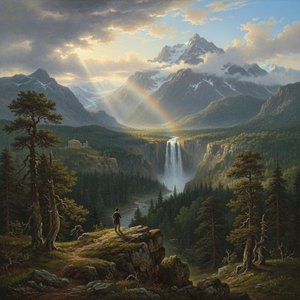
A Visionary of the Devonshire Wilds
Born in the historic town of Crediton, Devon, in 1789, William Traies entered the world at a moment when the artistic soul of Europe was undergoing a profound transformation. As the Romantic movement began to stir, championing the raw power of emotion and the untamed majesty of nature, Traies found his calling within the rugged landscapes of his native county. His life, spanning from the late eighteenth century through the height of the Victorian era until his death in 1872, was a lifelong devotion to the visual poetry of the English countryside. While much of his early biography remains shrouded in the mists of time, it is clear that Traies possessed an innate sensitivity to the light and atmosphere of the West Country, a gift that would eventually establish him as a significant interpreter of the Devonshire landscape.
Traies’s artistic development was characterized by a remarkable degree of self-reliance and observation. Though he lacked the formal academic pedigree common among many of his contemporaries, he possessed a disciplined eye, honing his craft through meticulous study of the natural world and the works of masters such as John Constable and Thomas Gainsbrgh. From these luminaries, he absorbed the essential techniques of atmospheric perspective—the ability to use tonal shifts to create an illusion of vast, receding space—and a certain expressive freedom in brushwork. His style evolved into a beautiful synthesis of technical accuracy and emotional resonance, where the physical reality of a riverbank or a rolling hill was always infused with a deeper, more evocative mood.
The Spirit of Dartmoor and the Romantic Tradition
The heart of Traies’s oeuvre lies in his profound connection to Dartmoor National Park. He did not merely paint the landscape; he sought to capture its very essence—the brooding granite tors, the shifting shadows of misty valleys, and the serene, often melancholic beauty of its watercourses. His work stands as a testament to the Romantic tradition, moving away from the rigid, idealized precision of earlier topographical art toward a more subjective and felt experience of nature. In his hands, a simple river scene becomes a meditation on time and tranquility, while his depictions of wooded landscapes pulse with a quiet, living energy.
His technical mastery is perhaps most evident in his handling of light and texture. Traies had a singular ability to render the subtle interplay of sunlight filtering through dense foliage or the soft, diffused glow of an overcast Devonshire afternoon. His canvases often feature:
- Atmospheric Depth: A masterful use of hazy horizons and layered tones to draw the viewer into the far reaches of the moorland.
- Expressive Brushwork: A loose, confident application of paint that conveys movement in water and the organic irregularity of vegetation.
- Tonal Harmony: A sophisticated palette that captures the earthy, muted greens, browns, and greys characteristic of the regional landscape, punctuated by moments of brilliant light.
Legacy and Historical Significance
Throughout his career, Traies achieved a level of recognition that allowed his works to find their way into significant collections, with his pieces appearing in prestigious venues such as Christie's and Art UK. His ability to capture the "sublime"—that specific Romantic intersection of beauty and awe—ensured that his paintings resonated with the Victorian sensibility, which held a deep reverence for the pastoral and the picturesque. Even today, his works serve as vital historical windows into a nineteenth-century landscape that was beginning to feel the first tremors of industrial change, yet remained, in his eyes, a sanctuary of natural splendor.
The enduring significance of William Traies lies in his role as a regional visionary who elevated the local scenery of Devon to the level of high art. He remains a pivotal figure for those studying the transition from classical landscape traditions to the more emotive, atmospheric styles of the mid-nineteenth century. Through his dedicated gaze, the rugged terrain of Dartmoor and the quiet corners of the Okement and Teign rivers were immortalized, preserving a sense of peace and natural grandeur that continues to captivate art lovers and historians alike.
Otázky a odpovědi
Jak mohu sledovat tvorbu umělce William Traies chronologicky?
Prohlédněte si časovou osu děl umělce William Traies: na stránce Chronologie děl jsou díla seřazena podle data jejich vzniku.
Mohu si prohlédnout díla umělce William Traies podle použité techniky?
Díla umělce William Traies si můžete prohlédnout podle použité techniky na jeho stránce Podle techniky.
Mohu si prohlédnout díla umělce William Traies podle barevné palety?
Chcete-li najít díla umělce William Traies v určité barevné paletě, navštivte jeho stránku Podle palet.