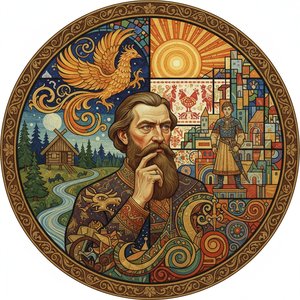
A Life in Brush and Ink
Born in Moscow in 1857, Yakov Prokopievich Turlygin occupied a specific niche in the Russian artistic landscape of the late nineteenth century. His training at the Moscow School of Painting, Sculpture and Architecture provided the technical foundation for a career that moved between the heavy gravity of historical painting and the lighter, more satirical demands of periodical illustration. He was a man of many mediums, finding work as a decorator in the Lentovsky Theater and lending his hand to the illustrations of various short stories. His presence in the Moscow Society of Artists from 1893 marked his integration into the professional circles of his era.
His talent was recognized early through formal accolades. In 1882, he was awarded a large silver medal for his work Without Means to Live, a piece that found its way into the permanent collection of the Tretyakov Gallery. This recognition signaled his ability to handle the social and psychological weight of genre painting, a skill he would refine throughout his life until his death in Moscow in 1909.
The Breadth of His Canvas
Turlygin’s output was characterized by a versatility that allowed him to navigate different social strata and historical epochs. His subjects ranged from the quiet dignity of a peasant's harvest to the intense, often violent, friction of Russian history. His repertoire included:
- Historical Dramas: Works such as Metropolitan Philip and Ivan the Terrible, which explores the tension of the Muscovite era.
- Genre Scenes: Observational studies of daily life, including The Harvest and Without Means to Live.
- Portraiture: Intimate studies of the human face, such as Female Portrait, Head of a Youth, and Head of an Old Man.
- Nature and Seasonality: Atmospheric depictions like The Last Spring.
This variety suggests an artist who was as comfortable with the nuances of a single face as he was with the grand scale of historical confrontation. His work in humorous journals required a different kind of precision, one that relied on wit and clarity rather than the dramatic lighting of his oil paintings.
Historical Presence
The legacy of Turlygin is preserved in several significant regional museums across Russia. His paintings are not merely local curiosities but are held in institutions like the Omsk Regional Museum of Fine Arts and the museum-reserve in Pereslavl-Zalessky. These collections ensure that his contributions to the Russian school of historical and genre painting remain accessible. He left behind a family lineage of intellect, including his son, Sergey Yakovlevich Turlygin, who became a noted Soviet radio engineer.
Otázky a odpovědi
Jaké barvy používal/a Yakov Turlygin nejčastěji?
Použití barev v dílech umělce Yakov Turlygin uvedených na tato webová stránka můžete prozkoumat na stránce Genom palety tohoto umělce.
Kde mohu vidět díla umělce Yakov Turlygin v 3D galerii?
Možná je i virtuální prohlídka: na stránce 3D galerie umělce Yakov Turlygin můžete obdivovat jeho díla v trojrozměrné galerii.
Mohu si prohlédnout díla umělce Yakov Turlygin podle nálady?
Stránka umělce Galerie nálad nabízí díla Yakov Turlygin uspořádaná podle jejich atmosféry.
Existuje časová osa děl umělce Yakov Turlygin?
Prohlédněte si časovou osu děl umělce Yakov Turlygin: na stránce Chronologie děl jsou díla seřazena podle data jejich vzniku.