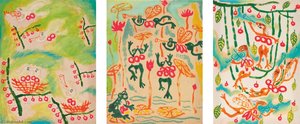
Gu Dexin: A Disruptive Visionary of Chinese Contemporary Art
Gu Dexin’s story is one of profound quiet rebellion, a refusal to conform to the established narratives of Chinese art history. Born in Beijing in 1962, he emerged from the vibrant, yet often chaotic, landscape of the late 1980s and early 1990s – a period of unprecedented artistic experimentation following China’s opening up to the world. Unlike many of his contemporaries who sought validation within formal art institutions or by embracing Western trends, Dexin forged his own path, developing a uniquely unsettling and deeply personal visual language that continues to challenge viewers today.
His early work, beginning in 1986, was characterized by a restless exploration of styles – a seemingly haphazard mix of Western influences like Pop Art, Surrealism, and Abstract Expressionism. He painted apples alongside sides of meat, rendered fantastical humanoid figures with an unsettling abundance of limbs and eyes, and experimented with various media including watercolor, wood panel, and even rudimentary computer animation. This initial period wasn’t about mastering a single style; it was about dismantling the idea of stylistic purity altogether – a foreshadowing of his later radical approach to art-making.
The Shock of the Real: Meat, Plastic, and Performance
A pivotal moment in Dexin's career arrived in 1989 with his participation in “Magiciens de la Terre,” the landmark exhibition at the Centre Pompidou in Paris. This international showcase provided a crucial platform for emerging Chinese artists, yet it also exposed Dexin to the critical gaze of the Western art world. He responded by intensifying his already provocative practice, incorporating increasingly unsettling materials – primarily plastic and animal parts – into his installations. These works, often presented as “performances” rather than static objects, were designed to confront viewers with the uncomfortable realities of decay, consumption, and the grotesque.
The 1990s saw Dexin pushing these themes further, creating elaborate installations featuring swarming masses of plastic figures, meticulously rendered animal carcasses, and even incorporating elements of human flesh. These works were deliberately unsettling, rejecting traditional notions of beauty and inviting a visceral response from the audience. His decision to abandon art entirely in 2009 – returning to his childhood apartment in Beijing’s working-class district of Hepingli – was not a retreat but a radical statement about the relationship between art, society, and personal identity.
A Legacy of Disruption: The Ullens Retrospective
The recent retrospective at the UCCA in Beijing, titled “Gu Dexin: The Important Thing is Not the Meat,” offered a comprehensive overview of his career. Curated by Philip Tinari, the exhibition showcased over 100 works spanning three decades, revealing the evolution of his singular artistic vision. It highlighted recurring motifs – the juxtaposition of opulent materials (red carpets, gilded frames) with decaying organic matter (meat, plastic), and the unsettling presence of the humanoid figure – all rendered with a meticulous attention to detail that amplifies their impact.
The exhibition’s title, borrowed from an article by Qiu Zhijie, underscores Dexin's deliberate rejection of conventional art criticism. It reflects his belief that the true value of his work lies not in its aesthetic qualities or its adherence to established artistic norms, but in its capacity to provoke uncomfortable questions about life, death, and the nature of representation. The works on display are a testament to his refusal to be categorized, a defiant assertion of artistic autonomy in a rapidly changing cultural landscape.
Historical Significance and Continuing Relevance
Gu Dexin’s work occupies a unique position within the history of Chinese contemporary art. He emerged during a period of intense debate about the direction of the nation's artistic future, challenging both the conservative traditions of Socialist Realism and the uncritical embrace of Western trends. His use of unconventional materials – particularly meat and plastic – was profoundly disruptive, forcing viewers to confront their own assumptions about beauty, value, and the role of art in society.
More than three decades after his initial emergence, Dexin’s work remains remarkably relevant. His unsettling imagery continues to resonate with contemporary concerns about environmental degradation, consumerism, and the fragility of human existence. He is a crucial figure in understanding the complexities of Chinese artistic identity – an artist who refused to be defined by any single category or movement, forging his own path through a landscape of shifting ideologies and cultural tensions.