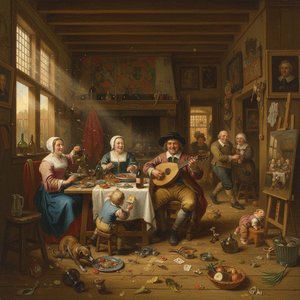
A Glimpse into the Intimate World of Jan Josef Horemans the Younger
Jan Josef Horemans the Younger, a name perhaps less immediately recognizable than some of his Flemish contemporaries, nevertheless occupies a significant and delightful niche in the history of 18th-century painting. Born into an artistic family – his father, Jan Josef Horemans the Elder, was also a painter – he inherited not only a skill for brushwork but also a keen eye for capturing the nuances of everyday life. While biographical details remain somewhat sparse, the body of work attributed to him speaks volumes about his interests and talents. He flourished during a period marked by increasing prosperity among the merchant class in Flanders, and it is this world – comfortable, domestic, and subtly imbued with moralizing undertones – that he so expertly portrayed. Horemans wasn’t interested in grand historical narratives or dramatic religious scenes; instead, he focused on the interiors of homes, the quiet moments of family life, and the gentle pursuits of bourgeois society.
Early Influences and Artistic Development
The artistic lineage of Horemans undoubtedly shaped his early development. His father’s influence is visible in the initial stages of his career, particularly in the meticulous detail and balanced compositions that characterize their paintings. However, Jan Josef the Younger soon began to forge his own path, demonstrating a particular aptitude for rendering light and shadow with remarkable sensitivity. He absorbed influences from Dutch genre painters like Pieter de Hooch and Gabriel Metsu, whose works he likely studied either directly or through engravings. The Italianate landscapes frequently appearing in his compositions suggest an awareness of artists active in Italy, though it’s unclear whether he ever traveled there himself. This blend of Flemish precision with Dutch realism and a touch of Italianate romanticism created a unique style that would become his hallmark. His early works often feature smaller scale paintings, intimate scenes designed for private enjoyment rather than public display.
Themes and Techniques: A Window into 18th-Century Life
Horemans’s oeuvre is dominated by genre scenes – depictions of everyday life. These are not merely snapshots of domesticity, however; they are carefully constructed narratives that often convey subtle moral lessons or celebrate the virtues of family life. Interiors are richly furnished, showcasing the material comforts enjoyed by the burgeoning middle class. He excelled at portraying women engaged in various activities: reading letters, sewing, playing musical instruments, or tending to children. Men are typically shown in more contemplative roles, perhaps studying, writing, or engaging in polite conversation.
The artist’s mastery of light is particularly noteworthy. He used it not only to create a sense of realism but also to draw attention to specific details and emphasize the emotional atmosphere of each scene. His brushwork is delicate and precise, allowing him to render textures with remarkable accuracy – from the sheen of silk fabrics to the polished surfaces of furniture.
He often incorporated architectural elements into his compositions, creating a sense of depth and perspective that further enhances their realism.
Major Achievements and Historical Significance
While Horemans did not achieve the widespread fame of some of his contemporaries, his work is highly regarded by collectors and art historians for its charm, technical skill, and insightful portrayal of 18th-century life. His paintings provide a valuable glimpse into the values and aspirations of the Flemish bourgeoisie during a period of significant social and economic change. He was particularly adept at capturing the atmosphere of domestic tranquility and the importance of family relationships.
- His ability to imbue everyday scenes with subtle moralizing undertones sets his work apart.
- The meticulous detail and balanced compositions demonstrate a high level of artistic skill.
- Horemans’s paintings offer a unique window into the material culture of 18th-century Flanders.
His legacy lies in his ability to elevate the ordinary to the realm of art, transforming commonplace scenes into captivating narratives that continue to resonate with viewers today. He stands as a testament to the power of observation and the enduring appeal of intimate portrayals of human life. Although documentation about his life remains limited, Jan Josef Horemans the Younger’s paintings speak for themselves – offering a charming and insightful glimpse into a bygone era.